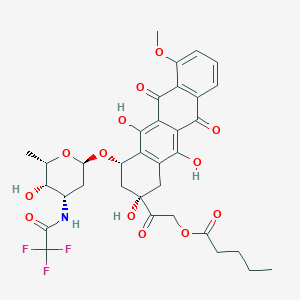
General Information of Drug Combination (ID: DC1LPRA)

Drug Combination Name
Valrubicin Plicamycin
Indication
Disease Entry Status REF
Invasive ductal carcinoma Investigative [1]
Component Drugs Valrubicin   DMOYJFK Plicamycin   DM7C8YV
Small molecular drug Small molecular drug
2D MOL 2D MOL
3D MOL is unavailable 3D MOL is unavailable
High-throughput Screening Result Testing Cell Line: BT-549
Zero Interaction Potency (ZIP) Score: 5.55
Bliss Independence Score: 1.61
Loewe Additivity Score: 0.6
LHighest Single Agent (HSA) Score: 0.04

Molecular Interaction Atlas of This Drug Combination

Molecular Interaction Atlas (MIA)
Indication(s) of Valrubicin
Disease Entry ICD 11 Status REF
Bladder cancer 2C94 Approved [2]
In situ carcinoma N.A. Approved [3]
Urinary bladder cancer N.A. Approved [3]
Psoriasis vulgaris EA90 Phase 2 [4]
Valrubicin Interacts with 1 DTT Molecule(s)
DTT Name DTT ID UniProt ID Mode of Action REF
DNA topoisomerase II (TOP2) TT0IHXV TOP2A_HUMAN; TOP2B_HUMAN Inhibitor [7]
------------------------------------------------------------------------------------
Valrubicin Interacts with 1 DOT Molecule(s)
DOT Name DOT ID UniProt ID Mode of Action REF
Bile salt export pump (ABCB11) OTRU7THO ABCBB_HUMAN Decreases Activity [8]
------------------------------------------------------------------------------------
Indication(s) of Plicamycin
Disease Entry ICD 11 Status REF
Hypercalcaemia 5B91.0 Approved [4]
Testicular cancer 2C80 Approved [4]
Solid tumour/cancer 2A00-2F9Z Withdrawn from market [5]
Lung cancer 2C25.0 Investigative [6]
Ovarian cancer 2C73 Investigative [6]
Plicamycin Interacts with 1 DTT Molecule(s)
DTT Name DTT ID UniProt ID Mode of Action REF
RNA synthesis (hRNA synth) TTX2AYW NOUNIPROTAC Modulator [10]
------------------------------------------------------------------------------------
Plicamycin Interacts with 8 DOT Molecule(s)
DOT Name DOT ID UniProt ID Mode of Action REF
17-beta-hydroxysteroid dehydrogenase type 2 (HSD17B2) OT3K7HY5 DHB2_HUMAN Decreases Expression [11]
Baculoviral IAP repeat-containing protein 5 (BIRC5) OTILXZYL BIRC5_HUMAN Decreases Expression [12]
Proto-oncogene tyrosine-protein kinase Src (SRC) OTETYX40 SRC_HUMAN Decreases Expression [13]
Tyrosine-protein kinase receptor UFO (AXL) OTKA2SUX UFO_HUMAN Decreases Expression [14]
Transcription factor Sp3 (SP3) OTYDQZ1T SP3_HUMAN Decreases Expression [9]
Epidermal growth factor receptor kinase substrate 8 (EPS8) OTZ6ES6V EPS8_HUMAN Decreases Expression [13]
TNFAIP3-interacting protein 1 (TNIP1) OTRAOTEW TNIP1_HUMAN Decreases Expression [15]
Sphingomyelin phosphodiesterase 3 (SMPD3) OTHQBETH NSMA2_HUMAN Decreases Expression [16]
------------------------------------------------------------------------------------
⏷ Show the Full List of 8 DOT(s)

Test Results of This Drug Combination in Other Disease Systems

Indication DrugCom ID Cell Line Status REF
Astrocytoma DCPB8OE U251 Investigative [17]
Chronic myelogenous leukemia DCSMY4W K-562 Investigative [17]
Clear cell renal cell carcinoma DCW1ARM A498 Investigative [17]
Glioma DCY1GF4 SF-295 Investigative [17]
Renal cell carcinoma DCS7F2R UO-31 Investigative [17]
Colon adenocarcinoma DCCDS9D COLO 205 Investigative [1]
Adenocarcinoma DCSTK81 A549 Investigative [18]
Adenocarcinoma DCGQPVA HCT116 Investigative [18]
Amelanotic melanoma DCNDQIQ MDA-MB-435 Investigative [18]
Cutaneous melanoma DC4I2CK SK-MEL-28 Investigative [18]
High grade ovarian serous adenocarcinoma DCN27KX OVCAR-5 Investigative [18]
Lung adenocarcinoma DC6OBD5 HOP-62 Investigative [18]
Lung adenocarcinoma DCXPKWA MDA-MB-231 Investigative [18]
Lung adenocarcinoma DCQKAVO NCI-H522 Investigative [18]
Malignant melanoma DCQWWIG UACC62 Investigative [18]
Melanoma DCR54V6 MALME-3M Investigative [18]
Melanoma DCPRQX4 UACC-257 Investigative [18]
Melanoma DCQQIZB SK-MEL-2 Investigative [18]
Mixed endometrioid and clear cell carcinoma DCW04JH IGROV1 Investigative [18]
------------------------------------------------------------------------------------
⏷ Show the Full List of 19 DrugCom(s)

References

1 CheMBL Affinity Phenotypic Cellular Interaction Assay ID: CHEMBL1126165
2 Natural products as sources of new drugs over the last 25 years. J Nat Prod. 2007 Mar;70(3):461-77.
3 Valrubicin FDA Label
4 Drugs@FDA. U.S. Food and Drug Administration. U.S. Department of Health & Human Services. 2015
5 URL: http://www.guidetopharmacology.org Nucleic Acids Res. 2015 Oct 12. pii: gkv1037. The IUPHAR/BPS Guide to PHARMACOLOGY in 2016: towards curated quantitative interactions between 1300 protein targets and 6000 ligands. (Ligand id: 8394).
6 The Pluripotency Factor Musashi-2 Is a Novel Target for Lung Cancer Therapy.Ann Am Thorac Soc. 2018 Apr;15(Supplement_2):S124.
7 Metabolic activation of N-acylanthracyclines precedes their interaction with DNA topoisomerase II. NCI Monogr. 1987;(4):111-5.
8 A multifactorial approach to hepatobiliary transporter assessment enables improved therapeutic compound development. Toxicol Sci. 2013 Nov;136(1):216-41.
9 The activity of a novel mithramycin analog is related to its binding to DNA, cellular accumulation, and inhibition of Sp1-driven gene transcription. Chem Biol Interact. 2014 Aug 5;219:123-32. doi: 10.1016/j.cbi.2014.05.019. Epub 2014 Jun 4.
10 Role of magnesium ion in mithramycin-DNA interaction: binding of mithramycin-Mg2+ complexes with DNA. Biochemistry. 1995 Jan 31;34(4):1376-85.
11 SP1 and SP3 mediate progesterone-dependent induction of the 17beta hydroxysteroid dehydrogenase type 2 gene in human endometrium. Biol Reprod. 2006 Oct;75(4):605-14.
12 Molecular mechanisms of transactivation and doxorubicin-mediated repression of survivin gene in cancer cells. J Biol Chem. 2007 Jan 26;282(4):2615-25. doi: 10.1074/jbc.M606203200. Epub 2006 Nov 22.
13 Mithramycin inhibits human epithelial carcinoma cell proliferation and migration involving downregulation of Eps8 expression. Chem Biol Interact. 2010 Jan 5;183(1):181-6. doi: 10.1016/j.cbi.2009.09.018.
14 The human receptor tyrosine kinase Axl gene--promoter characterization and regulation of constitutive expression by Sp1, Sp3 and CpG methylation. Biosci Rep. 2008 Jun;28(3):161-76. doi: 10.1042/BSR20080046.
15 Sp sites contribute to basal and inducible expression of the human TNIP1 (TNF-inducible protein 3-interacting protein 1) promoter. Biochem J. 2013 Jun 15;452(3):519-29. doi: 10.1042/BJ20121666.
16 Transcriptional regulation of neutral sphingomyelinase 2 gene expression of a human breast cancer cell line, MCF-7, induced by the anti-cancer drug, daunorubicin. Biochim Biophys Acta. 2009 Nov-Dec;1789(11-12):681-90. doi: 10.1016/j.bbagrm.2009.08.006. Epub 2009 Aug 19.
17 CheMBL Affinity Phenotypic Cellular Interaction Assay ID: CHEMBL1125966
18 CheMBL Affinity Phenotypic Cellular Interaction Assay ID: CHEMBL1125976