General Information of Drug Combination (ID: DC20B88)

Drug Combination Name
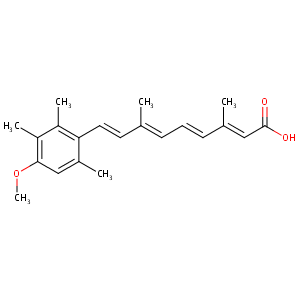
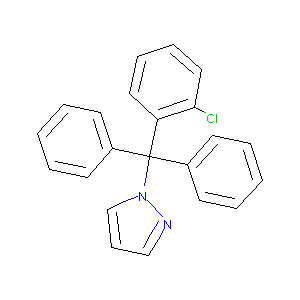
Acitretin 1-((2-chlorophenyl)diphenylmethyl)-1H-pyrazole
Indication
Disease Entry Status REF
Chronic myelogenous leukemia Investigative [1]
Component Drugs Acitretin   DM8BKU9 1-((2-chlorophenyl)diphenylmethyl)-1H-pyrazole   DMQEJVU
Small molecular drug Small molecular drug
2D MOL 2D MOL
3D MOL 3D MOL
High-throughput Screening Result Testing Cell Line: KBM-7
Zero Interaction Potency (ZIP) Score: 12.91
Bliss Independence Score: 12.91
Loewe Additivity Score: 21.64
LHighest Single Agent (HSA) Score: 21.65

Molecular Interaction Atlas of This Drug Combination

Molecular Interaction Atlas (MIA)
Indication(s) of Acitretin
Disease Entry ICD 11 Status REF
Psoriasis vulgaris EA90 Approved [2]
Acitretin Interacts with 1 DTT Molecule(s)
DTT Name DTT ID UniProt ID Mode of Action REF
Signal transducer and activator of transcription 3 (STAT3) TTH8FZW STAT3_HUMAN Inhibitor [4]
------------------------------------------------------------------------------------
Acitretin Interacts with 6 DOT Molecule(s)
DOT Name DOT ID UniProt ID Mode of Action REF
Poly polymerase 1 (PARP1) OT310QSG PARP1_HUMAN Increases Activity [5]
Tumor necrosis factor receptor superfamily member 6 (FAS) OTP9XG86 TNR6_HUMAN Increases Expression [5]
Mitogen-activated protein kinase 3 (MAPK3) OTCYKGKO MK03_HUMAN Decreases Expression [6]
Mitogen-activated protein kinase 1 (MAPK1) OTH85PI5 MK01_HUMAN Decreases Expression [6]
Tumor necrosis factor ligand superfamily member 6 (FASLG) OTZARCHH TNFL6_HUMAN Increases Expression [5]
FAS-associated death domain protein (FADD) OTV7GFHH FADD_HUMAN Increases Expression [5]
------------------------------------------------------------------------------------
⏷ Show the Full List of 6 DOT(s)
Indication(s) of 1-((2-chlorophenyl)diphenylmethyl)-1H-pyrazole
Disease Entry ICD 11 Status REF
Conjunctival fibrosis 9A61.3 Investigative [3]
1-((2-chlorophenyl)diphenylmethyl)-1H-pyrazole Interacts with 2 DTT Molecule(s)
DTT Name DTT ID UniProt ID Mode of Action REF
Calcium-activated potassium channel (KCN) TTMNI76 NOUNIPROTAC Inhibitor [7]
Calcium-activated potassium channel KCa3.1 (KCNN4) TT7M9I6 KCNN4_HUMAN Blocker (channel blocker) [8]
------------------------------------------------------------------------------------

References

1 CheMBL Affinity Phenotypic Cellular Interaction Assay ID: CHEMBL1125966
2 URL: http://www.guidetopharmacology.org Nucleic Acids Res. 2015 Oct 12. pii: gkv1037. The IUPHAR/BPS Guide to PHARMACOLOGY in 2016: towards curated quantitative interactions between 1300 protein targets and 6000 ligands. (Ligand id: 7598).
3 Blockade of KCa3.1: A novel target to treat TGF-1 induced conjunctival fibrosis.Exp Eye Res. 2018 Feb;167:140-144.
4 Effects of acitretin on the expression of signaling pathway-related genes in epidermal squamous-cell carcinoma cells. Zhonghua Zhong Liu Za Zhi. 2006 Jan;28(1):21-4.
5 Acitretin induces apoptosis through CD95 signalling pathway in human cutaneous squamous cell carcinoma cell line SCL-1. J Cell Mol Med. 2009 Sep;13(9A):2888-98. doi: 10.1111/j.1582-4934.2008.00397.x. Epub 2009 Jun 20.
6 [Acitretin induces apoptosis and changes of relative signaling pathway in epidermoid carcinoma cell line A431]. Zhejiang Da Xue Xue Bao Yi Xue Ban. 2006 Mar;35(2):182-8. doi: 10.3785/j.issn.1008-9292.2006.02.013.
7 Inhibitors of potassium channels KV1.3 and IK-1 as immunosuppressants. Bioorg Med Chem Lett. 2009 Apr 15;19(8):2299-304.
8 Blockade of the intermediate-conductance calcium-activated potassium channel as a new therapeutic strategy for restenosis. Circulation. 2003 Sep 2;108(9):1119-25.