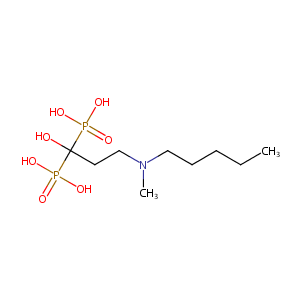
General Information of Drug Combination (ID: DC2KOB2)

Drug Combination Name
Ibandronate Alendronate
Indication
Disease Entry Status REF
Postmenopausal Osteoporosis Phase 4 [1]
Component Drugs Ibandronate   DM0QZBN Alendronate   DMY2KX9
Small molecular drug Small molecular drug
2D MOL 2D MOL
3D MOL 3D MOL

Molecular Interaction Atlas of This Drug Combination

Molecular Interaction Atlas (MIA)
Indication(s) of Ibandronate
Disease Entry ICD 11 Status REF
Hypercalcaemia 5B91.0 Approved [2]
Osteoporosis FB83.0 Approved [3]
Ibandronate Interacts with 1 DTT Molecule(s)
DTT Name DTT ID UniProt ID Mode of Action REF
Geranyltranstransferase (FDPS) TTIKWV4 FPPS_HUMAN Modulator [6]
------------------------------------------------------------------------------------
Ibandronate Interacts with 1 DOT Molecule(s)
DOT Name DOT ID UniProt ID Mode of Action REF
Ras-related protein Rap-1A (RAP1A) OT5RH6TI RAP1A_HUMAN Decreases Prenylation [7]
------------------------------------------------------------------------------------
Indication(s) of Alendronate
Disease Entry ICD 11 Status REF
Bone Paget disease N.A. Approved [4]
Exostosis N.A. Approved [4]
Osteoporosis FB83.0 Approved [5]
Paget's disease FB85 Approved [5]
Prostate adenocarcinoma N.A. Approved [4]
Alendronate Interacts with 1 DTT Molecule(s)
DTT Name DTT ID UniProt ID Mode of Action REF
Geranyltranstransferase (FDPS) TTIKWV4 FPPS_HUMAN Modulator [6]
------------------------------------------------------------------------------------
Alendronate Interacts with 5 DOT Molecule(s)
DOT Name DOT ID UniProt ID Mode of Action REF
Collagen alpha-1(II) chain (COL2A1) OT5E59C8 CO2A1_HUMAN Decreases Expression [9]
Collagen alpha-1(III) chain (COL3A1) OTT1EMLM CO3A1_HUMAN Decreases Expression [9]
Osteocalcin (BGLAP) OTK1YLWQ OSTCN_HUMAN Decreases Expression [9]
Collagen alpha-3(V) chain (COL5A3) OTCGC4DM CO5A3_HUMAN Decreases Expression [9]
Ras-related protein Rap-1A (RAP1A) OT5RH6TI RAP1A_HUMAN Decreases Prenylation [10]
------------------------------------------------------------------------------------

References

1 ClinicalTrials.gov (NCT02598440) A Study of Ibandronate (Bonviva) in Patients With Post-Menopausal Osteoporosis
2 Ibandronate FDA Label
3 URL: http://www.guidetopharmacology.org Nucleic Acids Res. 2015 Oct 12. pii: gkv1037. The IUPHAR/BPS Guide to PHARMACOLOGY in 2016: towards curated quantitative interactions between 1300 protein targets and 6000 ligands. (Ligand id: 3059).
4 Alendronate FDA Label
5 URL: http://www.guidetopharmacology.org Nucleic Acids Res. 2015 Oct 12. pii: gkv1037. The IUPHAR/BPS Guide to PHARMACOLOGY in 2016: towards curated quantitative interactions between 1300 protein targets and 6000 ligands. (Ligand id: 3141).
6 Drugs@FDA. U.S. Food and Drug Administration. U.S. Department of Health & Human Services.
7 Extracellular calcium increases bisphosphonate-induced growth inhibition of breast cancer cells. Breast Cancer Res. 2008;10(1):R4. doi: 10.1186/bcr1845. Epub 2008 Jan 11.
8 Effectiveness of alendronate treatment in postmenopausal women with osteoporosis: relationship with BsmI vitamin D receptor genotypes. Clin Endocrinol (Oxf). 2003 Mar;58(3):365-71. doi: 10.1046/j.1365-2265.2003.01724.x.
9 Expression profile and synthesis of different collagen types I, II, III, and V of human gingival fibroblasts, osteoblasts, and SaOS-2 cells after bisphosphonate treatment. Clin Oral Investig. 2010 Feb;14(1):51-8. doi: 10.1007/s00784-009-0312-2. Epub 2009 Jul 14.
10 Nitrogen-containing bisphosphonates induce apoptosis of Caco-2 cells in vitro by inhibiting the mevalonate pathway: a model of bisphosphonate-induced gastrointestinal toxicity. Bone. 2001 Oct;29(4):336-43. doi: 10.1016/s8756-3282(01)00589-0.