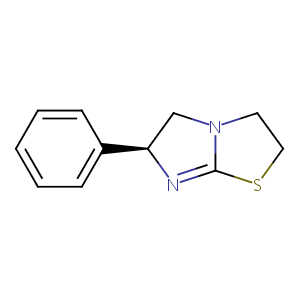
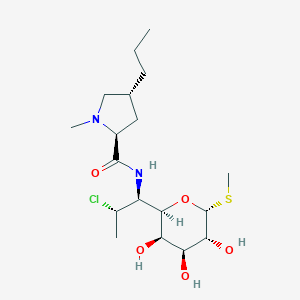
General Information of Drug Combination (ID: DC2WGX7)

Drug Combination Name
Levamisole Clindamycin
Indication
Disease Entry Status REF
Chronic myelogenous leukemia Investigative [1]
Component Drugs Levamisole   DM5EN79 Clindamycin   DM15HL8
Small molecular drug Small molecular drug
2D MOL 2D MOL
3D MOL 3D MOL
High-throughput Screening Result Testing Cell Line: KBM-7
Zero Interaction Potency (ZIP) Score: 65.63
Bliss Independence Score: 65.63
Loewe Additivity Score: 79.34
LHighest Single Agent (HSA) Score: 79.34

Molecular Interaction Atlas of This Drug Combination

Molecular Interaction Atlas (MIA)
Indication(s) of Levamisole
Disease Entry ICD 11 Status REF
Parasitic infection 1D0Y-1G2Z Approved [2]
Colon cancer 2B90.Z Withdrawn from market [3]
Levamisole Interacts with 1 DTT Molecule(s)
DTT Name DTT ID UniProt ID Mode of Action REF
Alkaline phosphatase tissue-nonspecific (ALPL) TTMR5UV PPBT_HUMAN Inhibitor [5]
------------------------------------------------------------------------------------
Levamisole Interacts with 2 DOT Molecule(s)
DOT Name DOT ID UniProt ID Mode of Action REF
Retinoblastoma-associated protein (RB1) OTQJUJMZ RB_HUMAN Decreases Expression [6]
Bcl-2 homologous antagonist/killer (BAK1) OTDP6ILW BAK_HUMAN Increases Expression [6]
------------------------------------------------------------------------------------
Indication(s) of Clindamycin
Disease Entry ICD 11 Status REF
Acne vulgaris ED80 Approved [2]
Aspiration pneumonia N.A. Approved [4]
Bacteremia 1A73 Approved [4]
Bacterial vaginosis MF3A Approved [4]
Pleural empyema N.A. Approved [4]
Staphylococcal pneumonia N.A. Approved [4]
Staphylococcus aureus infection N.A. Approved [4]
Streptococcal pneumonia N.A. Approved [4]
Pelvic inflammatory disease GA05 Investigative [4]
Clindamycin Interacts with 1 DTT Molecule(s)
DTT Name DTT ID UniProt ID Mode of Action REF
Bacterial 50S ribosomal RNA (Bact 50S rRNA) TTUWYEA NOUNIPROTAC Binder [7]
------------------------------------------------------------------------------------
Clindamycin Interacts with 2 DME Molecule(s)
DME Name DME ID UniProt ID Mode of Action REF
Cytochrome P450 3A4 (CYP3A4) DE4LYSA CP3A4_HUMAN Metabolism [8]
Beta-lactamase (blaB) DEMSNER A4LA84_EDWTA Metabolism [9]
------------------------------------------------------------------------------------
Clindamycin Interacts with 2 DOT Molecule(s)
DOT Name DOT ID UniProt ID Mode of Action REF
HLA class I histocompatibility antigen, alpha chain E (HLA-E) OTX1CTFB HLAE_HUMAN Affects Expression [10]
Collagenase 3 (MMP13) OTY8BZIE MMP13_HUMAN Increases Expression [11]
------------------------------------------------------------------------------------

References

1 CheMBL Affinity Phenotypic Cellular Interaction Assay ID: CHEMBL1125966
2 Drugs@FDA. U.S. Food and Drug Administration. U.S. Department of Health & Human Services. 2015
3 URL: http://www.guidetopharmacology.org Nucleic Acids Res. 2015 Oct 12. pii: gkv1037. The IUPHAR/BPS Guide to PHARMACOLOGY in 2016: towards curated quantitative interactions between 1300 protein targets and 6000 ligands. (Ligand id: 7210).
4 Clindamycin FDA Label
5 Characterization of rat heart alkaline phosphatase isoenzymes and modulation of activity. Braz J Med Biol Res. 2008 Jul;41(7):600-9.
6 Levamisole induced apoptosis in cultured vascular endothelial cells. Br J Pharmacol. 2000 Dec;131(8):1577-83.
7 Structural basis for the interaction of antibiotics with the peptidyl transferase centre in eubacteria. Nature. 2001 Oct 25;413(6858):814-21.
8 In vitro metabolism of clindamycin in human liver and intestinal microsomes. Drug Metab Dispos. 2003 Jul;31(7):878-87.
9 Comparison of antimicrobial susceptibility, beta-lactamase production, plasmid analysis and serum bactericidal activity in Edwardsiella tarda, E. ictaluri and E. hoshinae. J Med Microbiol. 1993 Oct;39(4):273-81.
10 Systems pharmacological analysis of drugs inducing stevens-johnson syndrome and toxic epidermal necrolysis. Chem Res Toxicol. 2015 May 18;28(5):927-34. doi: 10.1021/tx5005248. Epub 2015 Apr 3.
11 Chloramphenicol causes mitochondrial stress, decreases ATP biosynthesis, induces matrix metalloproteinase-13 expression, and solid-tumor cell invasion. Toxicol Sci. 2010 Jul;116(1):140-50. doi: 10.1093/toxsci/kfq085. Epub 2010 Mar 25.