General Information of Drug Combination (ID: DC4TWTR)

Drug Combination Name
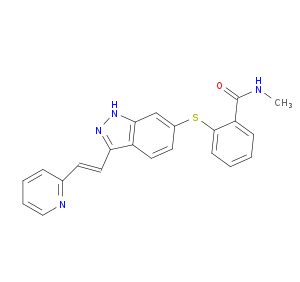
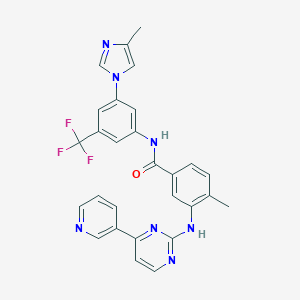
Indazole derivative 5 Nilotinib
Indication
Disease Entry Status REF
Chronic myelogenous leukemia Investigative [1]
Component Drugs Indazole derivative 5   DMM1I8R Nilotinib   DM7HXWT
Small molecular drug Small molecular drug
2D MOL 2D MOL
3D MOL 3D MOL
High-throughput Screening Result Testing Cell Line: K-562
Zero Interaction Potency (ZIP) Score: 11.88
Bliss Independence Score: 10.98
Loewe Additivity Score: 10.95
LHighest Single Agent (HSA) Score: 13.98

Molecular Interaction Atlas of This Drug Combination

Molecular Interaction Atlas (MIA)
Indazole derivative 5 Interacts with 2 DTT Molecule(s)
DTT Name DTT ID UniProt ID Mode of Action REF
ABL T315I mutant (ABL T315I) TTZJTWA ABL1_HUMAN Inhibitor [3]
Fusion protein Bcr-Abl T315I mutant (Bcr-Abl T315I) TTIV39N BCR_HUMAN-ABL1_HUMAN Inhibitor [3]
------------------------------------------------------------------------------------
Indication(s) of Nilotinib
Disease Entry ICD 11 Status REF
Chronic myelogenous leukaemia 2A20.0 Approved [2]
Nilotinib Interacts with 1 DTT Molecule(s)
DTT Name DTT ID UniProt ID Mode of Action REF
Fusion protein Bcr-Abl (Bcr-Abl) TTS7G69 BCR_HUMAN-ABL1_HUMAN Modulator [7]
------------------------------------------------------------------------------------
Nilotinib Interacts with 5 DTP Molecule(s)
DTP Name DTP ID UniProt ID Mode of Action REF
Multidrug resistance-associated protein 2 (ABCC2) DTFI42L MRP2_HUMAN Substrate [8]
P-glycoprotein 1 (ABCB1) DTUGYRD MDR1_HUMAN Substrate [9]
Breast cancer resistance protein (ABCG2) DTI7UX6 ABCG2_HUMAN Substrate [8]
Organic anion transporting polypeptide 1B1 (SLCO1B1) DT3D8F0 SO1B1_HUMAN Substrate [10]
Organic anion transporting polypeptide 1B3 (SLCO1B3) DT9C1TS SO1B3_HUMAN Substrate [10]
------------------------------------------------------------------------------------
Nilotinib Interacts with 2 DME Molecule(s)
DME Name DME ID UniProt ID Mode of Action REF
Cytochrome P450 3A4 (CYP3A4) DE4LYSA CP3A4_HUMAN Metabolism [11]
Cytochrome P450 2C8 (CYP2C8) DES5XRU CP2C8_HUMAN Metabolism [12]
------------------------------------------------------------------------------------
Nilotinib Interacts with 21 DOT Molecule(s)
DOT Name DOT ID UniProt ID Mode of Action REF
Broad substrate specificity ATP-binding cassette transporter ABCG2 (ABCG2) OTW8V2V1 ABCG2_HUMAN Affects Response To Substance [13]
ATP-dependent translocase ABCB1 (ABCB1) OTEJROBO MDR1_HUMAN Affects Response To Substance [14]
Acetyl-CoA carboxylase 1 (ACACA) OT5CQPZY ACACA_HUMAN Increases Phosphorylation [15]
Protein c-Fos (FOS) OTJBUVWS FOS_HUMAN Increases Expression [6]
Transcription factor Jun (JUN) OTCYBO6X JUN_HUMAN Increases Expression [6]
Homeobox protein Hox-B7 (HOXB7) OTC7WYU8 HXB7_HUMAN Increases Expression [5]
Poly polymerase 1 (PARP1) OT310QSG PARP1_HUMAN Increases Cleavage [16]
Transcription factor JunB (JUNB) OTG2JXV5 JUNB_HUMAN Increases Expression [6]
Homeobox protein Hox-B9 (HOXB9) OTMVHQOU HXB9_HUMAN Increases Expression [5]
Cyclic AMP-dependent transcription factor ATF-6 alpha (ATF6) OTAFHAVI ATF6A_HUMAN Decreases Expression [6]
Paired box protein Pax-3 (PAX3) OTN5PJZV PAX3_HUMAN Decreases Expression [5]
Paired box protein Pax-6 (PAX6) OTOC9876 PAX6_HUMAN Increases Expression [5]
DNA damage-inducible transcript 3 protein (DDIT3) OTI8YKKE DDIT3_HUMAN Increases Expression [6]
Crk-like protein (CRKL) OTOYSD1R CRKL_HUMAN Decreases Phosphorylation [6]
Homeobox protein MOX-1 (MEOX1) OTJEMT2D MEOX1_HUMAN Decreases Expression [5]
Mesoderm posterior protein 2 (MESP2) OT7H4LYA MESP2_HUMAN Decreases Expression [5]
Transcription factor 15 (TCF15) OTA6UCWC TCF15_HUMAN Decreases Expression [5]
Oligodendrocyte transcription factor 3 (OLIG3) OTU8XLAF OLIG3_HUMAN Increases Expression [5]
ER degradation-enhancing alpha-mannosidase-like protein 1 (EDEM1) OTWHN69S EDEM1_HUMAN Increases Expression [6]
Eyes absent homolog 1 (EYA1) OTHU807A EYA1_HUMAN Decreases Expression [5]
Neurogenin-2 (NEUROG2) OTAEMIGT NGN2_HUMAN Increases Expression [5]
------------------------------------------------------------------------------------
⏷ Show the Full List of 21 DOT(s)

Test Results of This Drug Combination in Other Disease Systems

Indication DrugCom ID Cell Line Status REF
Clear cell renal cell carcinoma DCB5KEM 786-0 Investigative [1]
Plasma cell myeloma DC81TEI RPMI-8226 Investigative [1]
Renal cell carcinoma DCD5RTQ SN12C Investigative [1]
Invasive ductal carcinoma DC49RWB T-47D Investigative [17]
Cutaneous melanoma DCT2SDA SK-MEL-28 Investigative [18]
High grade ovarian serous adenocarcinoma DCLADWD OVCAR-8 Investigative [18]
Large cell lung carcinoma DCNWOFG NCI-H460 Investigative [18]
Lung adenocarcinoma DCU11K4 HOP-62 Investigative [18]
Pleural epithelioid mesothelioma DC9GOG9 NCI-H226 Investigative [18]
Prostate carcinoma DCL9UK6 PC-3 Investigative [18]
------------------------------------------------------------------------------------
⏷ Show the Full List of 10 DrugCom(s)

References

1 CheMBL Affinity Phenotypic Cellular Interaction Assay ID: CHEMBL1125966
2 URL: http://www.guidetopharmacology.org Nucleic Acids Res. 2015 Oct 12. pii: gkv1037. The IUPHAR/BPS Guide to PHARMACOLOGY in 2016: towards curated quantitative interactions between 1300 protein targets and 6000 ligands. (Ligand id: 5697).
3 Bcr-Abl tyrosine kinase inhibitors: a patent review.Expert Opin Ther Pat. 2015 Apr;25(4):397-412.
4 Assessment of the inhibition potential of Licochalcone A against human UDP-glucuronosyltransferases. Food Chem Toxicol. 2016 Apr;90:112-22.
5 Exposure-based assessment of chemical teratogenicity using morphogenetic aggregates of human embryonic stem cells. Reprod Toxicol. 2020 Jan;91:74-91. doi: 10.1016/j.reprotox.2019.10.004. Epub 2019 Nov 8.
6 Endoplasmic reticulum stress-mediated apoptosis in imatinib-resistant leukemic K562-r cells triggered by AMN107 combined with arsenic trioxide. Exp Biol Med (Maywood). 2013 Aug 1;238(8):932-42. doi: 10.1177/1535370213492689. Epub 2013 Jul 24.
7 2007 FDA drug approvals: a year of flux. Nat Rev Drug Discov. 2008 Feb;7(2):107-9.
8 Interaction of nilotinib, dasatinib and bosutinib with ABCB1 and ABCG2: implications for altered anti-cancer effects and pharmacological properties. Br J Pharmacol. 2009 Oct;158(4):1153-64.
9 KEGG: new perspectives on genomes, pathways, diseases and drugs. Nucleic Acids Res. 2017 Jan 4;45(D1):D353-D361. (dg:DG01665)
10 Contribution of OATP1B1 and OATP1B3 to the disposition of sorafenib and sorafenib-glucuronide. Clin Cancer Res. 2013 Mar 15;19(6):1458-66.
11 Drug interactions with the tyrosine kinase inhibitors imatinib, dasatinib, and nilotinib. Blood. 2011 Feb 24;117(8):e75-87.
12 Role of cytochrome P450 2C8 in drug metabolism and interactions. Pharmacol Rev. 2016 Jan;68(1):168-241.
13 Resistance to daunorubicin, imatinib, or nilotinib depends on expression levels of ABCB1 and ABCG2 in human leukemia cells. Chem Biol Interact. 2014 Aug 5;219:203-10. doi: 10.1016/j.cbi.2014.06.009. Epub 2014 Jun 19.
14 Reversal of ABCB1 mediated efflux by imatinib and nilotinib in cells expressing various transporter levels. Chem Biol Interact. 2017 Aug 1;273:171-179. doi: 10.1016/j.cbi.2017.06.012. Epub 2017 Jun 13.
15 Multi-parameter in vitro toxicity testing of crizotinib, sunitinib, erlotinib, and nilotinib in human cardiomyocytes. Toxicol Appl Pharmacol. 2013 Oct 1;272(1):245-55.
16 Nilotinib reduced the viability of human ovarian cancer cells via mitochondria-dependent apoptosis, independent of JNK activation. Toxicol In Vitro. 2016 Mar;31:1-11. doi: 10.1016/j.tiv.2015.11.002. Epub 2015 Nov 6.
17 CheMBL Affinity Phenotypic Cellular Interaction Assay ID: CHEMBL1126165
18 CheMBL Affinity Phenotypic Cellular Interaction Assay ID: CHEMBL1125976