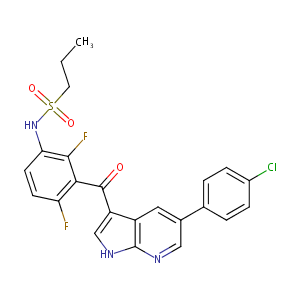
General Information of Drug Combination (ID: DC75NC1)

Drug Combination Name
Vemurafenib Plicamycin
Indication
Disease Entry Status REF
Adenocarcinoma Investigative [1]
Component Drugs Vemurafenib   DM62UG5 Plicamycin   DM7C8YV
Small molecular drug Small molecular drug
2D MOL 2D MOL
3D MOL 3D MOL is unavailable
High-throughput Screening Result Testing Cell Line: SW-620
Zero Interaction Potency (ZIP) Score: 29.38
Bliss Independence Score: 23.55
Loewe Additivity Score: 4.71
LHighest Single Agent (HSA) Score: 4.71

Molecular Interaction Atlas of This Drug Combination

Molecular Interaction Atlas (MIA)
Indication(s) of Vemurafenib
Disease Entry ICD 11 Status REF
Melanoma 2C30 Approved [2]
Vemurafenib Interacts with 1 DTT Molecule(s)
DTT Name DTT ID UniProt ID Mode of Action REF
Serine/threonine-protein kinase B-raf (BRAF) TTWCGQT BRAF_HUMAN Modulator [3]
------------------------------------------------------------------------------------
Vemurafenib Interacts with 3 DTP Molecule(s)
DTP Name DTP ID UniProt ID Mode of Action REF
P-glycoprotein 1 (ABCB1) DTUGYRD MDR1_HUMAN Substrate [8]
Organic anion transporting polypeptide 1B1 (SLCO1B1) DT3D8F0 SO1B1_HUMAN Substrate [9]
Organic anion transporting polypeptide 1B3 (SLCO1B3) DT9C1TS SO1B3_HUMAN Substrate [9]
------------------------------------------------------------------------------------
Vemurafenib Interacts with 1 DME Molecule(s)
DME Name DME ID UniProt ID Mode of Action REF
Cytochrome P450 3A4 (CYP3A4) DE4LYSA CP3A4_HUMAN Metabolism [10]
------------------------------------------------------------------------------------
Vemurafenib Interacts with 8 DOT Molecule(s)
DOT Name DOT ID UniProt ID Mode of Action REF
Microphthalmia-associated transcription factor (MITF) OT6XJCZH MITF_HUMAN Affects Expression [6]
Myc proto-oncogene protein (MYC) OTPV5LUK MYC_HUMAN Decreases Expression [11]
C-C motif chemokine 2 (CCL2) OTAD2HEL CCL2_HUMAN Increases Expression [12]
Mitogen-activated protein kinase 3 (MAPK3) OTCYKGKO MK03_HUMAN Decreases Phosphorylation [7]
Mitogen-activated protein kinase 1 (MAPK1) OTH85PI5 MK01_HUMAN Decreases Phosphorylation [7]
CD70 antigen (CD70) OTHB2AL1 CD70_HUMAN Decreases Expression [13]
Melanocyte protein PMEL (PMEL) OTCDDHHM PMEL_HUMAN Increases Expression [6]
Melanoma antigen recognized by T-cells 1 (MLANA) OT1N2S2K MAR1_HUMAN Increases Expression [6]
------------------------------------------------------------------------------------
⏷ Show the Full List of 8 DOT(s)
Indication(s) of Plicamycin
Disease Entry ICD 11 Status REF
Hypercalcaemia 5B91.0 Approved [3]
Testicular cancer 2C80 Approved [3]
Solid tumour/cancer 2A00-2F9Z Withdrawn from market [4]
Lung cancer 2C25.0 Investigative [5]
Ovarian cancer 2C73 Investigative [5]
Plicamycin Interacts with 1 DTT Molecule(s)
DTT Name DTT ID UniProt ID Mode of Action REF
RNA synthesis (hRNA synth) TTX2AYW NOUNIPROTAC Modulator [15]
------------------------------------------------------------------------------------
Plicamycin Interacts with 8 DOT Molecule(s)
DOT Name DOT ID UniProt ID Mode of Action REF
17-beta-hydroxysteroid dehydrogenase type 2 (HSD17B2) OT3K7HY5 DHB2_HUMAN Decreases Expression [16]
Baculoviral IAP repeat-containing protein 5 (BIRC5) OTILXZYL BIRC5_HUMAN Decreases Expression [17]
Proto-oncogene tyrosine-protein kinase Src (SRC) OTETYX40 SRC_HUMAN Decreases Expression [18]
Tyrosine-protein kinase receptor UFO (AXL) OTKA2SUX UFO_HUMAN Decreases Expression [19]
Transcription factor Sp3 (SP3) OTYDQZ1T SP3_HUMAN Decreases Expression [14]
Epidermal growth factor receptor kinase substrate 8 (EPS8) OTZ6ES6V EPS8_HUMAN Decreases Expression [18]
TNFAIP3-interacting protein 1 (TNIP1) OTRAOTEW TNIP1_HUMAN Decreases Expression [20]
Sphingomyelin phosphodiesterase 3 (SMPD3) OTHQBETH NSMA2_HUMAN Decreases Expression [21]
------------------------------------------------------------------------------------
⏷ Show the Full List of 8 DOT(s)

Test Results of This Drug Combination in Other Disease Systems

Indication DrugCom ID Cell Line Status REF
Carcinoma DC05WSL RXF 393 Investigative [22]
Carcinoma DCWHHQN MCF7 Investigative [22]
Colon adenocarcinoma DCH9FDL COLO 205 Investigative [22]
Colon carcinoma DCF9N8A KM12 Investigative [22]
Invasive ductal carcinoma DCX9W8B BT-549 Investigative [22]
Invasive ductal carcinoma DCNLBE5 HS 578T Investigative [22]
Invasive ductal carcinoma DCZTZ9E T-47D Investigative [22]
Adenocarcinoma DCKNOV8 DU-145 Investigative [1]
Adenocarcinoma DCWDJ7M OVCAR3 Investigative [1]
Adenocarcinoma DCX4V28 NCIH23 Investigative [1]
Adenocarcinoma DC38VHF A549 Investigative [1]
Adenocarcinoma DCNPD62 HT29 Investigative [1]
Adenocarcinoma DCQP8CV HCT116 Investigative [1]
Adult acute myeloid leukemia DC4HP4E HL-60(TB) Investigative [1]
Amelanotic melanoma DC9IRHW M14 Investigative [1]
Amelanotic melanoma DCPX94P MDA-MB-435 Investigative [1]
Anaplastic large cell lymphoma DCPOKL4 SR Investigative [1]
Astrocytoma DC6J564 SNB-19 Investigative [1]
Childhood T acute lymphoblastic leukemia DC4QSK0 CCRF-CEM Investigative [1]
Chronic myelogenous leukemia DCXI08Y K-562 Investigative [1]
Clear cell renal cell carcinoma DCYV3QO 786-0 Investigative [1]
Clear cell renal cell carcinoma DCA533J A498 Investigative [1]
Clear cell renal cell carcinoma DCCMNUO TK-10 Investigative [1]
Clear cell renal cell carcinoma DCNYD2H CAKI-1 Investigative [1]
Cutaneous melanoma DCQT4Y1 SK-MEL-5 Investigative [1]
Glioblastoma DCAP0KL SNB-75 Investigative [1]
Glioma DCS7X3S SF-268 Investigative [1]
Glioma DC15OV4 SF-295 Investigative [1]
Glioma DC011S5 SF-539 Investigative [1]
High grade ovarian serous adenocarcinoma DCQ1ZBC OVCAR-8 Investigative [1]
High grade ovarian serous adenocarcinoma DCKFN6S OVCAR-5 Investigative [1]
Large cell lung carcinoma DCCYIUS NCI-H460 Investigative [1]
Lung adenocarcinoma DCSKY2I HOP-62 Investigative [1]
Lung adenocarcinoma DCQ8Z73 EKVX Investigative [1]
Lung adenocarcinoma DCM0TGK MDA-MB-231 Investigative [1]
Lung adenocarcinoma DC9WWA4 NCI-H522 Investigative [1]
Malignant melanoma DCQ0NHB LOX IMVI Investigative [1]
Malignant melanoma DCS9CG3 UACC62 Investigative [1]
Melanoma DCVQHZW MALME-3M Investigative [1]
Melanoma DC82YZ1 UACC-257 Investigative [1]
Melanoma DCOO583 SK-MEL-2 Investigative [1]
Minimally invasive lung adenocarcinoma DCRAZRU NCI-H322M Investigative [1]
Mixed endometrioid and clear cell carcinoma DC1IN24 IGROV1 Investigative [1]
Non-small cell lung carcinoma DCJAPNR HOP-92 Investigative [1]
Ovarian serous cystadenocarcinoma DCWG8IE SK-OV-3 Investigative [1]
Papillary renal cell carcinoma DCT1WMY ACHN Investigative [1]
Plasma cell myeloma DCD3D9F RPMI-8226 Investigative [1]
Pleural epithelioid mesothelioma DCSTHBE NCI-H226 Investigative [1]
Prostate carcinoma DCZEDLB PC-3 Investigative [1]
Renal cell carcinoma DCSCYQT UO-31 Investigative [1]
Renal cell carcinoma DCFAJ2B SN12C Investigative [1]
------------------------------------------------------------------------------------
⏷ Show the Full List of 51 DrugCom(s)

References

1 CheMBL Affinity Phenotypic Cellular Interaction Assay ID: CHEMBL1125976
2 URL: http://www.guidetopharmacology.org Nucleic Acids Res. 2015 Oct 12. pii: gkv1037. The IUPHAR/BPS Guide to PHARMACOLOGY in 2016: towards curated quantitative interactions between 1300 protein targets and 6000 ligands. (Ligand id: 5893).
3 Drugs@FDA. U.S. Food and Drug Administration. U.S. Department of Health & Human Services. 2015
4 URL: http://www.guidetopharmacology.org Nucleic Acids Res. 2015 Oct 12. pii: gkv1037. The IUPHAR/BPS Guide to PHARMACOLOGY in 2016: towards curated quantitative interactions between 1300 protein targets and 6000 ligands. (Ligand id: 8394).
5 The Pluripotency Factor Musashi-2 Is a Novel Target for Lung Cancer Therapy.Ann Am Thorac Soc. 2018 Apr;15(Supplement_2):S124.
6 PLX4032 Mediated Melanoma Associated Antigen Potentiation in Patient Derived Primary Melanoma Cells. J Cancer. 2015 Oct 29;6(12):1320-30. doi: 10.7150/jca.11126. eCollection 2015.
7 Actin remodeling confers BRAF inhibitor resistance to melanoma cells through YAP/TAZ activation. EMBO J. 2016 Mar 1;35(5):462-78. doi: 10.15252/embj.201592081. Epub 2015 Dec 14.
8 Differential effects of the oncogenic BRAF inhibitor PLX4032 (vemurafenib) and its progenitor PLX4720 on ABCB1 function. J Pharm Pharm Sci. 2014;17(1):154-68.
9 Contribution of OATP1B1 and OATP1B3 to the disposition of sorafenib and sorafenib-glucuronide. Clin Cancer Res. 2013 Mar 15;19(6):1458-66.
10 Vemurafenib for the treatment of melanoma. Expert Opin Pharmacother. 2012 Dec;13(17):2533-43.
11 Perturbation biology nominates upstream-downstream drug combinations in RAF inhibitor resistant melanoma cells. Elife. 2015 Aug 18;4:e04640. doi: 10.7554/eLife.04640.
12 Overcoming melanoma resistance to vemurafenib by targeting CCL2-induced miR-34a, miR-100 and miR-125b. Oncotarget. 2016 Jan 26;7(4):4428-41. doi: 10.18632/oncotarget.6599.
13 Melanoma Expressed-CD70 Is Regulated by RhoA and MAPK Pathways without Affecting Vemurafenib Treatment Activity. PLoS One. 2016 Feb 1;11(2):e0148095. doi: 10.1371/journal.pone.0148095. eCollection 2016.
14 The activity of a novel mithramycin analog is related to its binding to DNA, cellular accumulation, and inhibition of Sp1-driven gene transcription. Chem Biol Interact. 2014 Aug 5;219:123-32. doi: 10.1016/j.cbi.2014.05.019. Epub 2014 Jun 4.
15 Role of magnesium ion in mithramycin-DNA interaction: binding of mithramycin-Mg2+ complexes with DNA. Biochemistry. 1995 Jan 31;34(4):1376-85.
16 SP1 and SP3 mediate progesterone-dependent induction of the 17beta hydroxysteroid dehydrogenase type 2 gene in human endometrium. Biol Reprod. 2006 Oct;75(4):605-14.
17 Molecular mechanisms of transactivation and doxorubicin-mediated repression of survivin gene in cancer cells. J Biol Chem. 2007 Jan 26;282(4):2615-25. doi: 10.1074/jbc.M606203200. Epub 2006 Nov 22.
18 Mithramycin inhibits human epithelial carcinoma cell proliferation and migration involving downregulation of Eps8 expression. Chem Biol Interact. 2010 Jan 5;183(1):181-6. doi: 10.1016/j.cbi.2009.09.018.
19 The human receptor tyrosine kinase Axl gene--promoter characterization and regulation of constitutive expression by Sp1, Sp3 and CpG methylation. Biosci Rep. 2008 Jun;28(3):161-76. doi: 10.1042/BSR20080046.
20 Sp sites contribute to basal and inducible expression of the human TNIP1 (TNF-inducible protein 3-interacting protein 1) promoter. Biochem J. 2013 Jun 15;452(3):519-29. doi: 10.1042/BJ20121666.
21 Transcriptional regulation of neutral sphingomyelinase 2 gene expression of a human breast cancer cell line, MCF-7, induced by the anti-cancer drug, daunorubicin. Biochim Biophys Acta. 2009 Nov-Dec;1789(11-12):681-90. doi: 10.1016/j.bbagrm.2009.08.006. Epub 2009 Aug 19.
22 CheMBL Affinity Phenotypic Cellular Interaction Assay ID: CHEMBL1126165