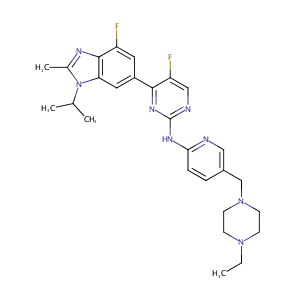
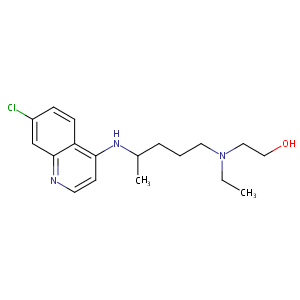
General Information of Drug Combination (ID: DC7L5M5)

Drug Combination Name
LY2835219 Hydroxychloroquine
Indication
Disease Entry Status REF
Breast Cancer Phase 2 [1]
Component Drugs LY2835219   DM93VBZ Hydroxychloroquine   DMSIVND
Small molecular drug Small molecular drug
2D MOL 2D MOL
3D MOL is unavailable 3D MOL

Molecular Interaction Atlas of This Drug Combination

Molecular Interaction Atlas (MIA)
Indication(s) of LY2835219
Disease Entry ICD 11 Status REF
Breast cancer 2C60-2C65 Approved [2]
Solid tumour/cancer 2A00-2F9Z Phase 3 [3]
LY2835219 Interacts with 2 DTT Molecule(s)
DTT Name DTT ID UniProt ID Mode of Action REF
Cyclin-dependent kinase 4 (CDK4) TT0PG8F CDK4_HUMAN Modulator [8]
Cyclin-dependent kinase 6 (CDK6) TTO0FDJ CDK6_HUMAN Modulator [8]
------------------------------------------------------------------------------------
LY2835219 Interacts with 3 DTP Molecule(s)
DTP Name DTP ID UniProt ID Mode of Action REF
Organic cation transporter 2 (SLC22A2) DT9IDPW S22A2_HUMAN Substrate [9]
Multidrug and toxin extrusion protein 1 (SLC47A1) DTZGT0P S47A1_HUMAN Substrate [9]
Multidrug and toxin extrusion protein 2 (SLC47A2) DT3TX4H S47A2_HUMAN Substrate [9]
------------------------------------------------------------------------------------
LY2835219 Interacts with 1 DME Molecule(s)
DME Name DME ID UniProt ID Mode of Action REF
Cytochrome P450 3A4 (CYP3A4) DE4LYSA CP3A4_HUMAN Metabolism [10]
------------------------------------------------------------------------------------
LY2835219 Interacts with 17 DOT Molecule(s)
DOT Name DOT ID UniProt ID Mode of Action REF
Glutaminase kidney isoform, mitochondrial (GLS) OTGOZG2M GLSK_HUMAN Increases Expression [7]
G2/mitotic-specific cyclin-B2 (CCNB2) OTIEXTDK CCNB2_HUMAN Decreases Expression [7]
Securin (PTTG1) OTIMYS4W PTTG1_HUMAN Decreases Expression [7]
Fibrinogen beta chain (FGB) OT6RKLI9 FIBB_HUMAN Decreases Expression [7]
Fibrinogen gamma chain (FGG) OT5BJSEX FIBG_HUMAN Decreases Expression [7]
Retinoblastoma-associated protein (RB1) OTQJUJMZ RB_HUMAN Decreases Expression [11]
ATP-dependent translocase ABCB1 (ABCB1) OTEJROBO MDR1_HUMAN Decreases Activity [12]
Gamma-enolase (ENO2) OTRODL0T ENOG_HUMAN Increases Expression [7]
SPARC (SPARC) OTPN90H0 SPRC_HUMAN Increases Expression [7]
Cyclin-dependent kinase inhibitor 1 (CDKN1A) OTQWHCZE CDN1A_HUMAN Increases Expression [7]
Ran-specific GTPase-activating protein (RANBP1) OTQE226K RANG_HUMAN Decreases Expression [7]
Ephrin-B3 (EFNB3) OT12WTXQ EFNB3_HUMAN Decreases Expression [7]
Insulin growth factor-like family member 2 (IGFL2) OT64M0K7 IGFL2_HUMAN Increases Expression [7]
BRCA1-associated RING domain protein 1 (BARD1) OTTC0Z9Y BARD1_HUMAN Decreases Expression [7]
Fanconi anemia group E protein (FANCE) OTKRPBW1 FANCE_HUMAN Decreases Expression [7]
Broad substrate specificity ATP-binding cassette transporter ABCG2 (ABCG2) OTW8V2V1 ABCG2_HUMAN Decreases Activity [12]
Transforming acidic coiled-coil-containing protein 3 (TACC3) OTRNEZTA TACC3_HUMAN Decreases Expression [7]
------------------------------------------------------------------------------------
⏷ Show the Full List of 17 DOT(s)
Indication(s) of Hydroxychloroquine
Disease Entry ICD 11 Status REF
Chronic renal failure GB61.Z Approved [4]
Malaria 1F40-1F45 Approved [5]
Plasmodium falciparum malaria 1F40 Approved [4]
Plasmodium malariae malaria N.A. Approved [4]
Plasmodium ovale malaria N.A. Approved [4]
Systemic lupus erythematosus 4A40.0 Approved [4]
Coronavirus Disease 2019 (COVID-19) 1D6Y Phase 3 [6]
Colon cancer 2B90.Z Investigative [4]
Hydroxychloroquine Interacts with 4 DTT Molecule(s)
DTT Name DTT ID UniProt ID Mode of Action REF
HUMAN pH-dependent viral fusion/replication (pH-DVF/R) TTD16BI N.A. Inhibitor [13]
HUMAN glycosylation of host receptor (GHR) TTZGK1R N.A. Inhibitor [13]
Toll-like receptor 7 (TLR7) TTRJ1K4 TLR7_HUMAN Antagonist [14]
HUMAN toll-like receptor 7/9 signalling pathway (TLR7/9 pathway) TT3A1EZ N.A. Inhibitor [15]
------------------------------------------------------------------------------------
Hydroxychloroquine Interacts with 1 DTP Molecule(s)
DTP Name DTP ID UniProt ID Mode of Action REF
Breast cancer resistance protein (ABCG2) DTI7UX6 ABCG2_HUMAN Substrate [16]
------------------------------------------------------------------------------------
Hydroxychloroquine Interacts with 1 DME Molecule(s)
DME Name DME ID UniProt ID Mode of Action REF
Cytochrome P450 3A4 (CYP3A4) DE4LYSA CP3A4_HUMAN Metabolism [17]
------------------------------------------------------------------------------------
Hydroxychloroquine Interacts with 17 DOT Molecule(s)
DOT Name DOT ID UniProt ID Mode of Action REF
Interferon-induced protein with tetratricopeptide repeats 3 (IFIT3) OTPGHZB9 IFIT3_HUMAN Increases Expression [18]
CASP8 and FADD-like apoptosis regulator (CFLAR) OTX14BAS CFLAR_HUMAN Decreases Expression [19]
Serine/threonine-protein kinase/endoribonuclease IRE1 (ERN1) OTY9R6FZ ERN1_HUMAN Increases Expression [18]
Nuclear factor of activated T-cells, cytoplasmic 1 (NFATC1) OT4TMERS NFAC1_HUMAN Affects Expression [20]
Claudin-1 (CLDN1) OT27KV99 CLD1_HUMAN Increases Expression [21]
Transcription factor Jun (JUN) OTCYBO6X JUN_HUMAN Increases Phosphorylation [18]
Interleukin-8 (CXCL8) OTS7T5VH IL8_HUMAN Increases Expression [22]
C-C motif chemokine 2 (CCL2) OTAD2HEL CCL2_HUMAN Increases Expression [22]
CD40 ligand (CD40LG) OT75Z6A6 CD40L_HUMAN Decreases Expression [20]
Transcription factor p65 (RELA) OTUJP9CN TF65_HUMAN Increases Expression [18]
TNF receptor-associated factor 3 (TRAF3) OT5TQBGV TRAF3_HUMAN Increases Expression [18]
Nuclear factor of activated T-cells, cytoplasmic 2 (NFATC2) OTK5T6HZ NFAC2_HUMAN Affects Localization [20]
Occludin (OCLN) OTSUTVWL OCLN_HUMAN Increases Expression [21]
Mitochondrial antiviral-signaling protein (MAVS) OTTQ0J64 MAVS_HUMAN Increases Expression [18]
S-adenosylmethionine-dependent nucleotide dehydratase RSAD2 (RSAD2) OTCA9WCM RSAD2_HUMAN Increases Expression [18]
Interferon-induced helicase C domain-containing protein 1 (IFIH1) OTZA2AHA IFIH1_HUMAN Increases Expression [18]
7-dehydrocholesterol reductase (DHCR7) OTLILBUI DHCR7_HUMAN Affects Expression [23]
------------------------------------------------------------------------------------
⏷ Show the Full List of 17 DOT(s)

Test Results of This Drug Combination in Other Disease Systems

Indication DrugCom ID Cell Line Status REF
Solid Tumor DC2D0P2 N. A. Phase 1 [24]
------------------------------------------------------------------------------------

References

1 ClinicalTrials.gov (NCT04523857) ABemacicliB or Abemaciclib and HydroxYchloroquine to Target Minimal Residual Disease in Breast Cancer
2 2017 FDA drug approvals.Nat Rev Drug Discov. 2018 Feb;17(2):81-85.
3 URL: http://www.guidetopharmacology.org Nucleic Acids Res. 2015 Oct 12. pii: gkv1037. The IUPHAR/BPS Guide to PHARMACOLOGY in 2016: towards curated quantitative interactions between 1300 protein targets and 6000 ligands. (Ligand id: 7382).
4 Hydroxychloroquine FDA Label
5 URL: http://www.guidetopharmacology.org Nucleic Acids Res. 2015 Oct 12. pii: gkv1037. The IUPHAR/BPS Guide to PHARMACOLOGY in 2016: towards curated quantitative interactions between 1300 protein targets and 6000 ligands. (Ligand id: 7198).
6 ClinicalTrials.gov (NCT04341727) Hydroxychloroquine,Hydroxychloroquine,Azithromycin in the Treatment of SARS CoV-2 Infection (WU352). U.S. National Institutes of Health.
7 Biological specificity of CDK4/6 inhibitors: dose response relationship, in vivo signaling, and composite response signature. Oncotarget. 2017 Jul 4;8(27):43678-43691. doi: 10.18632/oncotarget.18435.
8 Interpreting expression profiles of cancers by genome-wide survey of breadth of expression in normal tissues. Genomics 2005 Aug;86(2):127-41.
9 Abemaciclib Inhibits Renal Tubular Secretion Without Changing Glomerular Filtration Rate. Clin Pharmacol Ther. 2019 May;105(5):1187-1195.
10 LiverTox: Clinical and Research Information on Drug-Induced Liver Injury [Internet]-Abemaciclib.
11 CDK4/6 Inhibition Controls Proliferation of Bladder Cancer and Transcription of RB1. J Urol. 2016 Mar;195(3):771-9. doi: 10.1016/j.juro.2015.08.082. Epub 2015 Aug 28.
12 Effect of abemaciclib (LY2835219) on enhancement of chemotherapeutic agents in ABCB1 and ABCG2 overexpressing cells in vitro and in vivo. Biochem Pharmacol. 2017 Jan 15;124:29-42. doi: 10.1016/j.bcp.2016.10.015. Epub 2016 Nov 2.
13 Remdesivir and chloroquine effectively inhibit the recently emerged novel coronavirus (2019-nCoV) in vitro. Cell Res. 2020 Mar;30(3):269-271.
14 TLR7/9 antagonists as therapeutics for immune-mediated inflammatory disorders. Inflamm Allergy Drug Targets. 2007 Dec;6(4):223-35.
15 Mechanisms of action of hydroxychloroquine and chloroquine: implications for rheumatology. Nat Rev Rheumatol. 2020 Mar;16(3):155-166.
16 MDR-ABC transporters: biomarkers in rheumatoid arthritis. Clin Exp Rheumatol. 2013 Sep-Oct;31(5):779-87.
17 Hydroxychloroquine: a physiologically-based pharmacokinetic model in the context of cancer-related autophagy modulation. J Pharmacol Exp Ther. 2018 Jun;365(3):447-459.
18 Hydroxychloroquine-inhibited dengue virus is associated with host defense machinery. J Interferon Cytokine Res. 2015 Mar;35(3):143-56. doi: 10.1089/jir.2014.0038. Epub 2014 Oct 16.
19 Hydroxychloroquine potentiates Fas-mediated apoptosis of rheumatoid synoviocytes. Clin Exp Immunol. 2006 Jun;144(3):503-11. doi: 10.1111/j.1365-2249.2006.03070.x.
20 Hydroxychloroquine inhibits CD154 expression in CD4(+) T lymphocytes of systemic lupus erythematosus through NFAT, but not STAT5, signaling. Arthritis Res Ther. 2017 Aug 9;19(1):183. doi: 10.1186/s13075-017-1393-y.
21 Chloroquine and Hydroxychloroquine Increase Retinal Pigment Epithelial Layer Permeability. J Biochem Mol Toxicol. 2015 Jul;29(7):299-304. doi: 10.1002/jbt.21696. Epub 2015 Mar 9.
22 Reactive oxygen species mediate chloroquine-induced expression of chemokines by human astroglial cells. Glia. 2004 Jul;47(1):9-20. doi: 10.1002/glia.20017.
23 Hydroxychloroquine decreases human MSC-derived osteoblast differentiation and mineralization in vitro. J Cell Mol Med. 2018 Feb;22(2):873-882. doi: 10.1111/jcmm.13373. Epub 2017 Oct 3.
24 ClinicalTrials.gov (NCT04316169) Hydroxychloroquine, Abemaciclib and Endocrine Therapy in Hormone Receptor Positive (HR+)/Her 2 Negative Breast Cancer