General Information of Drug Combination (ID: DC985EY)

Drug Combination Name
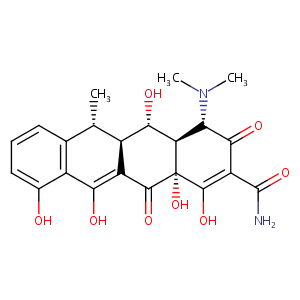
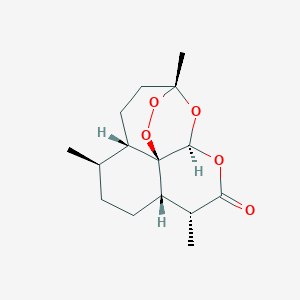
Doxycycline Artemisinin
Indication
Disease Entry Status REF
Hepatoblastoma Investigative [1]
Component Drugs Doxycycline   DM7ICNU Artemisinin   DMOY7W3
Small molecular drug Small molecular drug
2D MOL 2D MOL
3D MOL 3D MOL
High-throughput Screening Result Testing Cell Line: HB3
Zero Interaction Potency (ZIP) Score: 5.573
Bliss Independence Score: 1.521
Loewe Additivity Score: 0.309
LHighest Single Agent (HSA) Score: 4.818

Molecular Interaction Atlas of This Drug Combination

Molecular Interaction Atlas (MIA)
Indication(s) of Doxycycline
Disease Entry ICD 11 Status REF
Acne vulgaris ED80 Approved [2]
Actinomycosis N.A. Approved [2]
Acute gonococcal cervicitis N.A. Approved [2]
Acute gonococcal epididymo-orchitis N.A. Approved [2]
Advanced gum disease DA0D Approved [3]
Anthrax 1B97 Approved [2]
Bartonellosis N.A. Approved [2]
Boutonneuse fever N.A. Approved [2]
Brill-Zinsser disease N.A. Approved [2]
Bronchitis CA20 Approved [2]
Brucellosis N.A. Approved [2]
Chancroid N.A. Approved [2]
Chlamydiaceae infections N.A. Approved [2]
Chronic periodontitis DA0C.Y Approved [3]
Colorectal carcinoma N.A. Approved [2]
Cutaneous anthrax N.A. Approved [2]
Endemic typhus N.A. Approved [2]
Epidemic louse-borne typhus N.A. Approved [2]
Gastrointestinal anthrax N.A. Approved [2]
Inhalational anthrax N.A. Approved [2]
Listeriosis N.A. Approved [2]
Lymphogranuloma venereum N.A. Approved [2]
Mycoplasma pneumoniae pneumonia N.A. Approved [2]
Ornithosis N.A. Approved [2]
Q fever N.A. Approved [2]
Relapsing fever N.A. Approved [2]
Rickettsialpox N.A. Approved [2]
Rickettsiosis N.A. Approved [2]
Rocky mountain spotted fever N.A. Approved [2]
Syphilis N.A. Approved [2]
Trachoma N.A. Approved [2]
Tularemia 1B94 Approved [2]
Typhus N.A. Approved [2]
Yaws N.A. Approved [2]
Diabetic foot ulcer BD54 Phase 2 [4]
Sinusitis CA0A.Z Investigative [2]
Vibrio cholerae infection 1A00 Investigative [2]
Doxycycline Interacts with 1 DTT Molecule(s)
DTT Name DTT ID UniProt ID Mode of Action REF
Bacterial 30S ribosomal RNA (Bact 30S rRNA) TTOVFH2 NOUNIPROTAC Modulator [7]
------------------------------------------------------------------------------------
Doxycycline Interacts with 1 DTP Molecule(s)
DTP Name DTP ID UniProt ID Mode of Action REF
P-glycoprotein 1 (ABCB1) DTUGYRD MDR1_HUMAN Substrate [8]
------------------------------------------------------------------------------------
Doxycycline Interacts with 1 DME Molecule(s)
DME Name DME ID UniProt ID Mode of Action REF
Cytochrome P450 3A4 (CYP3A4) DE4LYSA CP3A4_HUMAN Metabolism [9]
------------------------------------------------------------------------------------
Doxycycline Interacts with 4 DOT Molecule(s)
DOT Name DOT ID UniProt ID Mode of Action REF
ATP-dependent translocase ABCB1 (ABCB1) OTEJROBO MDR1_HUMAN Decreases Expression [10]
Stromelysin-1 (MMP3) OTGBI74Z MMP3_HUMAN Decreases Activity [11]
Neutrophil collagenase (MMP8) OTZXH19L MMP8_HUMAN Decreases Activity [11]
Collagenase 3 (MMP13) OTY8BZIE MMP13_HUMAN Increases Expression [12]
------------------------------------------------------------------------------------
Indication(s) of Artemisinin
Disease Entry ICD 11 Status REF
Malaria 1F40-1F45 Approved [5]
Artemisinin Interacts with 2 DTT Molecule(s)
DTT Name DTT ID UniProt ID Mode of Action REF
Plasmodium Dihydroorotate dehydrogenase (Malaria DHOdehase) TT3PQ2Y PYRD_PLAF7 Inhibitor [5]
Sarcoplasmic/endoplasmic reticulum calcium ATPase (ATP2A) TTZVSJ2 NOUNIPROTAC Inhibitor [5]
------------------------------------------------------------------------------------
Artemisinin Interacts with 4 DME Molecule(s)
DME Name DME ID UniProt ID Mode of Action REF
Cytochrome P450 3A4 (CYP3A4) DE4LYSA CP3A4_HUMAN Metabolism [13]
Cytochrome P450 2A6 (CYP2A6) DEJVYAZ CP2A6_HUMAN Metabolism [14]
Glutathione S-transferase alpha-1 (GSTA1) DE4ZHS1 GSTA1_HUMAN Metabolism [15]
Cytochrome P450 2B6 (CYP2B6) DEPKLMQ CP2B6_HUMAN Metabolism [13]
------------------------------------------------------------------------------------
Artemisinin Interacts with 4 DOT Molecule(s)
DOT Name DOT ID UniProt ID Mode of Action REF
Cytochrome P450 2C19 (CYP2C19) OTFMJYYE CP2CJ_HUMAN Decreases Activity [16]
ATP-dependent translocase ABCB1 (ABCB1) OTEJROBO MDR1_HUMAN Increases Expression [17]
Isocitrate dehydrogenase subunit alpha, mitochondrial (IDH3A) OT5QQB5L IDH3A_HUMAN Decreases Expression [18]
Nuclear receptor subfamily 1 group I member 3 (NR1I3) OTS3SGH7 NR1I3_HUMAN Increases Activity [19]
------------------------------------------------------------------------------------

References

1 CheMBL Affinity Phenotypic Cellular Interaction Assay ID: CHEMBL1125976
2 Doxycycline FDA Label
3 URL: http://www.guidetopharmacology.org Nucleic Acids Res. 2015 Oct 12. pii: gkv1037. The IUPHAR/BPS Guide to PHARMACOLOGY in 2016: towards curated quantitative interactions between 1300 protein targets and 6000 ligands. (Ligand id: 6464).
4 ClinicalTrials.gov (NCT00764361) Safety Study of Topical Doxycycline Gel for Adult Diabetic Lower Extremity Ulcers. U.S. National Institutes of Health.
5 The fight against drug-resistant malaria: novel plasmodial targets and antimalarial drugs. Curr Med Chem. 2008;15(2):161-71.
6 Aryl hydrocarbon receptor protects lung adenocarcinoma cells against cigarette sidestream smoke particulates-induced oxidative stress. Toxicol Appl Pharmacol. 2012 Mar 15;259(3):293-301.
7 Drugs@FDA. U.S. Food and Drug Administration. U.S. Department of Health & Human Services.
8 Mammalian drug efflux transporters of the ATP binding cassette (ABC) family in multidrug resistance: A review of the past decade. Cancer Lett. 2016 Jan 1;370(1):153-64.
9 A further interaction study of quinine with clinically important drugs by human liver microsomes: determinations of inhibition constant (Ki) and type of inhibition. Eur J Drug Metab Pharmacokinet. 1999 Jul-Sep;24(3):272-8.
10 Functional and histochemical analysis of MDR3 P-glycoprotein in a tetracycline-controlled gene expression system. Eur J Med Res. 2000 Dec 29;5(12):517-22.
11 Synthesis and in vitro evaluation of targeted tetracycline derivatives: effects on inhibition of matrix metalloproteinases. Bioorg Med Chem. 2007 Mar 15;15(6):2368-74. doi: 10.1016/j.bmc.2007.01.026. Epub 2007 Jan 19.
12 Chloramphenicol causes mitochondrial stress, decreases ATP biosynthesis, induces matrix metalloproteinase-13 expression, and solid-tumor cell invasion. Toxicol Sci. 2010 Jul;116(1):140-50. doi: 10.1093/toxsci/kfq085. Epub 2010 Mar 25.
13 Antimalarial artemisinin drugs induce cytochrome P450 and MDR1 expression by activation of xenosensors pregnane X receptor and constitutive androstane receptor. Mol Pharmacol. 2005 Jun;67(6):1954-65.
14 Identification of the human cytochrome P450 enzymes involved in the in vitro metabolism of artemisinin. Br J Clin Pharmacol. 1999 Oct;48(4):528-35.
15 Inhibition of glutathione S-transferases by antimalarial drugs possible implications for circumventing anticancer drug resistance. Int J Cancer. 2002 Feb 10;97(5):700-5.
16 Application of higher throughput screening (HTS) inhibition assays to evaluate the interaction of antiparasitic drugs with cytochrome P450s. Drug Metab Dispos. 2001 Jan;29(1):30-5.
17 Antimalarial artemisinin drugs induce cytochrome P450 and MDR1 expression by activation of xenosensors pregnane X receptor and constitutive androstane receptor. Mol Pharmacol. 2005 Jun;67(6):1954-65.
18 Identification of Compounds That Inhibit Estrogen-Related Receptor Alpha Signaling Using High-Throughput Screening Assays. Molecules. 2019 Feb 27;24(5):841. doi: 10.3390/molecules24050841.
19 In vivo and mechanistic evidence of nuclear receptor CAR induction by artemisinin. Eur J Clin Invest. 2006 Sep;36(9):647-53. doi: 10.1111/j.1365-2362.2006.01700.x.