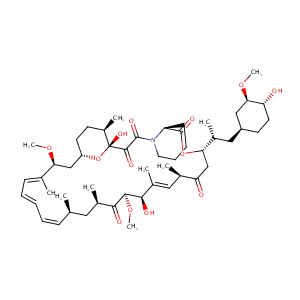
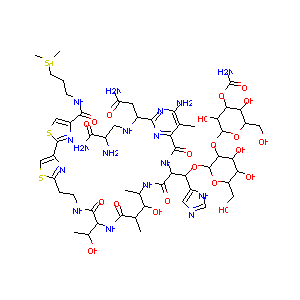
General Information of Drug Combination (ID: DCBFVD1)

Drug Combination Name
Sirolimus Bleomycin
Indication
Disease Entry Status REF
Melanoma Investigative [1]
Component Drugs Sirolimus   DMGW1ID Bleomycin   DMNER5S
Small molecular drug Small molecular drug
2D MOL 2D MOL
3D MOL 3D MOL
High-throughput Screening Result Testing Cell Line: UACC-257
Zero Interaction Potency (ZIP) Score: 0.56
Bliss Independence Score: 2.59
Loewe Additivity Score: 1.16
LHighest Single Agent (HSA) Score: 1.33

Molecular Interaction Atlas of This Drug Combination

Molecular Interaction Atlas (MIA)
Indication(s) of Sirolimus
Disease Entry ICD 11 Status REF
Advanced cancer 2A00-2F9Z Approved [2]
Brainstem neoplasm N.A. Approved [2]
Graft-versus-host disease 4B24 Approved [2]
Intracranial meningioma N.A. Approved [2]
Lung cancer 2C25.0 Approved [2]
Lung lymphangioleiomyomatosis N.A. Approved [2]
Lymphangioleiomyomatosis CB07 Approved [3]
Mucosal melanoma N.A. Approved [2]
Multiple myeloma 2A83 Approved [4]
Multiple sclerosis 8A40 Approved [2]
Non-small-cell lung cancer 2C25.Y Approved [2]
Organ transplant rejection NE84 Approved [5]
Plasma cell myeloma 2A83.1 Approved [2]
Prostate cancer 2C82.0 Approved [2]
Salivary gland squamous cell carcinoma N.A. Approved [2]
Uveitis 9A96.Z Phase 3 [6]
Coronavirus Disease 2019 (COVID-19) 1D6Y Phase 2 [7]
Dutch elm disease 8D64 Phase 1/2 [5]
Castration-resistant prostate carcinoma N.A. Investigative [2]
Neuroblastoma 2D11.2 Investigative [2]
Pancreatic acinar cell carcinoma N.A. Investigative [2]
Polycystic kidney disease GB8Y Investigative [2]
Rheumatoid arthritis FA20 Investigative [2]
Sirolimus Interacts with 3 DTT Molecule(s)
DTT Name DTT ID UniProt ID Mode of Action REF
Serine/threonine-protein kinase mTOR (mTOR) TTCJG29 MTOR_HUMAN Inhibitor [10]
PI3K/AKT/mTOR pathway (PAm pathway) TTGQUFK NOUNIPROTAC Inhibitor [11]
HUMAN mammalian target of rapamycin (mTOR) TT7HQAF MTOR_HUMAN Inhibitor [12]
------------------------------------------------------------------------------------
Sirolimus Interacts with 2 DTP Molecule(s)
DTP Name DTP ID UniProt ID Mode of Action REF
P-glycoprotein 1 (ABCB1) DTUGYRD MDR1_HUMAN Substrate [13]
Organic anion transporting polypeptide 1B1 (SLCO1B1) DT3D8F0 SO1B1_HUMAN Substrate [14]
------------------------------------------------------------------------------------
Sirolimus Interacts with 3 DME Molecule(s)
DME Name DME ID UniProt ID Mode of Action REF
Cytochrome P450 3A4 (CYP3A4) DE4LYSA CP3A4_HUMAN Metabolism [15]
Cytochrome P450 3A5 (CYP3A5) DEIBDNY CP3A5_HUMAN Metabolism [16]
Cytochrome P450 3A7 (CYP3A7) DERD86B CP3A7_HUMAN Metabolism [16]
------------------------------------------------------------------------------------
Sirolimus Interacts with 1 DOT Molecule(s)
DOT Name DOT ID UniProt ID Mode of Action REF
Calcineurin subunit B type 1 (PPP3R1) OTGQNFJQ CANB1_HUMAN Increases ADR [17]
------------------------------------------------------------------------------------
Indication(s) of Bleomycin
Disease Entry ICD 11 Status REF
Cervical cancer 2C77.0 Approved [8]
Head and neck cancer 2D42 Approved [8]
Hodgkin lymphoma 2B30 Approved [9]
Penile cancer N.A. Approved [8]
Testicular germ cell tumor N.A. Approved [8]
Classic Hodgkin lymphoma N.A. Investigative [8]
Follicular lymphoma 2A80 Investigative [8]
Bleomycin Interacts with 1 DTT Molecule(s)
DTT Name DTT ID UniProt ID Mode of Action REF
Human Deoxyribonucleic acid (hDNA) TTUTN1I NOUNIPROTAC Breaker [22]
------------------------------------------------------------------------------------
Bleomycin Interacts with 1 DME Molecule(s)
DME Name DME ID UniProt ID Mode of Action REF
Bleomycin hydrolase (BLMH) DECH1VP BLMH_HUMAN Metabolism [23]
------------------------------------------------------------------------------------
Bleomycin Interacts with 23 DOT Molecule(s)
DOT Name DOT ID UniProt ID Mode of Action REF
Superoxide dismutase , mitochondrial (SOD2) OTIWXGZ9 SODM_HUMAN Increases Expression [24]
Interstitial collagenase (MMP1) OTI4I2V1 MMP1_HUMAN Increases Expression [25]
Interleukin-8 (CXCL8) OTS7T5VH IL8_HUMAN Increases Expression [25]
Mucin-5AC (MUC5AC) OTJV8O04 MUC5A_HUMAN Increases Expression [25]
Transmembrane protein 250 (TMEM250) OTLJ4G5G TM250_HUMAN Increases Expression [18]
Serine/threonine-protein kinase Chk2 (CHEK2) OT8ZPCNS CHK2_HUMAN Increases Phosphorylation [26]
Transforming growth factor beta-1 proprotein (TGFB1) OTV5XHVH TGFB1_HUMAN Increases Expression [19]
Histone H2AX (H2AX) OT18UX57 H2AX_HUMAN Increases Expression [27]
Max-interacting protein 1 (MXI1) OTUQ9E0D MXI1_HUMAN Decreases Expression [18]
Actin, aortic smooth muscle (ACTA2) OTEDLG8E ACTA_HUMAN Increases Expression [19]
Unconventional myosin-Ie (MYO1E) OTM9YSIZ MYO1E_HUMAN Decreases Expression [18]
Serine-protein kinase ATM (ATM) OTQVOHLT ATM_HUMAN Increases Phosphorylation [26]
Structural maintenance of chromosomes protein 1A (SMC1A) OT9ZMRK9 SMC1A_HUMAN Increases Phosphorylation [26]
7SK snRNA methylphosphate capping enzyme (MEPCE) OTRBQEYP MEPCE_HUMAN Increases Expression [18]
Transmembrane protein 87A (TMEM87A) OT8ATDVX TM87A_HUMAN Increases Expression [18]
Lipase member H (LIPH) OTRGYLKL LIPH_HUMAN Decreases Expression [18]
Abasic site processing protein HMCES (HMCES) OTVRDL6U HMCES_HUMAN Decreases Expression [18]
Small integral membrane protein 14 (SMIM14) OT47IF19 SIM14_HUMAN Decreases Expression [18]
Kelch-like protein 42 (KLHL42) OTK6WARI KLH42_HUMAN Increases Expression [18]
Inactive cell surface hyaluronidase CEMIP2 (CEMIP2) OT9I1XUO CEIP2_HUMAN Decreases Expression [18]
ERBB receptor feedback inhibitor 1 (ERRFI1) OT7VZ2IZ ERRFI_HUMAN Decreases Expression [18]
Transmembrane and coiled-coil domain protein 3 (TMCC3) OTAIQ6V6 TMCC3_HUMAN Decreases Expression [18]
Baculoviral IAP repeat-containing protein 2 (BIRC2) OTFXFREP BIRC2_HUMAN Decreases Response To Substance [28]
------------------------------------------------------------------------------------
⏷ Show the Full List of 23 DOT(s)

Test Results of This Drug Combination in Other Disease Systems

Indication DrugCom ID Cell Line Status REF
Anaplastic large cell lymphoma DCFFN30 SR Investigative [29]
Cutaneous melanoma DCAMOY2 SK-MEL-5 Investigative [1]
------------------------------------------------------------------------------------

References

1 CheMBL Affinity Phenotypic Cellular Interaction Assay ID: CHEMBL1125976
2 Sirolimus FDA Label
3 FDA Approved Drug Products from FDA Official Website. 2019. Application Number: (ANDA) 201578.
4 Drugs@FDA. U.S. Food and Drug Administration. U.S. Department of Health & Human Services. 2015
5 URL: http://www.guidetopharmacology.org Nucleic Acids Res. 2015 Oct 12. pii: gkv1037. The IUPHAR/BPS Guide to PHARMACOLOGY in 2016: towards curated quantitative interactions between 1300 protein targets and 6000 ligands. (Ligand id: 6031).
6 Clinical pipeline report, company report or official report of the Pharmaceutical Research and Manufacturers of America (PhRMA)
7 ClinicalTrials.gov (NCT04341675) Sirolimus Treatment in Hospitalized Patients With COVID-19 Pneumonia. U.S. National Institutes of Health.
8 Bleomycin FDA Label
9 Natural products as sources of new drugs over the last 25 years. J Nat Prod. 2007 Mar;70(3):461-77.
10 Knockouts model the 100 best-selling drugs--will they model the next 100 Nat Rev Drug Discov. 2003 Jan;2(1):38-51.
11 The genomic landscape of nasopharyngeal carcinoma.Nat Genet. 2014 Aug;46(8):866-71.
12 Network-based drug repurposing for novel coronavirus 2019-nCoV/SARS-CoV-2. Cell Discov. 2020 Mar 16;6:14.
13 Pharmacogenetics of tacrolimus and sirolimus in renal transplant patients: from retrospective analyses to prospective studies. Transplant Proc. 2007 Sep;39(7):2142-4.
14 Pharmacokinetic and pharmacodynamic interactions between the immunosuppressant sirolimus and the lipid-lowering drug ezetimibe in healthy volunteers. Clin Pharmacol Ther. 2010 Jun;87(6):663-7.
15 Summary of information on human CYP enzymes: human P450 metabolism data. Drug Metab Rev. 2002 Feb-May;34(1-2):83-448.
16 Drug Interactions Flockhart Table
17 ADReCS-Target: target profiles for aiding drug safety research and application. Nucleic Acids Res. 2018 Jan 4;46(D1):D911-D917. doi: 10.1093/nar/gkx899.
18 Development and validation of the TGx-HDACi transcriptomic biomarker to detect histone deacetylase inhibitors in human TK6 cells. Arch Toxicol. 2021 May;95(5):1631-1645. doi: 10.1007/s00204-021-03014-2. Epub 2021 Mar 26.
19 Pulmonary fibrosis model using micro-CT analyzable human PSC-derived alveolar organoids containing alveolar macrophage-like cells. Cell Biol Toxicol. 2022 Aug;38(4):557-575. doi: 10.1007/s10565-022-09698-1. Epub 2022 Mar 10.
20 An antisense oligonucleotide targeted to human Ku86 messenger RNA sensitizes M059K malignant glioma cells to ionizing radiation, bleomycin, and etoposide but not DNA cross-linking agents. Cancer Res. 2002 Oct 15;62(20):5888-96.
21 XRCC1 deficiency sensitizes human lung epithelial cells to genotoxicity by crocidolite asbestos and Libby amphibole. Environ Health Perspect. 2010 Dec;118(12):1707-13. doi: 10.1289/ehp.1002312. Epub 2010 Aug 11.
22 Bleomycin and talisomycin sequence-specific strand scission of DNA: a mechanism of double-strand cleavage. Cancer Res. 1982 Jul;42(7):2779-85.
23 The C-terminus of human bleomycin hydrolase is required for protection against bleomycin-induced chromosomal damage. Mutat Res. 1998 Oct 12;421(1):1-7.
24 Age-dependent basal level and induction capacity of copper-zinc and manganese superoxide dismutase and other scavenging enzyme activities in leukocytes from young and elderly adults. Am J Pathol. 1993 Jul;143(1):312-20.
25 Agents associated with lung inflammation induce similar responses in NCI-H292 lung epithelial cells. Toxicol In Vitro. 2008 Oct;22(7):1782-8.
26 Direct activation of ATM by resveratrol under oxidizing conditions. PLoS One. 2014 Jun 16;9(6):e97969. doi: 10.1371/journal.pone.0097969. eCollection 2014.
27 Distinct mechanisms of cell-kill by triapine and its terminally dimethylated derivative Dp44mT due to a loss or gain of activity of their copper(II) complexes. Biochem Pharmacol. 2014 Oct 1;91(3):312-22. doi: 10.1016/j.bcp.2014.08.006. Epub 2014 Aug 15.
28 Expression and prognostic significance of IAP-family genes in human cancers and myeloid leukemias. Clin Cancer Res. 2000 May;6(5):1796-803.
29 CheMBL Affinity Phenotypic Cellular Interaction Assay ID: CHEMBL1125966