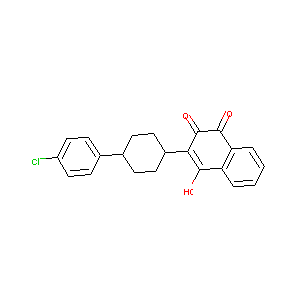
General Information of Drug Combination (ID: DCBX116)

Drug Combination Name
Atovaquone Lumefantrine
Indication
Disease Entry Status REF
Hepatoblastoma Investigative [1]
Component Drugs Atovaquone   DMY4UMW Lumefantrine   DM29GAD
Small molecular drug Small molecular drug
2D MOL 2D MOL
3D MOL 3D MOL
High-throughput Screening Result Testing Cell Line: HB3
Zero Interaction Potency (ZIP) Score: 1.354
Bliss Independence Score: 0.795
Loewe Additivity Score: 2.309
LHighest Single Agent (HSA) Score: 3.165

Molecular Interaction Atlas of This Drug Combination

Molecular Interaction Atlas (MIA)
Indication(s) of Atovaquone
Disease Entry ICD 11 Status REF
Fungal infection 1F29-1F2F Approved [2]
Atovaquone Interacts with 1 DTT Molecule(s)
DTT Name DTT ID UniProt ID Mode of Action REF
Plasmodium Dihydroorotate dehydrogenase (Malaria DHOdehase) TT3PQ2Y PYRD_PLAF7 Inhibitor [4]
------------------------------------------------------------------------------------
Atovaquone Interacts with 1 DME Molecule(s)
DME Name DME ID UniProt ID Mode of Action REF
Cytochrome P450 3A4 (CYP3A4) DE4LYSA CP3A4_HUMAN Metabolism [5]
------------------------------------------------------------------------------------
Indication(s) of Lumefantrine
Disease Entry ICD 11 Status REF
Malaria 1F40-1F45 Approved [3]
Lumefantrine Interacts with 1 DTT Molecule(s)
DTT Name DTT ID UniProt ID Mode of Action REF
Sodium pump subunit alpha-1 (ATP1A1) TTWK8D0 AT1A1_HUMAN Binder [2]
------------------------------------------------------------------------------------
Lumefantrine Interacts with 1 DME Molecule(s)
DME Name DME ID UniProt ID Mode of Action REF
Cytochrome P450 3A4 (CYP3A4) DE4LYSA CP3A4_HUMAN Metabolism [6]
------------------------------------------------------------------------------------

Test Results of This Drug Combination in Other Disease Systems

Indication DrugCom ID Cell Line Status REF
DD2 DCEUC62 DD2 Investigative [1]
------------------------------------------------------------------------------------

References

1 CheMBL Affinity Phenotypic Cellular Interaction Assay ID: CHEMBL1125966
2 The fight against drug-resistant malaria: novel plasmodial targets and antimalarial drugs. Curr Med Chem. 2008;15(2):161-71.
3 Drugs@FDA. U.S. Food and Drug Administration. U.S. Department of Health & Human Services. 2015
4 Inhibitor binding in a class 2 dihydroorotate dehydrogenase causes variations in the membrane-associated N-terminal domain. Protein Sci. 2004 Apr;13(4):1031-42.
5 Time-dependent pharmacokinetics and drug metabolism of atovaquone plus proguanil (Malarone) when taken as chemoprophylaxis. Eur J Clin Pharmacol. 2002 Apr;58(1):19-27.
6 Development of a paediatric physiologically based pharmacokinetic model to assess the impact of drug-drug interactions in tuberculosis co-infected malaria subjects: A case study with artemether-lumefantrine and the CYP3A4-inducer rifampicin. Eur J Pharm Sci. 2017 Aug 30;106:20-33.