General Information of Drug Combination (ID: DCCPHGL)

Drug Combination Name
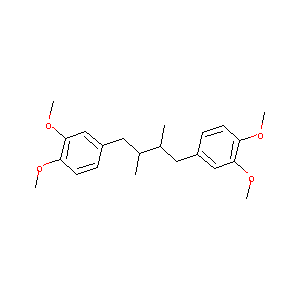
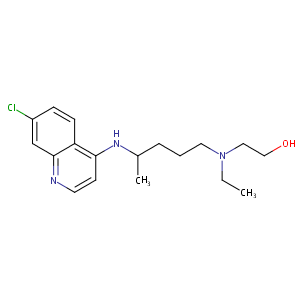
Terameprocol Hydroxychloroquine
Indication
Disease Entry Status REF
Chronic myelogenous leukemia Investigative [1]
Component Drugs Terameprocol   DMC3P45 Hydroxychloroquine   DMSIVND
Small molecular drug Small molecular drug
2D MOL 2D MOL
3D MOL 3D MOL
High-throughput Screening Result Testing Cell Line: KBM-7
Zero Interaction Potency (ZIP) Score: 11.99
Bliss Independence Score: 11.99
Loewe Additivity Score: 16.66
LHighest Single Agent (HSA) Score: 16.66

Molecular Interaction Atlas of This Drug Combination

Molecular Interaction Atlas (MIA)
Indication(s) of Terameprocol
Disease Entry ICD 11 Status REF
Solid tumour/cancer 2A00-2F9Z Phase 2 [2]
Terameprocol Interacts with 1 DTT Molecule(s)
DTT Name DTT ID UniProt ID Mode of Action REF
Transcription factor Sp1 (SP1) TTZEP6S SP1_HUMAN Modulator [2]
------------------------------------------------------------------------------------
Indication(s) of Hydroxychloroquine
Disease Entry ICD 11 Status REF
Chronic renal failure GB61.Z Approved [3]
Malaria 1F40-1F45 Approved [4]
Plasmodium falciparum malaria 1F40 Approved [3]
Plasmodium malariae malaria N.A. Approved [3]
Plasmodium ovale malaria N.A. Approved [3]
Systemic lupus erythematosus 4A40.0 Approved [3]
Coronavirus Disease 2019 (COVID-19) 1D6Y Phase 3 [5]
Colon cancer 2B90.Z Investigative [3]
Hydroxychloroquine Interacts with 4 DTT Molecule(s)
DTT Name DTT ID UniProt ID Mode of Action REF
HUMAN pH-dependent viral fusion/replication (pH-DVF/R) TTD16BI N.A. Inhibitor [6]
HUMAN glycosylation of host receptor (GHR) TTZGK1R N.A. Inhibitor [6]
Toll-like receptor 7 (TLR7) TTRJ1K4 TLR7_HUMAN Antagonist [7]
HUMAN toll-like receptor 7/9 signalling pathway (TLR7/9 pathway) TT3A1EZ N.A. Inhibitor [8]
------------------------------------------------------------------------------------
Hydroxychloroquine Interacts with 1 DTP Molecule(s)
DTP Name DTP ID UniProt ID Mode of Action REF
Breast cancer resistance protein (ABCG2) DTI7UX6 ABCG2_HUMAN Substrate [9]
------------------------------------------------------------------------------------
Hydroxychloroquine Interacts with 1 DME Molecule(s)
DME Name DME ID UniProt ID Mode of Action REF
Cytochrome P450 3A4 (CYP3A4) DE4LYSA CP3A4_HUMAN Metabolism [10]
------------------------------------------------------------------------------------
Hydroxychloroquine Interacts with 17 DOT Molecule(s)
DOT Name DOT ID UniProt ID Mode of Action REF
Interferon-induced protein with tetratricopeptide repeats 3 (IFIT3) OTPGHZB9 IFIT3_HUMAN Increases Expression [11]
CASP8 and FADD-like apoptosis regulator (CFLAR) OTX14BAS CFLAR_HUMAN Decreases Expression [12]
Serine/threonine-protein kinase/endoribonuclease IRE1 (ERN1) OTY9R6FZ ERN1_HUMAN Increases Expression [11]
Nuclear factor of activated T-cells, cytoplasmic 1 (NFATC1) OT4TMERS NFAC1_HUMAN Affects Expression [13]
Claudin-1 (CLDN1) OT27KV99 CLD1_HUMAN Increases Expression [14]
Transcription factor Jun (JUN) OTCYBO6X JUN_HUMAN Increases Phosphorylation [11]
Interleukin-8 (CXCL8) OTS7T5VH IL8_HUMAN Increases Expression [15]
C-C motif chemokine 2 (CCL2) OTAD2HEL CCL2_HUMAN Increases Expression [15]
CD40 ligand (CD40LG) OT75Z6A6 CD40L_HUMAN Decreases Expression [13]
Transcription factor p65 (RELA) OTUJP9CN TF65_HUMAN Increases Expression [11]
TNF receptor-associated factor 3 (TRAF3) OT5TQBGV TRAF3_HUMAN Increases Expression [11]
Nuclear factor of activated T-cells, cytoplasmic 2 (NFATC2) OTK5T6HZ NFAC2_HUMAN Affects Localization [13]
Occludin (OCLN) OTSUTVWL OCLN_HUMAN Increases Expression [14]
Mitochondrial antiviral-signaling protein (MAVS) OTTQ0J64 MAVS_HUMAN Increases Expression [11]
S-adenosylmethionine-dependent nucleotide dehydratase RSAD2 (RSAD2) OTCA9WCM RSAD2_HUMAN Increases Expression [11]
Interferon-induced helicase C domain-containing protein 1 (IFIH1) OTZA2AHA IFIH1_HUMAN Increases Expression [11]
7-dehydrocholesterol reductase (DHCR7) OTLILBUI DHCR7_HUMAN Affects Expression [16]
------------------------------------------------------------------------------------
⏷ Show the Full List of 17 DOT(s)

References

1 CheMBL Affinity Phenotypic Cellular Interaction Assay ID: CHEMBL1125966
2 Terameprocol, a novel site-specific transcription inhibitor with anticancer activity. IDrugs. 2008 Mar;11(3):204-14.
3 Hydroxychloroquine FDA Label
4 URL: http://www.guidetopharmacology.org Nucleic Acids Res. 2015 Oct 12. pii: gkv1037. The IUPHAR/BPS Guide to PHARMACOLOGY in 2016: towards curated quantitative interactions between 1300 protein targets and 6000 ligands. (Ligand id: 7198).
5 ClinicalTrials.gov (NCT04341727) Hydroxychloroquine,Hydroxychloroquine,Azithromycin in the Treatment of SARS CoV-2 Infection (WU352). U.S. National Institutes of Health.
6 Remdesivir and chloroquine effectively inhibit the recently emerged novel coronavirus (2019-nCoV) in vitro. Cell Res. 2020 Mar;30(3):269-271.
7 TLR7/9 antagonists as therapeutics for immune-mediated inflammatory disorders. Inflamm Allergy Drug Targets. 2007 Dec;6(4):223-35.
8 Mechanisms of action of hydroxychloroquine and chloroquine: implications for rheumatology. Nat Rev Rheumatol. 2020 Mar;16(3):155-166.
9 MDR-ABC transporters: biomarkers in rheumatoid arthritis. Clin Exp Rheumatol. 2013 Sep-Oct;31(5):779-87.
10 Hydroxychloroquine: a physiologically-based pharmacokinetic model in the context of cancer-related autophagy modulation. J Pharmacol Exp Ther. 2018 Jun;365(3):447-459.
11 Hydroxychloroquine-inhibited dengue virus is associated with host defense machinery. J Interferon Cytokine Res. 2015 Mar;35(3):143-56. doi: 10.1089/jir.2014.0038. Epub 2014 Oct 16.
12 Hydroxychloroquine potentiates Fas-mediated apoptosis of rheumatoid synoviocytes. Clin Exp Immunol. 2006 Jun;144(3):503-11. doi: 10.1111/j.1365-2249.2006.03070.x.
13 Hydroxychloroquine inhibits CD154 expression in CD4(+) T lymphocytes of systemic lupus erythematosus through NFAT, but not STAT5, signaling. Arthritis Res Ther. 2017 Aug 9;19(1):183. doi: 10.1186/s13075-017-1393-y.
14 Chloroquine and Hydroxychloroquine Increase Retinal Pigment Epithelial Layer Permeability. J Biochem Mol Toxicol. 2015 Jul;29(7):299-304. doi: 10.1002/jbt.21696. Epub 2015 Mar 9.
15 Reactive oxygen species mediate chloroquine-induced expression of chemokines by human astroglial cells. Glia. 2004 Jul;47(1):9-20. doi: 10.1002/glia.20017.
16 Hydroxychloroquine decreases human MSC-derived osteoblast differentiation and mineralization in vitro. J Cell Mol Med. 2018 Feb;22(2):873-882. doi: 10.1111/jcmm.13373. Epub 2017 Oct 3.