General Information of Drug Combination (ID: DCD0EN1)

Drug Combination Name
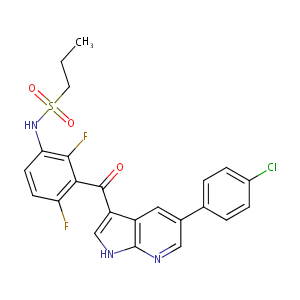
Picoplatin Vemurafenib
Indication
Disease Entry Status REF
Chronic myelogenous leukemia Investigative [1]
Component Drugs Picoplatin   DM0PIY6 Vemurafenib   DM62UG5
Small molecular drug Small molecular drug
2D MOL 2D MOL
3D MOL 3D MOL
High-throughput Screening Result Testing Cell Line: K-562
Zero Interaction Potency (ZIP) Score: 4.83
Bliss Independence Score: 9.19
Loewe Additivity Score: 4.88
LHighest Single Agent (HSA) Score: 4

Molecular Interaction Atlas of This Drug Combination

Molecular Interaction Atlas (MIA)
Indication(s) of Picoplatin
Disease Entry ICD 11 Status REF
Colorectal cancer 2B91.Z Phase 3 [2]
Ovarian cancer 2C73 Phase 3 [2]
Prostate cancer 2C82.0 Phase 3 [2]
Small-cell lung cancer 2C25.Y Phase 3 [2]
Indication(s) of Vemurafenib
Disease Entry ICD 11 Status REF
Melanoma 2C30 Approved [3]
Vemurafenib Interacts with 1 DTT Molecule(s)
DTT Name DTT ID UniProt ID Mode of Action REF
Serine/threonine-protein kinase B-raf (BRAF) TTWCGQT BRAF_HUMAN Modulator [6]
------------------------------------------------------------------------------------
Vemurafenib Interacts with 3 DTP Molecule(s)
DTP Name DTP ID UniProt ID Mode of Action REF
P-glycoprotein 1 (ABCB1) DTUGYRD MDR1_HUMAN Substrate [7]
Organic anion transporting polypeptide 1B1 (SLCO1B1) DT3D8F0 SO1B1_HUMAN Substrate [8]
Organic anion transporting polypeptide 1B3 (SLCO1B3) DT9C1TS SO1B3_HUMAN Substrate [8]
------------------------------------------------------------------------------------
Vemurafenib Interacts with 1 DME Molecule(s)
DME Name DME ID UniProt ID Mode of Action REF
Cytochrome P450 3A4 (CYP3A4) DE4LYSA CP3A4_HUMAN Metabolism [9]
------------------------------------------------------------------------------------
Vemurafenib Interacts with 8 DOT Molecule(s)
DOT Name DOT ID UniProt ID Mode of Action REF
Microphthalmia-associated transcription factor (MITF) OT6XJCZH MITF_HUMAN Affects Expression [4]
Myc proto-oncogene protein (MYC) OTPV5LUK MYC_HUMAN Decreases Expression [10]
C-C motif chemokine 2 (CCL2) OTAD2HEL CCL2_HUMAN Increases Expression [11]
Mitogen-activated protein kinase 3 (MAPK3) OTCYKGKO MK03_HUMAN Decreases Phosphorylation [5]
Mitogen-activated protein kinase 1 (MAPK1) OTH85PI5 MK01_HUMAN Decreases Phosphorylation [5]
CD70 antigen (CD70) OTHB2AL1 CD70_HUMAN Decreases Expression [12]
Melanocyte protein PMEL (PMEL) OTCDDHHM PMEL_HUMAN Increases Expression [4]
Melanoma antigen recognized by T-cells 1 (MLANA) OT1N2S2K MAR1_HUMAN Increases Expression [4]
------------------------------------------------------------------------------------
⏷ Show the Full List of 8 DOT(s)

Test Results of This Drug Combination in Other Disease Systems

Indication DrugCom ID Cell Line Status REF
Glioma DCVJRQD SF-295 Investigative [1]
Glioma DC1OUAV SF-268 Investigative [1]
Renal cell carcinoma DCZPBLW SN12C Investigative [1]
Adenocarcinoma DCQSXAM DU-145 Investigative [13]
Adenocarcinoma DCX4UTX NCIH23 Investigative [13]
Adenocarcinoma DC16W9R HCT116 Investigative [13]
Adenocarcinoma DCR423I HCT-15 Investigative [13]
Minimally invasive lung adenocarcinoma DCAEBFF NCI-H322M Investigative [13]
Prostate carcinoma DCHRUWV PC-3 Investigative [13]
------------------------------------------------------------------------------------
⏷ Show the Full List of 9 DrugCom(s)

References

1 CheMBL Affinity Phenotypic Cellular Interaction Assay ID: CHEMBL1125966
2 ClinicalTrials.gov (NCT00465491) Study of Picoplatin Efficacy After Relapse. U.S. National Institutes of Health.
3 URL: http://www.guidetopharmacology.org Nucleic Acids Res. 2015 Oct 12. pii: gkv1037. The IUPHAR/BPS Guide to PHARMACOLOGY in 2016: towards curated quantitative interactions between 1300 protein targets and 6000 ligands. (Ligand id: 5893).
4 PLX4032 Mediated Melanoma Associated Antigen Potentiation in Patient Derived Primary Melanoma Cells. J Cancer. 2015 Oct 29;6(12):1320-30. doi: 10.7150/jca.11126. eCollection 2015.
5 Actin remodeling confers BRAF inhibitor resistance to melanoma cells through YAP/TAZ activation. EMBO J. 2016 Mar 1;35(5):462-78. doi: 10.15252/embj.201592081. Epub 2015 Dec 14.
6 Drugs@FDA. U.S. Food and Drug Administration. U.S. Department of Health & Human Services. 2015
7 Differential effects of the oncogenic BRAF inhibitor PLX4032 (vemurafenib) and its progenitor PLX4720 on ABCB1 function. J Pharm Pharm Sci. 2014;17(1):154-68.
8 Contribution of OATP1B1 and OATP1B3 to the disposition of sorafenib and sorafenib-glucuronide. Clin Cancer Res. 2013 Mar 15;19(6):1458-66.
9 Vemurafenib for the treatment of melanoma. Expert Opin Pharmacother. 2012 Dec;13(17):2533-43.
10 Perturbation biology nominates upstream-downstream drug combinations in RAF inhibitor resistant melanoma cells. Elife. 2015 Aug 18;4:e04640. doi: 10.7554/eLife.04640.
11 Overcoming melanoma resistance to vemurafenib by targeting CCL2-induced miR-34a, miR-100 and miR-125b. Oncotarget. 2016 Jan 26;7(4):4428-41. doi: 10.18632/oncotarget.6599.
12 Melanoma Expressed-CD70 Is Regulated by RhoA and MAPK Pathways without Affecting Vemurafenib Treatment Activity. PLoS One. 2016 Feb 1;11(2):e0148095. doi: 10.1371/journal.pone.0148095. eCollection 2016.
13 CheMBL Affinity Phenotypic Cellular Interaction Assay ID: CHEMBL1125976