General Information of Drug Combination (ID: DCDX1RB)

Drug Combination Name
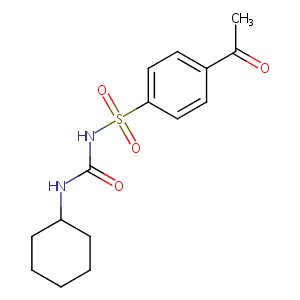
Acetohexamide Atenolol
Indication
Disease Entry Status REF
Chronic myelogenous leukemia Investigative [1]
Component Drugs Acetohexamide   DMR6N7H Atenolol   DMNKG1Z
Small molecular drug Small molecular drug
2D MOL 2D MOL
3D MOL 3D MOL
High-throughput Screening Result Testing Cell Line: KBM-7
Zero Interaction Potency (ZIP) Score: 21.78
Bliss Independence Score: 21.78
Loewe Additivity Score: 35.01
LHighest Single Agent (HSA) Score: 35.01

Molecular Interaction Atlas of This Drug Combination

Molecular Interaction Atlas (MIA)
Indication(s) of Acetohexamide
Disease Entry ICD 11 Status REF
Diabetic complication 5A2Y Approved [2]
Acetohexamide Interacts with 1 DTT Molecule(s)
DTT Name DTT ID UniProt ID Mode of Action REF
ATP-binding cassette transporter C8 (ABCC8) TTP835K ABCC8_HUMAN Modulator [5]
------------------------------------------------------------------------------------
Acetohexamide Interacts with 2 DME Molecule(s)
DME Name DME ID UniProt ID Mode of Action REF
Cytochrome P450 2C9 (CYP2C9) DE5IED8 CP2C9_HUMAN Metabolism [6]
Short-chain dehydrogenase/reductase retSDR1 (DHRS3) DEXPVUN DHRS3_HUMAN Metabolism [7]
------------------------------------------------------------------------------------
Acetohexamide Interacts with 2 DOT Molecule(s)
DOT Name DOT ID UniProt ID Mode of Action REF
Albumin (ALB) OTVMM513 ALBU_HUMAN Affects Binding [8]
Carbonyl reductase 3 (CBR3) OT9G6SF0 CBR3_HUMAN Increases ADR [9]
------------------------------------------------------------------------------------
Indication(s) of Atenolol
Disease Entry ICD 11 Status REF
Angina pectoris BA40 Approved [3]
Hypertension BA00-BA04 Approved [4]
Malignant essential hypertension BA00 Approved [3]
Myocardial infarction BA41-BA43 Approved [3]
Atenolol Interacts with 1 DTT Molecule(s)
DTT Name DTT ID UniProt ID Mode of Action REF
Adrenergic receptor beta-1 (ADRB1) TTR6W5O ADRB1_HUMAN Antagonist [11]
------------------------------------------------------------------------------------
Atenolol Interacts with 3 DTP Molecule(s)
DTP Name DTP ID UniProt ID Mode of Action REF
P-glycoprotein 1 (ABCB1) DTUGYRD MDR1_HUMAN Substrate [12]
Organic cation transporter 1 (SLC22A1) DTT79CX S22A1_HUMAN Substrate [13]
Organic anion transporting polypeptide 1A2 (SLCO1A2) DTE2B1D SO1A2_HUMAN Substrate [14]
------------------------------------------------------------------------------------
Atenolol Interacts with 2 DME Molecule(s)
DME Name DME ID UniProt ID Mode of Action REF
Cytochrome P450 3A4 (CYP3A4) DE4LYSA CP3A4_HUMAN Metabolism [15]
Cytochrome P450 2D6 (CYP2D6) DECB0K3 CP2D6_HUMAN Metabolism [16]
------------------------------------------------------------------------------------
Atenolol Interacts with 16 DOT Molecule(s)
DOT Name DOT ID UniProt ID Mode of Action REF
Bile salt export pump (ABCB11) OTRU7THO ABCBB_HUMAN Decreases Activity [17]
Renin (REN) OT52GZR2 RENI_HUMAN Decreases Activity [18]
Natriuretic peptides A (NPPA) OTMQNTNX ANF_HUMAN Decreases Expression [19]
Beta-2 adrenergic receptor (ADRB2) OTSDOX4Q ADRB2_HUMAN Increases Expression [20]
Natriuretic peptides B (NPPB) OTSN2IPY ANFB_HUMAN Increases Expression [21]
Reduced folate transporter (SLC19A1) OTWB0BTO S19A1_HUMAN Decreases Expression [22]
Sodium- and chloride-dependent creatine transporter 1 (SLC6A8) OT88C8JA SC6A8_HUMAN Decreases Expression [10]
Small nuclear ribonucleoprotein-associated protein N (SNRPN) OTQB1ID1 RSMN_HUMAN Increases Expression [10]
Peptidyl-prolyl cis-trans isomerase FKBP5 (FKBP5) OT404F9K FKBP5_HUMAN Decreases Expression [10]
Solute carrier organic anion transporter family member 4C1 (SLCO4C1) OTVILUUN SO4C1_HUMAN Increases Expression [10]
C-type lectin domain family 2 member B (CLEC2B) OT0W0M0L CLC2B_HUMAN Increases Expression [10]
Ryanodine receptor 2 (RYR2) OT0PF19E RYR2_HUMAN Increases Activity [23]
Voltage-dependent L-type calcium channel subunit alpha-1C (CACNA1C) OT6KFNMS CAC1C_HUMAN Increases Response To Substance [24]
Sodium channel protein type 5 subunit alpha (SCN5A) OTGYZWR6 SCN5A_HUMAN Increases ADR [9]
Alpha-2A adrenergic receptor (ADRA2A) OTZFGOTP ADA2A_HUMAN Affects Response To Substance [25]
Potassium voltage-gated channel subfamily E member 1 (KCNE1) OTZNQUW9 KCNE1_HUMAN Increases ADR [9]
------------------------------------------------------------------------------------
⏷ Show the Full List of 16 DOT(s)

References

1 CheMBL Affinity Phenotypic Cellular Interaction Assay ID: CHEMBL1125966
2 URL: http://www.guidetopharmacology.org Nucleic Acids Res. 2015 Oct 12. pii: gkv1037. The IUPHAR/BPS Guide to PHARMACOLOGY in 2016: towards curated quantitative interactions between 1300 protein targets and 6000 ligands. (Ligand id: 6793).
3 Atenolol FDA Label
4 URL: http://www.guidetopharmacology.org Nucleic Acids Res. 2015 Oct 12. pii: gkv1037. The IUPHAR/BPS Guide to PHARMACOLOGY in 2016: towards curated quantitative interactions between 1300 protein targets and 6000 ligands. (Ligand id: 548).
5 Diabetes and insulin secretion: the ATP-sensitive K+ channel (K ATP) connection.Diabetes.2005 Nov;54(11):3065-72.
6 Clinically and pharmacologically relevant interactions of antidiabetic drugs. Ther Adv Endocrinol Metab. 2016 Apr;7(2):69-83.
7 Molecular and biochemical characterisation of human short-chain dehydrogenase/reductase member 3 (DHRS3). Chem Biol Interact. 2015 Jun 5;234:178-87.
8 Characterization of the binding of sulfonylurea drugs to HSA by high-performance affinity chromatography. J Chromatogr B Analyt Technol Biomed Life Sci. 2010 Jun 1;878(19):1590-8. doi: 10.1016/j.jchromb.2010.04.019.
9 ADReCS-Target: target profiles for aiding drug safety research and application. Nucleic Acids Res. 2018 Jan 4;46(D1):D911-D917. doi: 10.1093/nar/gkx899.
10 Change in mRNA Expression after Atenolol, a Beta-adrenergic Receptor Antagonist and Association with Pharmacological Response. Arch Drug Inf. 2009 Sep;2(3):41-50. doi: 10.1111/j.1753-5174.2009.00020.x.
11 Prediction and experimental validation of acute toxicity of beta-blockers in Ceriodaphnia dubia. Environ Toxicol Chem. 2005 Oct;24(10):2470-6.
12 Interaction of digoxin with antihypertensive drugs via MDR1. Life Sci. 2002 Feb 15;70(13):1491-500.
13 Identification of novel substrates and structure-activity relationship of cellular uptake mediated by human organic cation transporters 1 and 2. J Med Chem. 2013 Sep 26;56(18):7232-42.
14 Fruit juice inhibition of uptake transport: a new type of food-drug interaction. Br J Clin Pharmacol. 2010 Nov;70(5):645-55.
15 Metabolism of atenolol in man. Xenobiotica. 1978 May;8(5):313-20.
16 Application of substrate depletion assay to evaluation of CYP isoforms responsible for stereoselective metabolism of carvedilol. Drug Metab Pharmacokinet. 2016 Dec;31(6):425-432.
17 Early identification of clinically relevant drug interactions with the human bile salt export pump (BSEP/ABCB11). Toxicol Sci. 2013 Dec;136(2):328-43.
18 Effects of the direct renin inhibitor aliskiren and atenolol alone or in combination in patients with hypertension. J Renin Angiotensin Aldosterone Syst. 2008 Sep;9(3):163-75. doi: 10.1177/1470320308096411.
19 Atenolol improves ventricular function without changing plasma noradrenaline but decreasing plasma atrial natriuretic factor in chronic heart failure. Auton Autacoid Pharmacol. 2002 Oct-Dec;22(5-6):261-8. doi: 10.1046/j.1474-8673.2002.00266.x.
20 Atenolol-induced regulation of leukocyte beta 2-adrenoceptors in hypertension. Pharmacology. 1984;29(4):210-4. doi: 10.1159/000138015.
21 A comparison of atenolol and nebivolol in isolated systolic hypertension. J Hypertens. 2008 Feb;26(2):351-6. doi: 10.1097/HJH.0b013e3282f283c9.
22 Folic acid uptake by the human syncytiotrophoblast: interference by pharmacotherapy, drugs of abuse and pathological conditions. Reprod Toxicol. 2009 Dec;28(4):511-20. doi: 10.1016/j.reprotox.2009.07.001. Epub 2009 Jul 16.
23 Beta-blockers restore calcium release channel function and improve cardiac muscle performance in human heart failure. Circulation. 2003 May 20;107(19):2459-66. doi: 10.1161/01.CIR.0000068316.53218.49. Epub 2003 May 12.
24 CACNA1C gene polymorphisms, cardiovascular disease outcomes, and treatment response. Circ Cardiovasc Genet. 2009 Aug;2(4):362-70. doi: 10.1161/CIRCGENETICS.109.857839. Epub 2009 Jun 3.
25 Single nucleotide polymorphisms predict the change in left ventricular mass in response to antihypertensive treatment. J Hypertens. 2004 Dec;22(12):2321-8. doi: 10.1097/00004872-200412000-00014.