General Information of Drug Combination (ID: DCELEVM)

Drug Combination Name
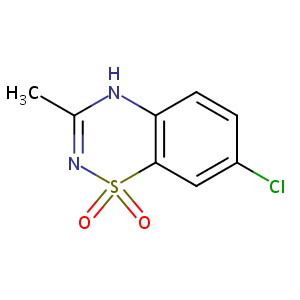
Diazoxide Pomalidomide
Indication
Disease Entry Status REF
Chronic myelogenous leukemia Investigative [1]
Component Drugs Diazoxide   DML1538 Pomalidomide   DMTGBAX
Small molecular drug Small molecular drug
2D MOL 2D MOL
3D MOL 3D MOL
High-throughput Screening Result Testing Cell Line: KBM-7
Zero Interaction Potency (ZIP) Score: 2.09
Bliss Independence Score: 2.09
Loewe Additivity Score: 2.52
LHighest Single Agent (HSA) Score: 2.52

Molecular Interaction Atlas of This Drug Combination

Molecular Interaction Atlas (MIA)
Indication(s) of Diazoxide
Disease Entry ICD 11 Status REF
Congenital hyperinsulinism 5A4Y Approved [2]
Hyperinsulinemia 5A4Y Approved [2]
Hypertension BA00-BA04 Approved [3]
Hypertensive emergency BA03 Approved [2]
Insulinoma 2C10.1 Approved [2]
Malignant essential hypertension BA00 Approved [2]
Diazoxide Interacts with 1 DTT Molecule(s)
DTT Name DTT ID UniProt ID Mode of Action REF
Potassium channel unspecific (KC) TT1VOHK NOUNIPROTAC Modulator [6]
------------------------------------------------------------------------------------
Diazoxide Interacts with 3 DOT Molecule(s)
DOT Name DOT ID UniProt ID Mode of Action REF
Nuclear factor NF-kappa-B p105 subunit (NFKB1) OTNRRD8I NFKB1_HUMAN Increases Activity [7]
Catenin beta-1 (CTNNB1) OTZ932A3 CTNB1_HUMAN Decreases Expression [8]
Bcl-2-like protein 1 (BCL2L1) OTRC5K9O B2CL1_HUMAN Increases Expression [7]
------------------------------------------------------------------------------------
Indication(s) of Pomalidomide
Disease Entry ICD 11 Status REF
Plasma cell myeloma 2A83.1 Approved [4]
Systemic sclerosis 4A42 Approved [5]
Pomalidomide Interacts with 1 DTT Molecule(s)
DTT Name DTT ID UniProt ID Mode of Action REF
Angiogenesis/myeloma cell growth (AMCG) TTDIBYJ NOUNIPROTAC Modulator [9]
------------------------------------------------------------------------------------
Pomalidomide Interacts with 1 DTP Molecule(s)
DTP Name DTP ID UniProt ID Mode of Action REF
P-glycoprotein 1 (ABCB1) DTUGYRD MDR1_HUMAN Substrate [10]
------------------------------------------------------------------------------------
Pomalidomide Interacts with 2 DME Molecule(s)
DME Name DME ID UniProt ID Mode of Action REF
Cytochrome P450 3A4 (CYP3A4) DE4LYSA CP3A4_HUMAN Metabolism [11]
Cytochrome P450 1A2 (CYP1A2) DEJGDUW CP1A2_HUMAN Metabolism [12]
------------------------------------------------------------------------------------
Pomalidomide Interacts with 15 DOT Molecule(s)
DOT Name DOT ID UniProt ID Mode of Action REF
C-C motif chemokine 2 (CCL2) OTAD2HEL CCL2_HUMAN Increases Secretion [13]
Erythroid transcription factor (GATA1) OTX1R7O1 GATA1_HUMAN Decreases Expression [13]
Transcription factor JunD (JUND) OTNKACJD JUND_HUMAN Decreases Expression [13]
Transcription factor PU.1 (SPI1) OTVCA1D0 SPI1_HUMAN Increases Expression [13]
Endothelial transcription factor GATA-2 (GATA2) OTBP2QQ2 GATA2_HUMAN Decreases Expression [13]
DNA-binding protein inhibitor ID-1 (ID1) OTKGNZN5 ID1_HUMAN Increases Expression [13]
CCAAT/enhancer-binding protein alpha (CEBPA) OTOM9OE4 CEBPA_HUMAN Increases Expression [13]
CCAAT/enhancer-binding protein delta (CEBPD) OTNBIPMY CEBPD_HUMAN Increases Expression [13]
Krueppel-like factor 1 (KLF1) OT1FK08U KLF1_HUMAN Decreases Expression [13]
CCAAT/enhancer-binding protein epsilon (CEBPE) OTKZA25M CEBPE_HUMAN Increases Expression [13]
Transcription factor NF-E2 45 kDa subunit (NFE2) OTLM94BI NFE2_HUMAN Decreases Expression [13]
Zinc finger protein Gfi-1b (GFI1B) OTRDW8YO GFI1B_HUMAN Decreases Expression [13]
Zinc finger protein Gfi-1 (GFI1) OT9HB9H8 GFI1_HUMAN Increases Expression [13]
Sal-like protein 4 (SALL4) OTC08PR5 SALL4_HUMAN Affects Binding [14]
Cytochrome P450 2C19 (CYP2C19) OTFMJYYE CP2CJ_HUMAN Increases Oxidation [15]
------------------------------------------------------------------------------------
⏷ Show the Full List of 15 DOT(s)

References

1 CheMBL Affinity Phenotypic Cellular Interaction Assay ID: CHEMBL1125966
2 Diazoxide FDA Label
3 URL: http://www.guidetopharmacology.org Nucleic Acids Res. 2015 Oct 12. pii: gkv1037. The IUPHAR/BPS Guide to PHARMACOLOGY in 2016: towards curated quantitative interactions between 1300 protein targets and 6000 ligands. (Ligand id: 2409).
4 Pomalidomide FDA Label
5 URL: http://www.guidetopharmacology.org Nucleic Acids Res. 2015 Oct 12. pii: gkv1037. The IUPHAR/BPS Guide to PHARMACOLOGY in 2016: towards curated quantitative interactions between 1300 protein targets and 6000 ligands. (Ligand id: 7348).
6 Drugs@FDA. U.S. Food and Drug Administration. U.S. Department of Health & Human Services.
7 Diazoxide-mediated preconditioning against apoptosis involves activation of cAMP-response element-binding protein (CREB) and NFkappaB. J Biol Chem. 2004 Nov 5;279(45):46748-54. doi: 10.1074/jbc.M406217200. Epub 2004 Aug 23.
8 Diazoxide-mediated growth inhibition in human lung cancer cells via downregulation of beta-catenin-mediated cyclin D1 transcription. Lung. 2009 Jan-Feb;187(1):61-7. doi: 10.1007/s00408-008-9127-1. Epub 2008 Dec 4.
9 Radium 223 dichloride for prostate cancer treatment. Drug Des Devel Ther. 2017 Sep 6;11:2643-2651.
10 DrugBank 5.0: a major update to the DrugBank database for 2018. Nucleic Acids Res. 2018 Jan 4;46(D1):D1074-D1082. (ID: DB08910)
11 Pomalidomide: evaluation of cytochrome P450 and transporter-mediated drug-drug interaction potential in vitro and in healthy subjects. J Clin Pharmacol. 2015 Feb;55(2):168-78.
12 Population pharmacokinetics of pomalidomide. J Clin Pharmacol. 2015 May;55(5):563-72.
13 Immunomodulatory derivative of thalidomide (IMiD CC-4047) induces a shift in lineage commitment by suppressing erythropoiesis and promoting myelopoiesis. Blood. 2005 May 15;105(10):3833-40. doi: 10.1182/blood-2004-03-0828. Epub 2004 Aug 3.
14 Thalidomide promotes degradation of SALL4, a transcription factor implicated in Duane Radial Ray syndrome. Elife. 2018 Aug 1;7:e38430. doi: 10.7554/eLife.38430.
15 Human cytochrome P450 oxidation of 5-hydroxythalidomide and pomalidomide, an amino analogue of thalidomide. Chem Res Toxicol. 2014 Jan 21;27(1):147-56. doi: 10.1021/tx4004215. Epub 2013 Dec 24.