General Information of Drug Combination (ID: DCFQJ0R)

Drug Combination Name
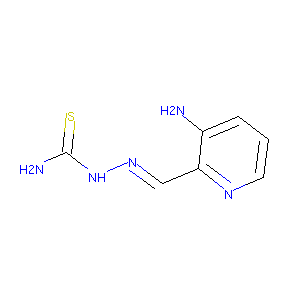
Triapine Plicamycin
Indication
Disease Entry Status REF
Glioma Investigative [1]
Component Drugs Triapine   DM7XZY5 Plicamycin   DM7C8YV
Small molecular drug Small molecular drug
2D MOL 2D MOL
3D MOL 3D MOL is unavailable
High-throughput Screening Result Testing Cell Line: SF-295
Zero Interaction Potency (ZIP) Score: 1.18
Bliss Independence Score: 3.13
Loewe Additivity Score: 0.57
LHighest Single Agent (HSA) Score: 0.43

Molecular Interaction Atlas of This Drug Combination

Molecular Interaction Atlas (MIA)
Indication(s) of Triapine
Disease Entry ICD 11 Status REF
Nerve injury ND56.4 Phase 2 [2]
Triapine Interacts with 1 DTT Molecule(s)
DTT Name DTT ID UniProt ID Mode of Action REF
Ribonucleoside-diphosphate reductase M2 (RRM2) TTBWDI0 RIR2_HUMAN Modulator [2]
------------------------------------------------------------------------------------
Triapine Interacts with 2 DOT Molecule(s)
DOT Name DOT ID UniProt ID Mode of Action REF
Histone H2AX (H2AX) OT18UX57 H2AX_HUMAN Increases Expression [7]
Thioredoxin-dependent peroxide reductase, mitochondrial (PRDX3) OTLB2WEU PRDX3_HUMAN Increases Oxidation [6]
------------------------------------------------------------------------------------
Indication(s) of Plicamycin
Disease Entry ICD 11 Status REF
Hypercalcaemia 5B91.0 Approved [3]
Testicular cancer 2C80 Approved [3]
Solid tumour/cancer 2A00-2F9Z Withdrawn from market [4]
Lung cancer 2C25.0 Investigative [5]
Ovarian cancer 2C73 Investigative [5]
Plicamycin Interacts with 1 DTT Molecule(s)
DTT Name DTT ID UniProt ID Mode of Action REF
RNA synthesis (hRNA synth) TTX2AYW NOUNIPROTAC Modulator [9]
------------------------------------------------------------------------------------
Plicamycin Interacts with 8 DOT Molecule(s)
DOT Name DOT ID UniProt ID Mode of Action REF
17-beta-hydroxysteroid dehydrogenase type 2 (HSD17B2) OT3K7HY5 DHB2_HUMAN Decreases Expression [10]
Baculoviral IAP repeat-containing protein 5 (BIRC5) OTILXZYL BIRC5_HUMAN Decreases Expression [11]
Proto-oncogene tyrosine-protein kinase Src (SRC) OTETYX40 SRC_HUMAN Decreases Expression [12]
Tyrosine-protein kinase receptor UFO (AXL) OTKA2SUX UFO_HUMAN Decreases Expression [13]
Transcription factor Sp3 (SP3) OTYDQZ1T SP3_HUMAN Decreases Expression [8]
Epidermal growth factor receptor kinase substrate 8 (EPS8) OTZ6ES6V EPS8_HUMAN Decreases Expression [12]
TNFAIP3-interacting protein 1 (TNIP1) OTRAOTEW TNIP1_HUMAN Decreases Expression [14]
Sphingomyelin phosphodiesterase 3 (SMPD3) OTHQBETH NSMA2_HUMAN Decreases Expression [15]
------------------------------------------------------------------------------------
⏷ Show the Full List of 8 DOT(s)

Test Results of This Drug Combination in Other Disease Systems

Indication DrugCom ID Cell Line Status REF
Colon adenocarcinoma DCFSTII COLO 205 Investigative [16]
Adenocarcinoma DCHGVTS A549 Investigative [1]
Cutaneous melanoma DCMS7SF SK-MEL-5 Investigative [1]
Cutaneous melanoma DCGRKRJ SK-MEL-28 Investigative [1]
Glioblastoma DCBW9UE SNB-75 Investigative [1]
Glioma DCD6281 SF-539 Investigative [1]
Large cell lung carcinoma DC7EGTV NCI-H460 Investigative [1]
Malignant melanoma DC23E9L LOX IMVI Investigative [1]
Melanoma DC71BCQ MALME-3M Investigative [1]
------------------------------------------------------------------------------------
⏷ Show the Full List of 9 DrugCom(s)

References

1 CheMBL Affinity Phenotypic Cellular Interaction Assay ID: CHEMBL1125976
2 PAN-811 inhibits oxidative stress-induced cell death of human Alzheimer's disease-derived and age-matched olfactory neuroepithelial cells via suppression of intracellular reactive oxygen species. J Alzheimers Dis. 2009;17(3):611-9.
3 Drugs@FDA. U.S. Food and Drug Administration. U.S. Department of Health & Human Services. 2015
4 URL: http://www.guidetopharmacology.org Nucleic Acids Res. 2015 Oct 12. pii: gkv1037. The IUPHAR/BPS Guide to PHARMACOLOGY in 2016: towards curated quantitative interactions between 1300 protein targets and 6000 ligands. (Ligand id: 8394).
5 The Pluripotency Factor Musashi-2 Is a Novel Target for Lung Cancer Therapy.Ann Am Thorac Soc. 2018 Apr;15(Supplement_2):S124.
6 The iron-chelating drug triapine causes pronounced mitochondrial thiol redox stress. Toxicol Lett. 2011 Mar 5;201(2):130-6. doi: 10.1016/j.toxlet.2010.12.017. Epub 2010 Dec 31.
7 Distinct mechanisms of cell-kill by triapine and its terminally dimethylated derivative Dp44mT due to a loss or gain of activity of their copper(II) complexes. Biochem Pharmacol. 2014 Oct 1;91(3):312-22. doi: 10.1016/j.bcp.2014.08.006. Epub 2014 Aug 15.
8 The activity of a novel mithramycin analog is related to its binding to DNA, cellular accumulation, and inhibition of Sp1-driven gene transcription. Chem Biol Interact. 2014 Aug 5;219:123-32. doi: 10.1016/j.cbi.2014.05.019. Epub 2014 Jun 4.
9 Role of magnesium ion in mithramycin-DNA interaction: binding of mithramycin-Mg2+ complexes with DNA. Biochemistry. 1995 Jan 31;34(4):1376-85.
10 SP1 and SP3 mediate progesterone-dependent induction of the 17beta hydroxysteroid dehydrogenase type 2 gene in human endometrium. Biol Reprod. 2006 Oct;75(4):605-14.
11 Molecular mechanisms of transactivation and doxorubicin-mediated repression of survivin gene in cancer cells. J Biol Chem. 2007 Jan 26;282(4):2615-25. doi: 10.1074/jbc.M606203200. Epub 2006 Nov 22.
12 Mithramycin inhibits human epithelial carcinoma cell proliferation and migration involving downregulation of Eps8 expression. Chem Biol Interact. 2010 Jan 5;183(1):181-6. doi: 10.1016/j.cbi.2009.09.018.
13 The human receptor tyrosine kinase Axl gene--promoter characterization and regulation of constitutive expression by Sp1, Sp3 and CpG methylation. Biosci Rep. 2008 Jun;28(3):161-76. doi: 10.1042/BSR20080046.
14 Sp sites contribute to basal and inducible expression of the human TNIP1 (TNF-inducible protein 3-interacting protein 1) promoter. Biochem J. 2013 Jun 15;452(3):519-29. doi: 10.1042/BJ20121666.
15 Transcriptional regulation of neutral sphingomyelinase 2 gene expression of a human breast cancer cell line, MCF-7, induced by the anti-cancer drug, daunorubicin. Biochim Biophys Acta. 2009 Nov-Dec;1789(11-12):681-90. doi: 10.1016/j.bbagrm.2009.08.006. Epub 2009 Aug 19.
16 CheMBL Affinity Phenotypic Cellular Interaction Assay ID: CHEMBL1126165