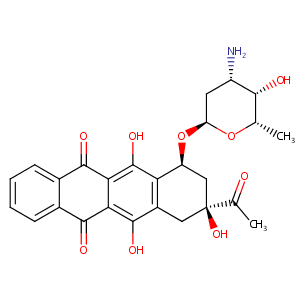
General Information of Drug Combination (ID: DCGLLP7)

Drug Combination Name
Penicillamine Idarubicin
Indication
Disease Entry Status REF
Glioblastoma? Investigative [1]
Component Drugs Penicillamine   DM40EF6 Idarubicin   DMM0XGL
Small molecular drug Small molecular drug
2D MOL 2D MOL
3D MOL 3D MOL
High-throughput Screening Result Testing Cell Line: T98G
Zero Interaction Potency (ZIP) Score: 21.24
Bliss Independence Score: 21.24
Loewe Additivity Score: 7.8
LHighest Single Agent (HSA) Score: 7.8

Molecular Interaction Atlas of This Drug Combination

Molecular Interaction Atlas (MIA)
Indication(s) of Penicillamine
Disease Entry ICD 11 Status REF
Cystinuria 5C60.2 Approved [2]
Rheumatoid arthritis FA20 Approved [3]
Wilson disease 5C64.00 Investigative [2]
Penicillamine Interacts with 1 DTT Molecule(s)
DTT Name DTT ID UniProt ID Mode of Action REF
Human immunodeficiency virus Tat protein (HIV tat) TTT3ZC9 TAT_HV1H2 Inhibitor [7]
------------------------------------------------------------------------------------
Penicillamine Interacts with 24 DOT Molecule(s)
DOT Name DOT ID UniProt ID Mode of Action REF
Elastin (ELN) OTFSO7PG ELN_HUMAN Affects Localization [8]
Collagen alpha-1(I) chain (COL1A1) OTI31178 CO1A1_HUMAN Increases ADR [9]
Eukaryotic translation initiation factor 2 subunit 1 (EIF2S1) OTM0GDTP IF2A_HUMAN Increases Phosphorylation [10]
Poly polymerase 1 (PARP1) OT310QSG PARP1_HUMAN Increases Cleavage [10]
C-C motif chemokine 3 (CCL3) OTW2H3ND CCL3_HUMAN Increases Expression [10]
C-C motif chemokine 4 (CCL4) OT6B8P25 CCL4_HUMAN Increases Expression [10]
Heat shock 70 kDa protein 6 (HSPA6) OTH4S7WB HSP76_HUMAN Increases Expression [10]
Glutathione S-transferase Mu 3 (GSTM3) OTLA2WJT GSTM3_HUMAN Increases Expression [10]
Growth arrest and DNA damage-inducible protein GADD45 alpha (GADD45A) OTDRV63V GA45A_HUMAN Increases Expression [10]
Heat shock 70 kDa protein 1-like (HSPA1L) OTC2V1K6 HS71L_HUMAN Increases Expression [10]
DNA damage-inducible transcript 3 protein (DDIT3) OTI8YKKE DDIT3_HUMAN Increases Expression [10]
Flavin-containing monooxygenase 5 (FMO5) OTTILF8T FMO5_HUMAN Increases Expression [10]
Heat shock-related 70 kDa protein 2 (HSPA2) OTSDET7B HSP72_HUMAN Increases Expression [10]
Flavin-containing monooxygenase 1 (FMO1) OTTHSQKP FMO1_HUMAN Increases Expression [10]
Phorbol-12-myristate-13-acetate-induced protein 1 (PMAIP1) OTXEE550 APR_HUMAN Increases Expression [10]
Bcl-2-binding component 3, isoforms 3/4 (BBC3) OTUAXDAY BBC3B_HUMAN Decreases Expression [10]
High affinity copper uptake protein 1 (SLC31A1) OTXLRTUB COPT1_HUMAN Increases Expression [11]
C-reactive protein (CRP) OT0RFT8F CRP_HUMAN Decreases Expression [12]
Amyloid-beta precursor protein (APP) OTKFD7R4 A4_HUMAN Increases Metabolism [13]
Metallothionein-1X (MT1X) OT9AKFVS MT1X_HUMAN Decreases Expression [14]
MHC class I antigen (HLA-B) OTGPIQEH O19755_HUMAN Increases ADR [9]
MHC class I antigen HLA-B18 (HLA-B18) OTO1T7OA O77967_HUMAN Increases ADR [9]
HLA-DR4 protein (HLA-DR4) OTR8MHXB O77963_HUMAN Increases ADR [9]
HLA-DR3 (HLA-DRB1) OTZ84GNP Q29887_HUMAN Increases ADR [9]
------------------------------------------------------------------------------------
⏷ Show the Full List of 24 DOT(s)
Indication(s) of Idarubicin
Disease Entry ICD 11 Status REF
Acute myelogenous leukaemia 2A41 Approved [4]
Acute myeloid leukaemia 2A60 Approved [5]
Adult acute monocytic leukemia N.A. Approved [4]
Childhood acute megakaryoblastic leukemia N.A. Approved [4]
Leukemia N.A. Approved [4]
Idarubicin Interacts with 1 DTT Molecule(s)
DTT Name DTT ID UniProt ID Mode of Action REF
DNA topoisomerase II (TOP2) TT0IHXV TOP2A_HUMAN; TOP2B_HUMAN Modulator [16]
------------------------------------------------------------------------------------
Idarubicin Interacts with 3 DTP Molecule(s)
DTP Name DTP ID UniProt ID Mode of Action REF
Multidrug resistance-associated protein 1 (ABCC1) DTSYQGK MRP1_HUMAN Substrate [17]
P-glycoprotein 1 (ABCB1) DTUGYRD MDR1_HUMAN Substrate [18]
Breast cancer resistance protein (ABCG2) DTI7UX6 ABCG2_HUMAN Substrate [18]
------------------------------------------------------------------------------------
Idarubicin Interacts with 2 DME Molecule(s)
DME Name DME ID UniProt ID Mode of Action REF
Cytochrome P450 2D6 (CYP2D6) DECB0K3 CP2D6_HUMAN Metabolism [19]
Cytochrome P450 2C9 (CYP2C9) DE5IED8 CP2C9_HUMAN Metabolism [19]
------------------------------------------------------------------------------------
Idarubicin Interacts with 2 DOT Molecule(s)
DOT Name DOT ID UniProt ID Mode of Action REF
Natriuretic peptides B (NPPB) OTSN2IPY ANFB_HUMAN Increases Expression [20]
Bile acid receptor (NR1H4) OTWZLPTB NR1H4_HUMAN Decreases Activity [15]
------------------------------------------------------------------------------------

References

1 CheMBL Affinity Phenotypic Cellular Interaction Assay ID: CHEMBL1125966
2 Penicillamine FDA Label
3 URL: http://www.guidetopharmacology.org Nucleic Acids Res. 2015 Oct 12. pii: gkv1037. The IUPHAR/BPS Guide to PHARMACOLOGY in 2016: towards curated quantitative interactions between 1300 protein targets and 6000 ligands. (Ligand id: 7264).
4 Idarubicin FDA Label
5 URL: http://www.guidetopharmacology.org Nucleic Acids Res. 2015 Oct 12. pii: gkv1037. The IUPHAR/BPS Guide to PHARMACOLOGY in 2016: towards curated quantitative interactions between 1300 protein targets and 6000 ligands. (Ligand id: 7083).
6 N-acetyl cysteine and penicillamine induce apoptosis via the ER stress response-signaling pathway. Mol Carcinog. 2010 Jan;49(1):68-74. doi: 10.1002/mc.20578.
7 Docking studies reveal a selective binding of D-penicillamine to the transactivator protein of human immunodeficiency virus type 1. FEBS Lett. 2002 Apr 10;516(1-3):43-6.
8 Collagen and elastin changes in D-penicillamine-induced pseudoxanthoma elasticum-like skin. Br J Dermatol. 1986 Mar;114(3):381-8. doi: 10.1111/j.1365-2133.1986.tb02832.x.
9 ADReCS-Target: target profiles for aiding drug safety research and application. Nucleic Acids Res. 2018 Jan 4;46(D1):D911-D917. doi: 10.1093/nar/gkx899.
10 D-Penicillamine targets metastatic melanoma cells with induction of the unfolded protein response (UPR) and Noxa (PMAIP1)-dependent mitochondrial apoptosis. Apoptosis. 2012 Oct;17(10):1079-94.
11 Mechanistic basis for overcoming platinum resistance using copper chelating agents. Mol Cancer Ther. 2012 Nov;11(11):2483-94. doi: 10.1158/1535-7163.MCT-12-0580. Epub 2012 Aug 21.
12 The influence of alclofenac treatment on acute-phase proteins, plasma tryptophan, and erythrocyte sedimentation rate in patients with rheumatoid arthritis. Curr Med Res Opin. 1975;3(5):286-97. doi: 10.1185/03007997509114779.
13 Chelation and intercalation: complementary properties in a compound for the treatment of Alzheimer's disease. J Struct Biol. 2000 Jun;130(2-3):209-16. doi: 10.1006/jsbi.2000.4285.
14 The effect of zinc and D-penicillamine in a stable human hepatoma ATP7B knockout cell line. PLoS One. 2014 Jun 3;9(6):e98809. doi: 10.1371/journal.pone.0098809. eCollection 2014.
15 Quantitative high-throughput profiling of environmental chemicals and drugs that modulate farnesoid X receptor. Sci Rep. 2014 Sep 26;4:6437. doi: 10.1038/srep06437.
16 Drugs@FDA. U.S. Food and Drug Administration. U.S. Department of Health & Human Services.
17 Human intestinal transporter database: QSAR modeling and virtual profiling of drug uptake, efflux and interactions. Pharm Res. 2013 Apr;30(4):996-1007.
18 Amonafide L-malate is not a substrate for multidrug resistance proteins in secondary acute myeloid leukemia. Leukemia. 2008 Nov;22(11):2110-5.
19 In vitro evaluation of cytochrome P450-mediated drug interactions between cytarabine, idarubicin, itraconazole and caspofungin. Hematology. 2004 Jun;9(3):217-21.
20 The use of biochemical markers in cardiotoxicity monitoring in patients treated for leukemia. Neoplasma. 2005;52(5):430-4.