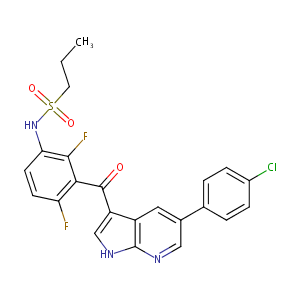
General Information of Drug Combination (ID: DCHLJYT)

Drug Combination Name
Vemurafenib Mercaptopurine
Indication
Disease Entry Status REF
Malignant melanoma Investigative [1]
Component Drugs Vemurafenib   DM62UG5 Mercaptopurine   DMTM2IK
Small molecular drug Small molecular drug
2D MOL 2D MOL
3D MOL 3D MOL
High-throughput Screening Result Testing Cell Line: LOX IMVI
Zero Interaction Potency (ZIP) Score: 5.92
Bliss Independence Score: 6.08
Loewe Additivity Score: 7.5
LHighest Single Agent (HSA) Score: 10.7

Molecular Interaction Atlas of This Drug Combination

Molecular Interaction Atlas (MIA)
Indication(s) of Vemurafenib
Disease Entry ICD 11 Status REF
Melanoma 2C30 Approved [2]
Vemurafenib Interacts with 1 DTT Molecule(s)
DTT Name DTT ID UniProt ID Mode of Action REF
Serine/threonine-protein kinase B-raf (BRAF) TTWCGQT BRAF_HUMAN Modulator [4]
------------------------------------------------------------------------------------
Vemurafenib Interacts with 3 DTP Molecule(s)
DTP Name DTP ID UniProt ID Mode of Action REF
P-glycoprotein 1 (ABCB1) DTUGYRD MDR1_HUMAN Substrate [9]
Organic anion transporting polypeptide 1B1 (SLCO1B1) DT3D8F0 SO1B1_HUMAN Substrate [10]
Organic anion transporting polypeptide 1B3 (SLCO1B3) DT9C1TS SO1B3_HUMAN Substrate [10]
------------------------------------------------------------------------------------
Vemurafenib Interacts with 1 DME Molecule(s)
DME Name DME ID UniProt ID Mode of Action REF
Cytochrome P450 3A4 (CYP3A4) DE4LYSA CP3A4_HUMAN Metabolism [11]
------------------------------------------------------------------------------------
Vemurafenib Interacts with 8 DOT Molecule(s)
DOT Name DOT ID UniProt ID Mode of Action REF
Microphthalmia-associated transcription factor (MITF) OT6XJCZH MITF_HUMAN Affects Expression [7]
Myc proto-oncogene protein (MYC) OTPV5LUK MYC_HUMAN Decreases Expression [12]
C-C motif chemokine 2 (CCL2) OTAD2HEL CCL2_HUMAN Increases Expression [13]
Mitogen-activated protein kinase 3 (MAPK3) OTCYKGKO MK03_HUMAN Decreases Phosphorylation [8]
Mitogen-activated protein kinase 1 (MAPK1) OTH85PI5 MK01_HUMAN Decreases Phosphorylation [8]
CD70 antigen (CD70) OTHB2AL1 CD70_HUMAN Decreases Expression [14]
Melanocyte protein PMEL (PMEL) OTCDDHHM PMEL_HUMAN Increases Expression [7]
Melanoma antigen recognized by T-cells 1 (MLANA) OT1N2S2K MAR1_HUMAN Increases Expression [7]
------------------------------------------------------------------------------------
⏷ Show the Full List of 8 DOT(s)
Indication(s) of Mercaptopurine
Disease Entry ICD 11 Status REF
Acute lymphoblastic leukaemia 2A85 Approved [3]
Acute lymphocytic leukaemia 2B33.3 Approved [4]
Crohn disease DD70 Phase 4 [5]
Middle East Respiratory Syndrome (MERS) 1D64 Preclinical [6]
Severe acute respiratory syndrome (SARS) 1D65 Preclinical [6]
Mercaptopurine Interacts with 4 DTT Molecule(s)
DTT Name DTT ID UniProt ID Mode of Action REF
MERS-CoV papain-like proteinase (PL-PRO) TTYJOLE R1AB_CVEMC (854-2740) Inhibitor [6]
Inosine-5'-monophosphate dehydrogenase 1 (IMPDH1) TTL7C8Q IMDH1_HUMAN Inhibitor [17]
SARS-CoV papain-like proteinase (PL-PRO) TTRGHB2 R1AB_CVHSA (819-2740) Inhibitor [6]
Amidophosphoribosyltransferase (PPAT) TTZFTY4 PUR1_HUMAN Breaker [18]
------------------------------------------------------------------------------------
Mercaptopurine Interacts with 9 DTP Molecule(s)
DTP Name DTP ID UniProt ID Mode of Action REF
Breast cancer resistance protein (ABCG2) DTI7UX6 ABCG2_HUMAN Substrate [19]
Multidrug resistance-associated protein 4 (ABCC4) DTCSGPB MRP4_HUMAN Substrate [20]
Multidrug resistance-associated protein 5 (ABCC5) DTYVM24 MRP5_HUMAN Substrate [21]
Organic anion transporter 3 (SLC22A8) DTVP67E S22A8_HUMAN Substrate [22]
Concentrative nucleoside transporter 2 (SLC28A2) DT82KPY S28A2_HUMAN Substrate [23]
Concentrative Na(+)-nucleoside cotransporter 3 (SLC28A3) DT4YL5R S28A3_HUMAN Substrate [24]
Equilibrative nucleoside transporter 1 (SLC29A1) DTXD1TQ S29A1_HUMAN Substrate [23]
Equilibrative nucleoside transporter 2 (SLC29A2) DTW78DQ S29A2_HUMAN Substrate [23]
Equilibrative nucleobase transporter 1 (SLC43A3) DTGBPR5 S43A3_HUMAN Substrate [25]
------------------------------------------------------------------------------------
⏷ Show the Full List of 9 DTP(s)
Mercaptopurine Interacts with 3 DME Molecule(s)
DME Name DME ID UniProt ID Mode of Action REF
UDP-glucuronosyltransferase 1A1 (UGT1A1) DEYGVN4 UD11_HUMAN Metabolism [26]
Cytochrome P450 1A1 (CYP1A1) DE6OQ3W CP1A1_HUMAN Metabolism [26]
Thiopurine methyltransferase (TPMT) DEFQ8VO TPMT_HUMAN Metabolism [27]
------------------------------------------------------------------------------------
Mercaptopurine Interacts with 10 DOT Molecule(s)
DOT Name DOT ID UniProt ID Mode of Action REF
Nuclear receptor subfamily 4 group A member 3 (NR4A3) OTPBE9R1 NR4A3_HUMAN Increases ADR [28]
Superoxide dismutase , mitochondrial (SOD2) OTIWXGZ9 SODM_HUMAN Increases Expression [29]
Glutathione peroxidase 2 (GPX2) OTXI2NTI GPX2_HUMAN Increases Expression [29]
Glutathione peroxidase 3 (GPX3) OT6PK94R GPX3_HUMAN Increases Expression [29]
Transcription factor p65 (RELA) OTUJP9CN TF65_HUMAN Affects Localization [15]
Bcl-2-like protein 1 (BCL2L1) OTRC5K9O B2CL1_HUMAN Decreases Expression [15]
Molybdenum cofactor sulfurase (MOCOS) OT0TL3Q5 MOCOS_HUMAN Decreases Oxidation [30]
HLA class II histocompatibility antigen, DQ alpha 1 chain (HLA-DQA1) OTC6GISG DQA1_HUMAN Affects Response To Substance [31]
Major vault protein (MVP) OTJGHJRB MVP_HUMAN Decreases Response To Substance [32]
Nucleotide triphosphate diphosphatase NUDT15 (NUDT15) OTX8SZOT NUD15_HUMAN Increases Response To Substance [33]
------------------------------------------------------------------------------------
⏷ Show the Full List of 10 DOT(s)

Test Results of This Drug Combination in Other Disease Systems

Indication DrugCom ID Cell Line Status REF
Invasive ductal carcinoma DCNWZ09 HS 578T Investigative [34]
Anaplastic large cell lymphoma DCDXEZB SR Investigative [1]
Glioblastoma DCFLPWD SNB-75 Investigative [1]
Malignant melanoma DCR5Y1F UACC62 Investigative [1]
Minimally invasive lung adenocarcinoma DCDEKE4 NCI-H322M Investigative [1]
Papillary renal cell carcinoma DC7QOZ8 ACHN Investigative [1]
------------------------------------------------------------------------------------
⏷ Show the Full List of 6 DrugCom(s)

References

1 CheMBL Affinity Phenotypic Cellular Interaction Assay ID: CHEMBL1125976
2 URL: http://www.guidetopharmacology.org Nucleic Acids Res. 2015 Oct 12. pii: gkv1037. The IUPHAR/BPS Guide to PHARMACOLOGY in 2016: towards curated quantitative interactions between 1300 protein targets and 6000 ligands. (Ligand id: 5893).
3 URL: http://www.guidetopharmacology.org Nucleic Acids Res. 2015 Oct 12. pii: gkv1037. The IUPHAR/BPS Guide to PHARMACOLOGY in 2016: towards curated quantitative interactions between 1300 protein targets and 6000 ligands. (Ligand id: 7226).
4 Drugs@FDA. U.S. Food and Drug Administration. U.S. Department of Health & Human Services. 2015
5 ClinicalTrials.gov (NCT00846703) The GD-2008 ALL Protocol for Childhood Acute Lymphoblastic Leukemia. U.S. National Institutes of Health.
6 Thiopurine analogs and mycophenolic acid synergistically inhibit the papain-like protease of Middle East respiratory syndrome coronavirus. Antiviral Res. 2015 Mar;115:9-16.
7 PLX4032 Mediated Melanoma Associated Antigen Potentiation in Patient Derived Primary Melanoma Cells. J Cancer. 2015 Oct 29;6(12):1320-30. doi: 10.7150/jca.11126. eCollection 2015.
8 Actin remodeling confers BRAF inhibitor resistance to melanoma cells through YAP/TAZ activation. EMBO J. 2016 Mar 1;35(5):462-78. doi: 10.15252/embj.201592081. Epub 2015 Dec 14.
9 Differential effects of the oncogenic BRAF inhibitor PLX4032 (vemurafenib) and its progenitor PLX4720 on ABCB1 function. J Pharm Pharm Sci. 2014;17(1):154-68.
10 Contribution of OATP1B1 and OATP1B3 to the disposition of sorafenib and sorafenib-glucuronide. Clin Cancer Res. 2013 Mar 15;19(6):1458-66.
11 Vemurafenib for the treatment of melanoma. Expert Opin Pharmacother. 2012 Dec;13(17):2533-43.
12 Perturbation biology nominates upstream-downstream drug combinations in RAF inhibitor resistant melanoma cells. Elife. 2015 Aug 18;4:e04640. doi: 10.7554/eLife.04640.
13 Overcoming melanoma resistance to vemurafenib by targeting CCL2-induced miR-34a, miR-100 and miR-125b. Oncotarget. 2016 Jan 26;7(4):4428-41. doi: 10.18632/oncotarget.6599.
14 Melanoma Expressed-CD70 Is Regulated by RhoA and MAPK Pathways without Affecting Vemurafenib Treatment Activity. PLoS One. 2016 Feb 1;11(2):e0148095. doi: 10.1371/journal.pone.0148095. eCollection 2016.
15 CD28-dependent Rac1 activation is the molecular target of azathioprine in primary human CD4+ T lymphocytes. J Clin Invest. 2003 Apr;111(8):1133-45. doi: 10.1172/JCI16432.
16 Pharmacogenetics of outcome in children with acute lymphoblastic leukemia. Blood. 2005 Jun 15;105(12):4752-8. doi: 10.1182/blood-2004-11-4544. Epub 2005 Feb 15.
17 Clinical pharmacology and pharmacogenetics of thiopurines. Eur J Clin Pharmacol. 2008 Aug;64(8):753-67.
18 6-mercaptopurine (6-MP) induces p53-mediated apoptosis of neural progenitor cells in the developing fetal rodent brain. Neurotoxicol Teratol. 2009 Jul-Aug;31(4):198-202.
19 ABC transporters and their role in nucleoside and nucleotide drug resistance. Biochem Pharmacol. 2012 Apr 15;83(8):1073-83.
20 Polymorphisms in multidrug resistance-associated protein gene 4 is associated with outcome in childhood acute lymphoblastic leukemia. Blood. 2009 Aug 13;114(7):1383-6.
21 Overexpression of MRP4 (ABCC4) and MRP5 (ABCC5) confer resistance to the nucleoside analogs cytarabine and troxacitabine, but not gemcitabine. Springerplus. 2014 Dec 13;3:732.
22 Organic anion transporter 3 is involved in the brain-to-blood efflux transport of thiopurine nucleobase analogs. J Neurochem. 2004 Aug;90(4):931-41.
23 PharmGKB: A worldwide resource for pharmacogenomic information. Wiley Interdiscip Rev Syst Biol Med. 2018 Jul;10(4):e1417. (ID: PA2040)
24 Involvement of the concentrative nucleoside transporter 3 and equilibrative nucleoside transporter 2 in the resistance of T-lymphoblastic cell lines to thiopurines. Biochem Biophys Res Commun. 2006 Apr 28;343(1):208-15.
25 Characterization of 6-Mercaptopurine Transport by the SLC43A3-Encoded Nucleobase Transporter. Mol Pharmacol. 2019 Jun;95(6):584-596.
26 Pharmacogenomics in drug-metabolizing enzymes catalyzing anticancer drugs for personalized cancer chemotherapy. Curr Drug Metab. 2007 Aug;8(6):554-62.
27 The degree of myelosuppression during maintenance therapy of adolescents with B-lineage intermediate risk acute lymphoblastic leukemia predicts risk of relapse. Leukemia. 2010 Apr;24(4):715-20.
28 ADReCS-Target: target profiles for aiding drug safety research and application. Nucleic Acids Res. 2018 Jan 4;46(D1):D911-D917. doi: 10.1093/nar/gkx899.
29 Petit E, Langouet S, Akhdar H, Nicolas-Nicolaz C, Guillouzo A, Morel F. Differential toxic effects of azathioprine, 6-mercaptopurine and 6-thioguanine on human hepatocytes. Toxicol In Vitro. 2008;22(3):632-642. [PMID: 18222062]
30 Thiopurine-induced toxicity is associated with dysfunction variant of the human molybdenum cofactor sulfurase gene (xanthinuria type II). Toxicol Appl Pharmacol. 2018 Aug 15;353:102-108. doi: 10.1016/j.taap.2018.06.015. Epub 2018 Jun 20.
31 HLA-DQA1-HLA-DRB1 variants confer susceptibility to pancreatitis induced by thiopurine immunosuppressants. Nat Genet. 2014 Oct;46(10):1131-4. doi: 10.1038/ng.3093. Epub 2014 Sep 14.
32 Sensitization of ABCG2-overexpressing cells to conventional chemotherapeutic agent by sunitinib was associated with inhibiting the function of ABCG2. Cancer Lett. 2009 Jun 28;279(1):74-83. doi: 10.1016/j.canlet.2009.01.027. Epub 2009 Feb 18.
33 A common missense variant in NUDT15 confers susceptibility to thiopurine-induced leukopenia. Nat Genet. 2014 Sep;46(9):1017-20. doi: 10.1038/ng.3060. Epub 2014 Aug 10.
34 CheMBL Affinity Phenotypic Cellular Interaction Assay ID: CHEMBL1126165