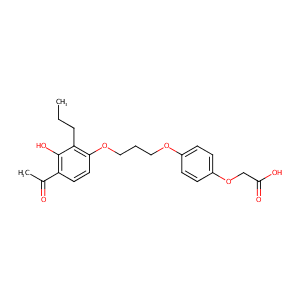
General Information of Drug Combination (ID: DCHN7VY)

Drug Combination Name
L-165041 Novobiocin
Indication
Disease Entry Status REF
Chronic myelogenous leukemia Investigative [1]
Component Drugs L-165041   DMZP7YM Novobiocin   DMRFWGK
Small molecular drug Small molecular drug
2D MOL 2D MOL
3D MOL is unavailable 3D MOL
High-throughput Screening Result Testing Cell Line: KBM-7
Zero Interaction Potency (ZIP) Score: 5.89
Bliss Independence Score: 5.89
Loewe Additivity Score: 19.89
LHighest Single Agent (HSA) Score: 19.91

Molecular Interaction Atlas of This Drug Combination

Molecular Interaction Atlas (MIA)
Indication(s) of L-165041
Disease Entry ICD 11 Status REF
Discovery agent N.A. Investigative [2]
L-165041 Interacts with 1 DTT Molecule(s)
DTT Name DTT ID UniProt ID Mode of Action REF
Peroxisome proliferator-activated receptor delta (PPARD) TT2JWF6 PPARD_HUMAN Agonist [5]
------------------------------------------------------------------------------------
L-165041 Interacts with 1 DOT Molecule(s)
DOT Name DOT ID UniProt ID Mode of Action REF
Fatty acid-binding protein, adipocyte (FABP4) OT3DKFOU FABP4_HUMAN Increases Expression [6]
------------------------------------------------------------------------------------
Indication(s) of Novobiocin
Disease Entry ICD 11 Status REF
Bacterial infection 1A00-1C4Z Approved [3]
Novobiocin Interacts with 1 DTT Molecule(s)
DTT Name DTT ID UniProt ID Mode of Action REF
DNA topoisomerase II (TOP2) TT0IHXV TOP2A_HUMAN; TOP2B_HUMAN Inhibitor [7]
------------------------------------------------------------------------------------
Novobiocin Interacts with 2 DOT Molecule(s)
DOT Name DOT ID UniProt ID Mode of Action REF
Cadherin-2 (CDH2) OTH0Y56P CADH2_HUMAN Decreases Expression [8]
Broad substrate specificity ATP-binding cassette transporter ABCG2 (ABCG2) OTW8V2V1 ABCG2_HUMAN Decreases Activity [9]
------------------------------------------------------------------------------------

References

1 CheMBL Affinity Phenotypic Cellular Interaction Assay ID: CHEMBL1125966
2 URL: http://www.guidetopharmacology.org Nucleic Acids Res. 2015 Oct 12. pii: gkv1037. The IUPHAR/BPS Guide to PHARMACOLOGY in 2016: towards curated quantitative interactions between 1300 protein targets and 6000 ligands. (Ligand id: 2691).
3 How many modes of action should an antibiotic have Curr Opin Pharmacol. 2008 Oct;8(5):564-73.
4 Keratinocyte-derived vascular endothelial growth factor biosynthesis represents a pleiotropic side effect of peroxisome proliferator-activated receptor-gamma agonist troglitazone but not rosiglitazone and involves activation of p38 mitogen-activated protein kinase: implications for diabetes-impaired skin repair. Mol Pharmacol. 2008 Oct;74(4):952-63. doi: 10.1124/mol.108.049395. Epub 2008 Jul 3.
5 Novel peroxisome proliferator-activated receptor (PPAR) gamma and PPARdelta ligands produce distinct biological effects. J Biol Chem. 1999 Mar 5;274(10):6718-25.
6 Human adipocyte fatty acid-binding protein (aP2) gene promoter-driven reporter assay discriminates nonlipogenic peroxisome proliferator-activated receptor gamma ligands. J Pharmacol Exp Ther. 2004 Nov;311(2):467-75. doi: 10.1124/jpet.104.068254. Epub 2004 Jul 23.
7 Transcriptional responses of Bacillus subtillis and thuringiensis to antibiotics and anti-tumour drugs. Int J Mol Med. 2009 Jan;23(1):33-9.
8 Novobiocin is a novel inducer of CD38 on cells of the myelomonocytic lineage. Biochim Biophys Acta. 2002 Jan 30;1542(1-3):32-40. doi: 10.1016/s0167-4889(01)00163-x.
9 Interactions between Oroxylin A with the solute carrier transporters and ATP-binding cassette transporters: Drug transporters profile for this flavonoid. Chem Biol Interact. 2020 Jun 1;324:109097. doi: 10.1016/j.cbi.2020.109097. Epub 2020 Apr 16.