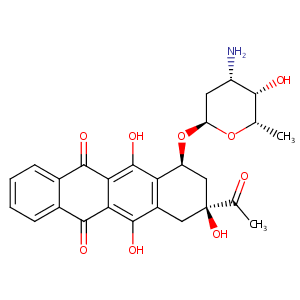
General Information of Drug Combination (ID: DCJVMU8)

Drug Combination Name
Idarubicin Repaglinide
Indication
Disease Entry Status REF
Chronic myelogenous leukemia Investigative [1]
Component Drugs Idarubicin   DMM0XGL Repaglinide   DM5SXUV
Small molecular drug Small molecular drug
2D MOL 2D MOL
3D MOL 3D MOL
High-throughput Screening Result Testing Cell Line: KBM-7
Zero Interaction Potency (ZIP) Score: 25.73
Bliss Independence Score: 25.73
Loewe Additivity Score: 33.51
LHighest Single Agent (HSA) Score: 33.52

Molecular Interaction Atlas of This Drug Combination

Molecular Interaction Atlas (MIA)
Indication(s) of Idarubicin
Disease Entry ICD 11 Status REF
Acute myelogenous leukaemia 2A41 Approved [2]
Acute myeloid leukaemia 2A60 Approved [3]
Adult acute monocytic leukemia N.A. Approved [2]
Childhood acute megakaryoblastic leukemia N.A. Approved [2]
Leukemia N.A. Approved [2]
Idarubicin Interacts with 1 DTT Molecule(s)
DTT Name DTT ID UniProt ID Mode of Action REF
DNA topoisomerase II (TOP2) TT0IHXV TOP2A_HUMAN; TOP2B_HUMAN Modulator [6]
------------------------------------------------------------------------------------
Idarubicin Interacts with 3 DTP Molecule(s)
DTP Name DTP ID UniProt ID Mode of Action REF
Multidrug resistance-associated protein 1 (ABCC1) DTSYQGK MRP1_HUMAN Substrate [7]
P-glycoprotein 1 (ABCB1) DTUGYRD MDR1_HUMAN Substrate [8]
Breast cancer resistance protein (ABCG2) DTI7UX6 ABCG2_HUMAN Substrate [8]
------------------------------------------------------------------------------------
Idarubicin Interacts with 2 DME Molecule(s)
DME Name DME ID UniProt ID Mode of Action REF
Cytochrome P450 2D6 (CYP2D6) DECB0K3 CP2D6_HUMAN Metabolism [9]
Cytochrome P450 2C9 (CYP2C9) DE5IED8 CP2C9_HUMAN Metabolism [9]
------------------------------------------------------------------------------------
Idarubicin Interacts with 2 DOT Molecule(s)
DOT Name DOT ID UniProt ID Mode of Action REF
Natriuretic peptides B (NPPB) OTSN2IPY ANFB_HUMAN Increases Expression [10]
Bile acid receptor (NR1H4) OTWZLPTB NR1H4_HUMAN Decreases Activity [5]
------------------------------------------------------------------------------------
Indication(s) of Repaglinide
Disease Entry ICD 11 Status REF
Diabetic complication 5A2Y Approved [4]
Repaglinide Interacts with 2 DTT Molecule(s)
DTT Name DTT ID UniProt ID Mode of Action REF
ATP-binding cassette transporter C9 (ABCC9) TTEF5MJ ABCC9_HUMAN Blocker [11]
ATP-binding cassette transporter C8 (ABCC8) TTP835K ABCC8_HUMAN Blocker [11]
------------------------------------------------------------------------------------
Repaglinide Interacts with 1 DTP Molecule(s)
DTP Name DTP ID UniProt ID Mode of Action REF
Organic anion transporting polypeptide 1B1 (SLCO1B1) DT3D8F0 SO1B1_HUMAN Substrate [12]
------------------------------------------------------------------------------------
Repaglinide Interacts with 3 DME Molecule(s)
DME Name DME ID UniProt ID Mode of Action REF
Cytochrome P450 3A4 (CYP3A4) DE4LYSA CP3A4_HUMAN Metabolism [13]
UDP-glucuronosyltransferase 1A1 (UGT1A1) DEYGVN4 UD11_HUMAN Metabolism [14]
Cytochrome P450 2C8 (CYP2C8) DES5XRU CP2C8_HUMAN Metabolism [13]
------------------------------------------------------------------------------------
Repaglinide Interacts with 5 DOT Molecule(s)
DOT Name DOT ID UniProt ID Mode of Action REF
Solute carrier organic anion transporter family member 1B1 (SLCO1B1) OTNEN8QK SO1B1_HUMAN Affects Metabolism [15]
Bile salt export pump (ABCB11) OTRU7THO ABCBB_HUMAN Decreases Activity [16]
Interleukin-8 (CXCL8) OTS7T5VH IL8_HUMAN Decreases Expression [17]
HLA class I histocompatibility antigen, alpha chain F (HLA-F) OT76CM19 HLAF_HUMAN Affects Expression [18]
Major histocompatibility complex class I-related gene protein (MR1) OTZU3XX7 HMR1_HUMAN Affects Expression [18]
------------------------------------------------------------------------------------

References

1 CheMBL Affinity Phenotypic Cellular Interaction Assay ID: CHEMBL1125966
2 Idarubicin FDA Label
3 URL: http://www.guidetopharmacology.org Nucleic Acids Res. 2015 Oct 12. pii: gkv1037. The IUPHAR/BPS Guide to PHARMACOLOGY in 2016: towards curated quantitative interactions between 1300 protein targets and 6000 ligands. (Ligand id: 7083).
4 URL: http://www.guidetopharmacology.org Nucleic Acids Res. 2015 Oct 12. pii: gkv1037. The IUPHAR/BPS Guide to PHARMACOLOGY in 2016: towards curated quantitative interactions between 1300 protein targets and 6000 ligands. (Ligand id: 6841).
5 Quantitative high-throughput profiling of environmental chemicals and drugs that modulate farnesoid X receptor. Sci Rep. 2014 Sep 26;4:6437. doi: 10.1038/srep06437.
6 Drugs@FDA. U.S. Food and Drug Administration. U.S. Department of Health & Human Services.
7 Human intestinal transporter database: QSAR modeling and virtual profiling of drug uptake, efflux and interactions. Pharm Res. 2013 Apr;30(4):996-1007.
8 Amonafide L-malate is not a substrate for multidrug resistance proteins in secondary acute myeloid leukemia. Leukemia. 2008 Nov;22(11):2110-5.
9 In vitro evaluation of cytochrome P450-mediated drug interactions between cytarabine, idarubicin, itraconazole and caspofungin. Hematology. 2004 Jun;9(3):217-21.
10 The use of biochemical markers in cardiotoxicity monitoring in patients treated for leukemia. Neoplasma. 2005;52(5):430-4.
11 Metformin/Repaglinide (PrandiMet) for type 2 diabetes. Med Lett Drugs Ther. 2009 Jun 1;51(1313):41-3.
12 Disease-Associated Changes in Drug Transporters May Impact the Pharmacokinetics and/or Toxicity of Drugs: A White Paper From the International Transporter Consortium. Clin Pharmacol Ther. 2018 Nov;104(5):900-915.
13 Drug-drug and food-drug pharmacokinetic interactions with new insulinotropic agents repaglinide and nateglinide. Clin Pharmacokinet. 2007;46(2):93-108.
14 Repaglinide-gemfibrozil drug interaction: inhibition of repaglinide glucuronidation as a potential additional contributing mechanism. Br J Clin Pharmacol. 2010 Dec;70(6):870-80.
15 Polymorphic organic anion transporting polypeptide 1B1 is a major determinant of repaglinide pharmacokinetics. Clin Pharmacol Ther. 2005 Jun;77(6):468-78. doi: 10.1016/j.clpt.2005.01.018.
16 A multifactorial approach to hepatobiliary transporter assessment enables improved therapeutic compound development. Toxicol Sci. 2013 Nov;136(1):216-41.
17 Toxicological evaluation of acyl glucuronides utilizing half-lives, peptide adducts, and immunostimulation assays. Toxicol In Vitro. 2015 Dec 25;30(1 Pt B):241-9.
18 Systems pharmacological analysis of drugs inducing stevens-johnson syndrome and toxic epidermal necrolysis. Chem Res Toxicol. 2015 May 18;28(5):927-34. doi: 10.1021/tx5005248. Epub 2015 Apr 3.