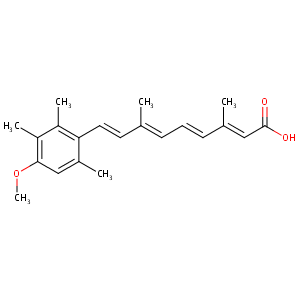
General Information of Drug Combination (ID: DCK8JRV)

Drug Combination Name
Acitretin Isosorbide Dinitrate
Indication
Disease Entry Status REF
Chronic myelogenous leukemia Investigative [1]
Component Drugs Acitretin   DM8BKU9 Isosorbide Dinitrate   DMBI4JG
Small molecular drug Small molecular drug
2D MOL 2D MOL
3D MOL 3D MOL
High-throughput Screening Result Testing Cell Line: KBM-7
Zero Interaction Potency (ZIP) Score: 23.66
Bliss Independence Score: 23.66
Loewe Additivity Score: 31.98
LHighest Single Agent (HSA) Score: 32.01

Molecular Interaction Atlas of This Drug Combination

Molecular Interaction Atlas (MIA)
Indication(s) of Acitretin
Disease Entry ICD 11 Status REF
Psoriasis vulgaris EA90 Approved [2]
Acitretin Interacts with 1 DTT Molecule(s)
DTT Name DTT ID UniProt ID Mode of Action REF
Signal transducer and activator of transcription 3 (STAT3) TTH8FZW STAT3_HUMAN Inhibitor [5]
------------------------------------------------------------------------------------
Acitretin Interacts with 6 DOT Molecule(s)
DOT Name DOT ID UniProt ID Mode of Action REF
Poly polymerase 1 (PARP1) OT310QSG PARP1_HUMAN Increases Activity [6]
Tumor necrosis factor receptor superfamily member 6 (FAS) OTP9XG86 TNR6_HUMAN Increases Expression [6]
Mitogen-activated protein kinase 3 (MAPK3) OTCYKGKO MK03_HUMAN Decreases Expression [7]
Mitogen-activated protein kinase 1 (MAPK1) OTH85PI5 MK01_HUMAN Decreases Expression [7]
Tumor necrosis factor ligand superfamily member 6 (FASLG) OTZARCHH TNFL6_HUMAN Increases Expression [6]
FAS-associated death domain protein (FADD) OTV7GFHH FADD_HUMAN Increases Expression [6]
------------------------------------------------------------------------------------
⏷ Show the Full List of 6 DOT(s)
Indication(s) of Isosorbide Dinitrate
Disease Entry ICD 11 Status REF
Anal fissure DB50.0 Approved [3]
Angina pectoris BA40 Approved [3]
Chronic heart failure BD1Z Approved [4]
Isosorbide Dinitrate Interacts with 1 DTT Molecule(s)
DTT Name DTT ID UniProt ID Mode of Action REF
Guanylate cyclase (GC) TT6HPVC NOUNIPROTAC Stimulator [8]
------------------------------------------------------------------------------------
Isosorbide Dinitrate Interacts with 2 DME Molecule(s)
DME Name DME ID UniProt ID Mode of Action REF
Cytochrome P450 3A4 (CYP3A4) DE4LYSA CP3A4_HUMAN Metabolism [9]
Glutathione S-transferase alpha-1 (GSTA1) DE4ZHS1 GSTA1_HUMAN Metabolism [10]
------------------------------------------------------------------------------------

References

1 CheMBL Affinity Phenotypic Cellular Interaction Assay ID: CHEMBL1125966
2 URL: http://www.guidetopharmacology.org Nucleic Acids Res. 2015 Oct 12. pii: gkv1037. The IUPHAR/BPS Guide to PHARMACOLOGY in 2016: towards curated quantitative interactions between 1300 protein targets and 6000 ligands. (Ligand id: 7598).
3 URL: http://www.guidetopharmacology.org Nucleic Acids Res. 2015 Oct 12. pii: gkv1037. The IUPHAR/BPS Guide to PHARMACOLOGY in 2016: towards curated quantitative interactions between 1300 protein targets and 6000 ligands. (Ligand id: 7051).
4 Isosorbide dinitrate FDA Label
5 Effects of acitretin on the expression of signaling pathway-related genes in epidermal squamous-cell carcinoma cells. Zhonghua Zhong Liu Za Zhi. 2006 Jan;28(1):21-4.
6 Acitretin induces apoptosis through CD95 signalling pathway in human cutaneous squamous cell carcinoma cell line SCL-1. J Cell Mol Med. 2009 Sep;13(9A):2888-98. doi: 10.1111/j.1582-4934.2008.00397.x. Epub 2009 Jun 20.
7 [Acitretin induces apoptosis and changes of relative signaling pathway in epidermoid carcinoma cell line A431]. Zhejiang Da Xue Xue Bao Yi Xue Ban. 2006 Mar;35(2):182-8. doi: 10.3785/j.issn.1008-9292.2006.02.013.
8 Nitric oxide and nitric oxide synthase isoforms in the normal, hypertrophic, and failing heart. Mol Cell Biochem. 2010 Jan;333(1-2):191-201.
9 Isoforms of cytochrome P450 on organic nitrate-derived nitric oxide release in human heart vessels. FEBS Lett. 1999 Jun 11;452(3):165-9.
10 Nitroglycerin and isosorbide dinitrate stimulation of glutathione disulfide efflux from perfused rat liver. Biochem Pharmacol. 1989 Nov 1;38(21):3807-10.