| 1 |
CheMBL Affinity Phenotypic Cellular Interaction Assay ID: CHEMBL1125966
|
| 2 |
URL: http://www.guidetopharmacology.org Nucleic Acids Res. 2015 Oct 12. pii: gkv1037. The IUPHAR/BPS Guide to PHARMACOLOGY in 2016: towards curated quantitative interactions between 1300 protein targets and 6000 ligands. (Ligand id: 6585).
|
| 3 |
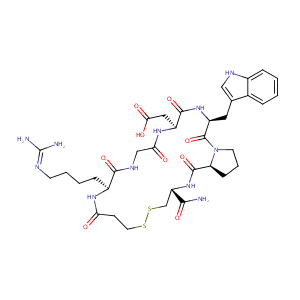
Eptifibatide FDA Label
|
| 4 |
URL: http://www.guidetopharmacology.org Nucleic Acids Res. 2015 Oct 12. pii: gkv1037. The IUPHAR/BPS Guide to PHARMACOLOGY in 2016: towards curated quantitative interactions between 1300 protein targets and 6000 ligands. (Ligand id: 357).
|
| 5 |
Imipramine FDA Label
|
| 6 |
Barbourin. A GPIIb-IIIa-specific integrin antagonist from the venom of Sistrurus m. barbouri. J Biol Chem. 1991 May 25;266(15):9359-62.
|
| 7 |
Eptifibatide in peripheral vascular interventions: results of the Integrilin Reduces Inflammation in Peripheral Vascular Interventions (INFLAME) trial. J Invasive Cardiol. 2006 Jan;18(1):6-12.
|
| 8 |
ADReCS-Target: target profiles for aiding drug safety research and application. Nucleic Acids Res. 2018 Jan 4;46(D1):D911-D917. doi: 10.1093/nar/gkx899.
|
| 9 |
A toxicogenomic approach to drug-induced phospholipidosis: analysis of its induction mechanism and establishment of a novel in vitro screening system. Toxicol Sci. 2005 Feb;83(2):282-92.
|
| 10 |
N-glucuronidation of nicotine and cotinine by human liver microsomes and heterologously expressed UDP-glucuronosyltransferases. Drug Metab Dispos. 2003 Nov;31(11):1361-8. doi: 10.1124/dmd.31.11.1361.
|
| 11 |
Invivo antioxidant status: a putative target of antidepressant action. Prog Neuropsychopharmacol Biol Psychiatry. 2009 Mar 17;33(2):220-8.
|
| 12 |
Caco-2 permeability, P-glycoprotein transport ratios and brain penetration of heterocyclic drugs. Int J Pharm. 2003 Sep 16;263(1-2):113-22.
|
| 13 |
Variability in metabolism of imipramine and desipramine using urinary excretion data. J Anal Toxicol. 2014 Jul-Aug;38(6):368-74.
|
| 14 |
Reappraisal of human CYP isoforms involved in imipramine N-demethylation and 2-hydroxylation: a study using microsomes obtained from putative extensive and poor metabolizers of S-mephenytoin and eleven recombinant human CYPs. J Pharmacol Exp Ther. 1997 Jun;281(3):1199-210.
|
| 15 |
Liquid chromatography-tandem mass spectrometry method for measurement of nicotine N-glucuronide: a marker for human UGT2B10 inhibition. J Pharm Biomed Anal. 2011 Jul 15;55(5):964-71.
|
| 16 |
QTc prolongation associated with combination therapy of levofloxacin, imipramine, and fluoxetine. Ann Pharmacother. 2005 Mar;39(3):543-6.
|
| 17 |
Catalysis of drug oxidation during embryogenesis in human hepatic tissues using imipramine as a model substrate. Drug Metab Dispos. 1999 Nov;27(11):1306-8.
|
| 18 |
Inhibitory effects of tricyclic antidepressants (TCAs) on human cytochrome P450 enzymes in vitro: mechanism of drug interaction between TCAs and phenytoin. Drug Metab Dispos. 2002 Oct;30(10):1102-7.
|
| 19 |
Expression and characterization of human cytochrome P450 4F11: putative role in the metabolism of therapeutic drugs and eicosanoids. Toxicol Appl Pharmacol. 2004 Sep 15;199(3):295-304.
|
| 20 |
Antidepressant drugs activate SREBP and up-regulate cholesterol and fatty acid biosynthesis in human glial cells. Neurosci Lett. 2006 Mar 13;395(3):185-90. doi: 10.1016/j.neulet.2005.10.096. Epub 2005 Dec 1.
|
| 21 |
Use of peak decay analysis and affinity microcolumns containing silica monoliths for rapid determination of drug-protein dissociation rates. J Chromatogr A. 2011 Apr 15;1218(15):2072-8. doi: 10.1016/j.chroma.2010.09.070. Epub 2010 Oct 16.
|
| 22 |
Neutrophil beta(2)-adrenoceptor function in major depression: G(s) coupling, effects of imipramine and relationship to treatment outcome. Eur J Pharmacol. 1999 Dec 15;386(2-3):135-44. doi: 10.1016/s0014-2999(99)00749-9.
|
| 23 |
The antidepressants imipramine, clomipramine, and citalopram induce apoptosis in human acute myeloid leukemia HL-60 cells via caspase-3 activation. J Biochem Mol Toxicol. 1999;13(6):338-47. doi: 10.1002/(sici)1099-0461(1999)13:6<338::aid-jbt8>3.0.co;2-7.
|
| 24 |
Binding of disopyramide, methadone, dipyridamole, chlorpromazine, lignocaine and progesterone to the two main genetic variants of human alpha 1-acid glycoprotein: evidence for drug-binding differences between the variants and for the presence of two separate drug-binding sites on alpha 1-acid glycoprotein. Pharmacogenetics. 1996 Oct;6(5):403-15. doi: 10.1097/00008571-199610000-00004.
|
| 25 |
A Gene Expression Biomarker Predicts Heat Shock Factor 1 Activation in a Gene Expression Compendium. Chem Res Toxicol. 2021 Jul 19;34(7):1721-1737. doi: 10.1021/acs.chemrestox.0c00510. Epub 2021 Jun 25.
|
| 26 |
Molecular identification and functional characterization of rat multidrug and toxin extrusion type transporter 1 as an organic cation/H+ antiporter in the kidney. Drug Metab Dispos. 2006 Nov;34(11):1868-74. doi: 10.1124/dmd.106.010876. Epub 2006 Aug 23.
|
| 27 |
Induction of cysteine string protein after chronic antidepressant treatment in rat frontal cortex. Neurosci Lett. 2001 Apr 6;301(3):183-6. doi: 10.1016/s0304-3940(01)01638-x.
|
| 28 |
Establishment of a 13 genes-based molecular prediction score model to discriminate the neurotoxic potential of food relevant-chemicals. Toxicol Lett. 2022 Feb 1;355:1-18. doi: 10.1016/j.toxlet.2021.10.013. Epub 2021 Nov 5.
|
|
|
|
|
|
|