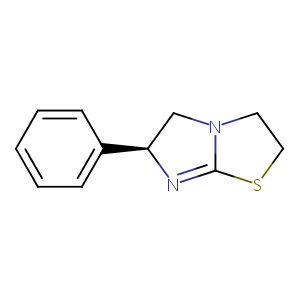
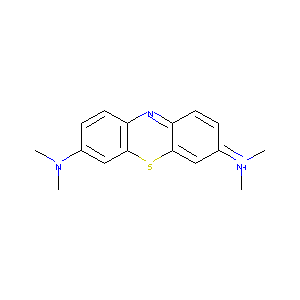
General Information of Drug Combination (ID: DCLRVOM)

Drug Combination Name
Levamisole Methylene blue
Indication
Disease Entry Status REF
Chronic myelogenous leukemia Investigative [1]
Component Drugs Levamisole   DM5EN79 Methylene blue   DMJAPE7
Small molecular drug N.A.
2D MOL 2D MOL
3D MOL 3D MOL
High-throughput Screening Result Testing Cell Line: KBM-7
Zero Interaction Potency (ZIP) Score: 1.91
Bliss Independence Score: 1.91
Loewe Additivity Score: 2.66
LHighest Single Agent (HSA) Score: 2.66

Molecular Interaction Atlas of This Drug Combination

Molecular Interaction Atlas (MIA)
Indication(s) of Levamisole
Disease Entry ICD 11 Status REF
Parasitic infection 1D0Y-1G2Z Approved [2]
Colon cancer 2B90.Z Withdrawn from market [3]
Levamisole Interacts with 1 DTT Molecule(s)
DTT Name DTT ID UniProt ID Mode of Action REF
Alkaline phosphatase tissue-nonspecific (ALPL) TTMR5UV PPBT_HUMAN Inhibitor [6]
------------------------------------------------------------------------------------
Levamisole Interacts with 2 DOT Molecule(s)
DOT Name DOT ID UniProt ID Mode of Action REF
Retinoblastoma-associated protein (RB1) OTQJUJMZ RB_HUMAN Decreases Expression [7]
Bcl-2 homologous antagonist/killer (BAK1) OTDP6ILW BAK_HUMAN Increases Expression [7]
------------------------------------------------------------------------------------
Indication(s) of Methylene blue
Disease Entry ICD 11 Status REF
Acquired methemoglobinemia 3A93 Approved [4]
Coronavirus Disease 2019 (COVID-19) 1D6Y Phase 2 [5]
Methylene blue Interacts with 2 DTT Molecule(s)
DTT Name DTT ID UniProt ID Mode of Action REF
Monoamine oxidase (MAO) TT32XQJ NOUNIPROTAC . [8]
Guanylate cyclase (GC) TT6HPVC NOUNIPROTAC Inhibitor [9]
------------------------------------------------------------------------------------
Methylene blue Interacts with 1 DOT Molecule(s)
DOT Name DOT ID UniProt ID Mode of Action REF
6-phosphogluconate dehydrogenase, decarboxylating (PGD) OTVG296F 6PGD_HUMAN Increases Activity [10]
------------------------------------------------------------------------------------

References

1 CheMBL Affinity Phenotypic Cellular Interaction Assay ID: CHEMBL1125966
2 Drugs@FDA. U.S. Food and Drug Administration. U.S. Department of Health & Human Services. 2015
3 URL: http://www.guidetopharmacology.org Nucleic Acids Res. 2015 Oct 12. pii: gkv1037. The IUPHAR/BPS Guide to PHARMACOLOGY in 2016: towards curated quantitative interactions between 1300 protein targets and 6000 ligands. (Ligand id: 7210).
4 Recombinant Plasmodium falciparum glutathione reductase is inhibited by the antimalarial dye methylene blue. FEBS Lett. 1998 Feb 6;422(3):311-4.
5 ClinicalTrials.gov (NCT04370288) Clinical Application of Methylene Blue for Treatment of Covid-19 Patients. U.S. National Institutes of Health.
6 Characterization of rat heart alkaline phosphatase isoenzymes and modulation of activity. Braz J Med Biol Res. 2008 Jul;41(7):600-9.
7 Levamisole induced apoptosis in cultured vascular endothelial cells. Br J Pharmacol. 2000 Dec;131(8):1577-83.
8 Photoluminescence of CdTe nanocrystals modulated by methylene blue and DNA. A label-free luminescent signaling nanohybrid platform. Phys Chem Chem Phys. 2009 Jul 7;11(25):5062-9.
9 Curcumin ameliorates high glucose-induced acute vascular endothelial dysfunction in rat thoracic aorta. Clin Exp Pharmacol Physiol. 2009 Dec;36(12):1177-82.
10 Defenses against oxidation in human erythrocytes: role of glutathione reductase in the activation of glucose decarboxylation by hemolytic drugs. J Lab Clin Med. 1991 Apr;117(4):325-31.