General Information of Drug Combination (ID: DCNHSBC)

Drug Combination Name
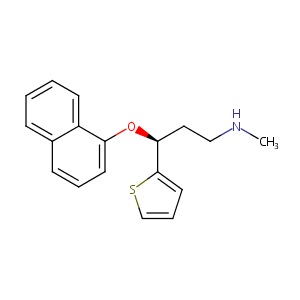
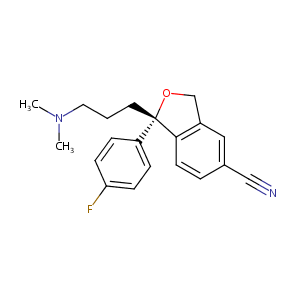
Duloxetine Escitalopram
Indication
Disease Entry Status REF
Post Traumatic Stress Disorder Phase 4 [1]
Component Drugs Duloxetine   DM9BI7M Escitalopram   DMFK9HG
Small molecular drug Small molecular drug
2D MOL 2D MOL
3D MOL 3D MOL

Molecular Interaction Atlas of This Drug Combination

Molecular Interaction Atlas (MIA)
Indication(s) of Duloxetine
Disease Entry ICD 11 Status REF
Depression 6A70-6A7Z Approved [2]
Major depressive disorder 6A70.3 Approved [3]
Stress urinary incontinence MF50.20 Approved [3]
Traumatic brain injury NA07.Z Approved [3]
Duloxetine Interacts with 2 DTT Molecule(s)
DTT Name DTT ID UniProt ID Mode of Action REF
Norepinephrine transporter (NET) TTAWNKZ SC6A2_HUMAN Inhibitor [5]
Serotonin transporter (SERT) TT3ROYC SC6A4_HUMAN Inhibitor [5]
------------------------------------------------------------------------------------
Duloxetine Interacts with 3 DME Molecule(s)
DME Name DME ID UniProt ID Mode of Action REF
Cytochrome P450 1A2 (CYP1A2) DEJGDUW CP1A2_HUMAN Metabolism [6]
Cytochrome P450 2D6 (CYP2D6) DECB0K3 CP2D6_HUMAN Metabolism [6]
Cytochrome P450 2C9 (CYP2C9) DE5IED8 CP2C9_HUMAN Metabolism [6]
------------------------------------------------------------------------------------
Indication(s) of Escitalopram
Disease Entry ICD 11 Status REF
Major depressive disorder 6A70.3 Approved [4]
Escitalopram Interacts with 1 DTT Molecule(s)
DTT Name DTT ID UniProt ID Mode of Action REF
Serotonin transporter (SERT) TT3ROYC SC6A4_HUMAN Inhibitor [7]
------------------------------------------------------------------------------------
Escitalopram Interacts with 3 DME Molecule(s)
DME Name DME ID UniProt ID Mode of Action REF
Cytochrome P450 3A4 (CYP3A4) DE4LYSA CP3A4_HUMAN Metabolism [8]
Cytochrome P450 2D6 (CYP2D6) DECB0K3 CP2D6_HUMAN Metabolism [9]
Mephenytoin 4-hydroxylase (CYP2C19) DEGTFWK CP2CJ_HUMAN Metabolism [10]
------------------------------------------------------------------------------------
Escitalopram Interacts with 1 DOT Molecule(s)
DOT Name DOT ID UniProt ID Mode of Action REF
Sodium-dependent serotonin transporter (SLC6A4) OT6FGDLW SC6A4_HUMAN Increases ADR [11]
------------------------------------------------------------------------------------

References

1 ClinicalTrials.gov (NCT04697693) Antidepressant Response in Older Adults With Comorbid PTSD and MDD
2 URL: http://www.guidetopharmacology.org Nucleic Acids Res. 2015 Oct 12. pii: gkv1037. The IUPHAR/BPS Guide to PHARMACOLOGY in 2016: towards curated quantitative interactions between 1300 protein targets and 6000 ligands. (Ligand id: 202).
3 Duloxetine FDA Label
4 Drugs@FDA. U.S. Food and Drug Administration. U.S. Department of Health & Human Services. 2015
5 Multi-target therapeutics: when the whole is greater than the sum of the parts. Drug Discov Today. 2007 Jan;12(1-2):34-42.
6 Duloxetine: clinical pharmacokinetics and drug interactions. Clin Pharmacokinet. 2011 May;50(5):281-94.
7 Antidepressants and sleep: a review. Perspect Psychiatr Care. 2009 Jul;45(3):191-7.
8 PharmGKB summary: citalopram pharmacokinetics pathway. Pharmacogenet Genomics. 2011 Nov;21(11):769-72.
9 CYP2D6 P34S Polymorphism and Outcomes of Escitalopram Treatment in Koreans with Major Depression. Psychiatry Investig. 2013 Sep;10(3):286-93.
10 Escitalopram pharmacogenetics: CYP2C19 relationships with dosing and clinical outcomes in autism spectrum disorder. Pharmacogenet Genomics. 2015 Nov;25(11):548-54.
11 Serotonin transporter promoter region polymorphisms do not influence treatment response to escitalopram in patients with major depression. Eur Neuropsychopharmacol. 2009 Jun;19(6):451-6. doi: 10.1016/j.euroneuro.2009.01.010. Epub 2009 Mar 9.