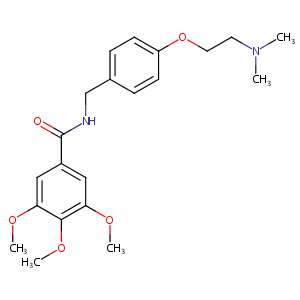
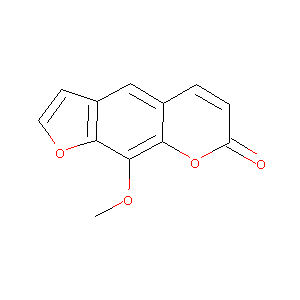
General Information of Drug Combination (ID: DCOSKXV)

Drug Combination Name
Trimethobenzamide Methoxsalen
Indication
Disease Entry Status REF
Chronic myelogenous leukemia Investigative [1]
Component Drugs Trimethobenzamide   DMPP4DT Methoxsalen   DME8FZ9
Small molecular drug Small molecular drug
2D MOL 2D MOL
3D MOL 3D MOL
High-throughput Screening Result Testing Cell Line: KBM-7
Zero Interaction Potency (ZIP) Score: 23.46
Bliss Independence Score: 23.46
Loewe Additivity Score: 33.94
LHighest Single Agent (HSA) Score: 33.94

Molecular Interaction Atlas of This Drug Combination

Molecular Interaction Atlas (MIA)
Indication(s) of Trimethobenzamide
Disease Entry ICD 11 Status REF
Nausea MD90 Approved [2]
Nausea and vomiting MD90 Approved [3]
Vomiting MD90 Approved [2]
Indication(s) of Methoxsalen
Disease Entry ICD 11 Status REF
Cutaneous T-cell lymphoma 2B01 Approved [4]
Primary cutaneous T-cell lymphoma N.A. Approved [5]
Psoriasis vulgaris EA90 Approved [4]
Methoxsalen Interacts with 1 DTT Molecule(s)
DTT Name DTT ID UniProt ID Mode of Action REF
Cytochrome P450 2A6 (CYP2A6) TTAQ6ZW CP2A6_HUMAN Binder [7]
------------------------------------------------------------------------------------
Methoxsalen Interacts with 2 DME Molecule(s)
DME Name DME ID UniProt ID Mode of Action REF
Cytochrome P450 3A4 (CYP3A4) DE4LYSA CP3A4_HUMAN Metabolism [8]
Cytochrome P450 2A6 (CYP2A6) DEJVYAZ CP2A6_HUMAN Metabolism [9]
------------------------------------------------------------------------------------
Methoxsalen Interacts with 9 DOT Molecule(s)
DOT Name DOT ID UniProt ID Mode of Action REF
Cocaine esterase (CES2) OTC647SQ EST2_HUMAN Increases Expression [8]
Nuclear receptor subfamily 1 group I member 2 (NR1I2) OTC5U0N5 NR1I2_HUMAN Increases Activity [8]
Class E basic helix-loop-helix protein 40 (BHLHE40) OTITX14U BHE40_HUMAN Decreases Expression [10]
Baculoviral IAP repeat-containing protein 5 (BIRC5) OTILXZYL BIRC5_HUMAN Decreases Expression [10]
ATP-binding cassette sub-family C member 3 (ABCC3) OTC3IJV4 MRP3_HUMAN Increases Expression [6]
ATP-dependent translocase ABCB1 (ABCB1) OTEJROBO MDR1_HUMAN Increases Expression [11]
Phosphatidylcholine translocator ABCB4 (ABCB4) OTE6PY83 MDR3_HUMAN Decreases Expression [12]
Nuclear receptor subfamily 0 group B member 2 (NR0B2) OT7UVICX NR0B2_HUMAN Increases Expression [6]
Broad substrate specificity ATP-binding cassette transporter ABCG2 (ABCG2) OTW8V2V1 ABCG2_HUMAN Increases Expression [11]
------------------------------------------------------------------------------------
⏷ Show the Full List of 9 DOT(s)

References

1 CheMBL Affinity Phenotypic Cellular Interaction Assay ID: CHEMBL1125966
2 Trimethobenzamide FDA Label
3 Drugs@FDA. U.S. Food and Drug Administration. U.S. Department of Health & Human Services. 2015
4 FDA Approved Drug Products from FDA Official Website. 2009. Application Number: (NDA) 009048.
5 Methoxsalen FDA Label
6 Adaptive homeostasis of the vitamin D-vitamin D nuclear receptor axis in 8-methoxypsoralen-induced hepatotoxicity. Toxicol Appl Pharmacol. 2019 Jan 1;362:150-158. doi: 10.1016/j.taap.2018.11.002. Epub 2018 Nov 10.
7 Mutagenicity and carcinogenicity of methoxsalen plus UV-A. Arch Dermatol. 1984 May;120(5):662-9.
8 Photochemotherapeutic agent 8-methoxypsoralen induces cytochrome P450 3A4 and carboxylesterase HCE2: evidence on an involvement of the pregnane X receptor. Toxicol Sci. 2007 Jan;95(1):13-22.
9 Identification of the human cytochrome P450 enzymes involved in the in vitro metabolism of artemisinin. Br J Clin Pharmacol. 1999 Oct;48(4):528-35.
10 Down regulation of differentiated embryonic chondrocytes 1 (DEC1) is involved in 8-methoxypsoralen-induced apoptosis in HepG2 cells. Toxicology. 2012 Nov 15;301(1-3):58-65. doi: 10.1016/j.tox.2012.06.022. Epub 2012 Jul 11.
11 ABC-transporter blockage mediated by xanthotoxin and bergapten is the major pathway for chemosensitization of multidrug-resistant cancer cells. Toxicol Appl Pharmacol. 2017 Dec 15;337:22-29. doi: 10.1016/j.taap.2017.10.018. Epub 2017 Oct 25.
12 8-Methoxypsoralen disrupts MDR3-mediated phospholipids efflux and bile acid homeostasis and its relevance to hepatotoxicity. Toxicology. 2017 Jul 1;386:40-48. doi: 10.1016/j.tox.2017.05.011. Epub 2017 May 24.