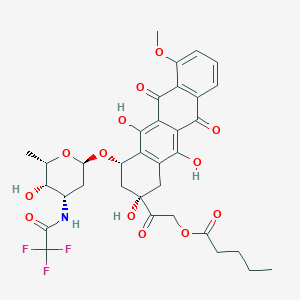
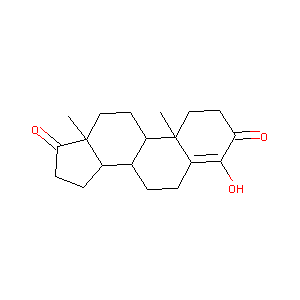
General Information of Drug Combination (ID: DCPIJEX)

Drug Combination Name
Valrubicin FORMESTANE
Indication
Disease Entry Status REF
Carcinoma Investigative [1]
Component Drugs Valrubicin   DMOYJFK FORMESTANE   DMWIDJK
Small molecular drug Small molecular drug
2D MOL 2D MOL
3D MOL is unavailable 3D MOL
High-throughput Screening Result Testing Cell Line: MCF7
Zero Interaction Potency (ZIP) Score: 3.68
Bliss Independence Score: 10.65
Loewe Additivity Score: 13.92
LHighest Single Agent (HSA) Score: 13.06

Molecular Interaction Atlas of This Drug Combination

Molecular Interaction Atlas (MIA)
Indication(s) of Valrubicin
Disease Entry ICD 11 Status REF
Bladder cancer 2C94 Approved [2]
In situ carcinoma N.A. Approved [3]
Urinary bladder cancer N.A. Approved [3]
Psoriasis vulgaris EA90 Phase 2 [4]
Valrubicin Interacts with 1 DTT Molecule(s)
DTT Name DTT ID UniProt ID Mode of Action REF
DNA topoisomerase II (TOP2) TT0IHXV TOP2A_HUMAN; TOP2B_HUMAN Inhibitor [5]
------------------------------------------------------------------------------------
Valrubicin Interacts with 1 DOT Molecule(s)
DOT Name DOT ID UniProt ID Mode of Action REF
Bile salt export pump (ABCB11) OTRU7THO ABCBB_HUMAN Decreases Activity [6]
------------------------------------------------------------------------------------
Indication(s) of FORMESTANE
Disease Entry ICD 11 Status REF
Breast cancer 2C60-2C65 Withdrawn from market [4]
FORMESTANE Interacts with 1 DTT Molecule(s)
DTT Name DTT ID UniProt ID Mode of Action REF
Aromatase (CYP19A1) TTSZLWK CP19A_HUMAN Inhibitor [7]
------------------------------------------------------------------------------------
FORMESTANE Interacts with 2 DOT Molecule(s)
DOT Name DOT ID UniProt ID Mode of Action REF
Adenylate kinase isoenzyme 1 (AK1) OT614AR3 KAD1_HUMAN Increases ADR [8]
17-beta-hydroxysteroid dehydrogenase type 1 (HSD17B1) OT6EBDHM DHB1_HUMAN Decreases Activity [9]
------------------------------------------------------------------------------------

Test Results of This Drug Combination in Other Disease Systems

Indication DrugCom ID Cell Line Status REF
Astrocytoma DC8JU71 U251 Investigative [10]
Astrocytoma DCBDP2O SNB-19 Investigative [10]
Renal cell carcinoma DCWMNIP SN12C Investigative [10]
Carcinoma DCQBZDC RXF 393 Investigative [1]
Adenocarcinoma DCBI8JR DU-145 Investigative [11]
Adenocarcinoma DCLX43N A549 Investigative [11]
Adenocarcinoma DCEDY43 HCT116 Investigative [11]
Adenocarcinoma DCITBN0 HT29 Investigative [11]
High grade ovarian serous adenocarcinoma DCSXK71 OVCAR-8 Investigative [11]
Large cell lung carcinoma DC0DDIK NCI-H460 Investigative [11]
Lung adenocarcinoma DC0IM15 MDA-MB-231 Investigative [11]
Malignant melanoma DCGI67H LOX IMVI Investigative [11]
Melanoma DCIBCYP SK-MEL-2 Investigative [11]
Mixed endometrioid and clear cell carcinoma DCPIC89 IGROV1 Investigative [11]
Non-small cell lung carcinoma DCUZ8D1 HOP-92 Investigative [11]
Prostate carcinoma DC3PN0D PC-3 Investigative [11]
------------------------------------------------------------------------------------
⏷ Show the Full List of 16 DrugCom(s)

References

1 CheMBL Affinity Phenotypic Cellular Interaction Assay ID: CHEMBL1126165
2 Natural products as sources of new drugs over the last 25 years. J Nat Prod. 2007 Mar;70(3):461-77.
3 Valrubicin FDA Label
4 Drugs@FDA. U.S. Food and Drug Administration. U.S. Department of Health & Human Services. 2015
5 Metabolic activation of N-acylanthracyclines precedes their interaction with DNA topoisomerase II. NCI Monogr. 1987;(4):111-5.
6 A multifactorial approach to hepatobiliary transporter assessment enables improved therapeutic compound development. Toxicol Sci. 2013 Nov;136(1):216-41.
7 The taiwaniaquinoids: a review. J Nat Prod. 2010 Feb 26;73(2):284-98.
8 ADReCS-Target: target profiles for aiding drug safety research and application. Nucleic Acids Res. 2018 Jan 4;46(D1):D911-D917. doi: 10.1093/nar/gkx899.
9 Mammalian lignans and genistein decrease the activities of aromatase and 17beta-hydroxysteroid dehydrogenase in MCF-7 cells. J Steroid Biochem Mol Biol. 2005 Apr;94(5):461-7.
10 CheMBL Affinity Phenotypic Cellular Interaction Assay ID: CHEMBL1125966
11 CheMBL Affinity Phenotypic Cellular Interaction Assay ID: CHEMBL1125976