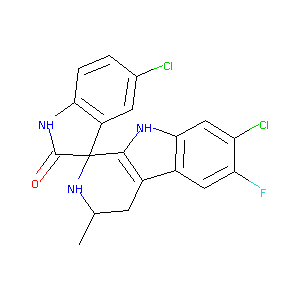
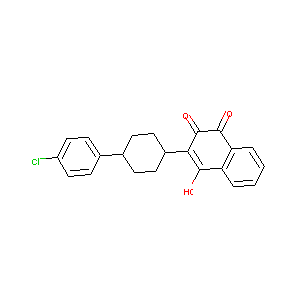
General Information of Drug Combination (ID: DCPX591)

Drug Combination Name
NITD609 Atovaquone
Indication
Disease Entry Status REF
Hepatoblastoma Investigative [1]
Component Drugs NITD609   DMQHBSX Atovaquone   DMY4UMW
Small molecular drug Small molecular drug
2D MOL 2D MOL
3D MOL 3D MOL
High-throughput Screening Result Testing Cell Line: HB3
Zero Interaction Potency (ZIP) Score: 2.713
Bliss Independence Score: 2.33
Loewe Additivity Score: 1.474
LHighest Single Agent (HSA) Score: 4.811

Molecular Interaction Atlas of This Drug Combination

Molecular Interaction Atlas (MIA)
Indication(s) of NITD609
Disease Entry ICD 11 Status REF
Malaria 1F40-1F45 Phase 2 [2]
NITD609 Interacts with 2 DTT Molecule(s)
DTT Name DTT ID UniProt ID Mode of Action REF
Voltage-gated potassium channel Kv11.1 (KCNH2) TTQ6VDM KCNH2_HUMAN Inhibitor [4]
Adenosine A3 receptor (ADORA3) TTJFY5U AA3R_HUMAN Inhibitor [4]
------------------------------------------------------------------------------------
Indication(s) of Atovaquone
Disease Entry ICD 11 Status REF
Fungal infection 1F29-1F2F Approved [3]
Atovaquone Interacts with 1 DTT Molecule(s)
DTT Name DTT ID UniProt ID Mode of Action REF
Plasmodium Dihydroorotate dehydrogenase (Malaria DHOdehase) TT3PQ2Y PYRD_PLAF7 Inhibitor [5]
------------------------------------------------------------------------------------
Atovaquone Interacts with 1 DME Molecule(s)
DME Name DME ID UniProt ID Mode of Action REF
Cytochrome P450 3A4 (CYP3A4) DE4LYSA CP3A4_HUMAN Metabolism [6]
------------------------------------------------------------------------------------

Test Results of This Drug Combination in Other Disease Systems

Indication DrugCom ID Cell Line Status REF
DD2 DC3OYNW DD2 Investigative [7]
------------------------------------------------------------------------------------

References

1 CheMBL Affinity Phenotypic Cellular Interaction Assay ID: CHEMBL1125976
2 ClinicalTrials.gov (NCT01836458) A Study to Find the Minimum Inhibitory Concentration of KAE609 in Adult Male Patients With P. Falciparum Monoinfection. U.S. National Institutes of Health.
3 The fight against drug-resistant malaria: novel plasmodial targets and antimalarial drugs. Curr Med Chem. 2008;15(2):161-71.
4 Spiroindolones, a potent compound class for the treatment of malaria. Science. 2010 Sep 3;329(5996):1175-80.
5 Inhibitor binding in a class 2 dihydroorotate dehydrogenase causes variations in the membrane-associated N-terminal domain. Protein Sci. 2004 Apr;13(4):1031-42.
6 Time-dependent pharmacokinetics and drug metabolism of atovaquone plus proguanil (Malarone) when taken as chemoprophylaxis. Eur J Clin Pharmacol. 2002 Apr;58(1):19-27.
7 CheMBL Affinity Phenotypic Cellular Interaction Assay ID: CHEMBL1125966