General Information of Drug Combination (ID: DCQEBSK)

Drug Combination Name
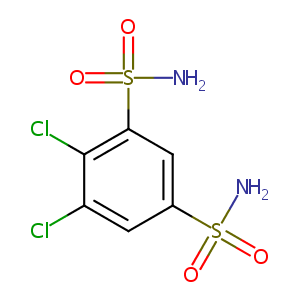
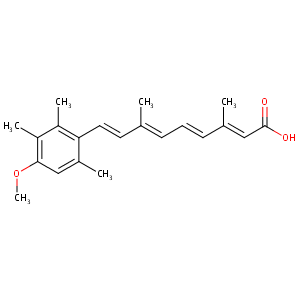
Dichlorphenamide Acitretin
Indication
Disease Entry Status REF
Chronic myelogenous leukemia Investigative [1]
Component Drugs Dichlorphenamide   DMH7IDQ Acitretin   DM8BKU9
Small molecular drug Small molecular drug
2D MOL 2D MOL
3D MOL 3D MOL
High-throughput Screening Result Testing Cell Line: KBM-7
Zero Interaction Potency (ZIP) Score: 16.73
Bliss Independence Score: 16.73
Loewe Additivity Score: 28.42
LHighest Single Agent (HSA) Score: 28.43

Molecular Interaction Atlas of This Drug Combination

Molecular Interaction Atlas (MIA)
Indication(s) of Dichlorphenamide
Disease Entry ICD 11 Status REF
Chronic glaucoma 9C61.0Z Approved [2]
Dichlorphenamide Interacts with 2 DTT Molecule(s)
DTT Name DTT ID UniProt ID Mode of Action REF
Carbonic anhydrase I (CA-I) TTHQPL7 CAH1_HUMAN Modulator [4]
Carbonic anhydrase II (CA-II) TTANPDJ CAH2_HUMAN Inhibitor [5]
------------------------------------------------------------------------------------
Indication(s) of Acitretin
Disease Entry ICD 11 Status REF
Psoriasis vulgaris EA90 Approved [3]
Acitretin Interacts with 1 DTT Molecule(s)
DTT Name DTT ID UniProt ID Mode of Action REF
Signal transducer and activator of transcription 3 (STAT3) TTH8FZW STAT3_HUMAN Inhibitor [6]
------------------------------------------------------------------------------------
Acitretin Interacts with 6 DOT Molecule(s)
DOT Name DOT ID UniProt ID Mode of Action REF
Poly polymerase 1 (PARP1) OT310QSG PARP1_HUMAN Increases Activity [7]
Tumor necrosis factor receptor superfamily member 6 (FAS) OTP9XG86 TNR6_HUMAN Increases Expression [7]
Mitogen-activated protein kinase 3 (MAPK3) OTCYKGKO MK03_HUMAN Decreases Expression [8]
Mitogen-activated protein kinase 1 (MAPK1) OTH85PI5 MK01_HUMAN Decreases Expression [8]
Tumor necrosis factor ligand superfamily member 6 (FASLG) OTZARCHH TNFL6_HUMAN Increases Expression [7]
FAS-associated death domain protein (FADD) OTV7GFHH FADD_HUMAN Increases Expression [7]
------------------------------------------------------------------------------------
⏷ Show the Full List of 6 DOT(s)

References

1 CheMBL Affinity Phenotypic Cellular Interaction Assay ID: CHEMBL1125966
2 URL: http://www.guidetopharmacology.org Nucleic Acids Res. 2015 Oct 12. pii: gkv1037. The IUPHAR/BPS Guide to PHARMACOLOGY in 2016: towards curated quantitative interactions between 1300 protein targets and 6000 ligands. (Ligand id: 6807).
3 URL: http://www.guidetopharmacology.org Nucleic Acids Res. 2015 Oct 12. pii: gkv1037. The IUPHAR/BPS Guide to PHARMACOLOGY in 2016: towards curated quantitative interactions between 1300 protein targets and 6000 ligands. (Ligand id: 7598).
4 Drugs@FDA. U.S. Food and Drug Administration. U.S. Department of Health & Human Services.
5 The Protein Data Bank. Nucleic Acids Res. 2000 Jan 1;28(1):235-42.
6 Effects of acitretin on the expression of signaling pathway-related genes in epidermal squamous-cell carcinoma cells. Zhonghua Zhong Liu Za Zhi. 2006 Jan;28(1):21-4.
7 Acitretin induces apoptosis through CD95 signalling pathway in human cutaneous squamous cell carcinoma cell line SCL-1. J Cell Mol Med. 2009 Sep;13(9A):2888-98. doi: 10.1111/j.1582-4934.2008.00397.x. Epub 2009 Jun 20.
8 [Acitretin induces apoptosis and changes of relative signaling pathway in epidermoid carcinoma cell line A431]. Zhejiang Da Xue Xue Bao Yi Xue Ban. 2006 Mar;35(2):182-8. doi: 10.3785/j.issn.1008-9292.2006.02.013.