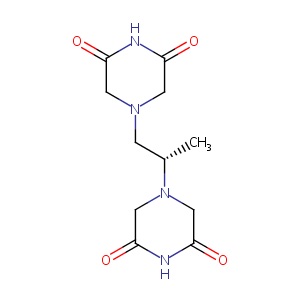
General Information of Drug Combination (ID: DCSGCN7)

Drug Combination Name
Dexrazoxane Estramustine
Indication
Disease Entry Status REF
Adult T acute lymphoblastic leukemia Investigative [1]
Component Drugs Dexrazoxane   DMD7X1O Estramustine   DMWTAOI
Small molecular drug Small molecular drug
2D MOL 2D MOL
3D MOL 3D MOL
High-throughput Screening Result Testing Cell Line: MOLT-4
Zero Interaction Potency (ZIP) Score: 3.39
Bliss Independence Score: 3.6
Loewe Additivity Score: 5.05
LHighest Single Agent (HSA) Score: 8.34

Molecular Interaction Atlas of This Drug Combination

Molecular Interaction Atlas (MIA)
Indication(s) of Dexrazoxane
Disease Entry ICD 11 Status REF
Breast cancer 2C60-2C65 Approved [2]
Chemoprotection N.A. Approved [3]
Inflammatory breast cancer 2C62 Approved [4]
Respiratory tract disease CB7Z Investigative [5]
Dexrazoxane Interacts with 2 DTT Molecule(s)
DTT Name DTT ID UniProt ID Mode of Action REF
DNA topoisomerase II beta (TOP2B) TT4NVEM TOP2B_HUMAN Inhibitor [7]
DNA topoisomerase II (TOP2) TT0IHXV TOP2A_HUMAN; TOP2B_HUMAN Modulator [8]
------------------------------------------------------------------------------------
Dexrazoxane Interacts with 1 DME Molecule(s)
DME Name DME ID UniProt ID Mode of Action REF
Dihydropyrimidinase-related protein 1 (DRP1) DE0EUXB DPYL1_HUMAN Metabolism [9]
------------------------------------------------------------------------------------
Indication(s) of Estramustine
Disease Entry ICD 11 Status REF
Prostate cancer 2C82.0 Approved [6]
Estramustine Interacts with 1 DTT Molecule(s)
DTT Name DTT ID UniProt ID Mode of Action REF
Estramustine binding protein (EMBP) TTSBFYK NOUNIPROTAC Binder [10]
------------------------------------------------------------------------------------
Estramustine Interacts with 1 DME Molecule(s)
DME Name DME ID UniProt ID Mode of Action REF
Cytochrome P450 3A4 (CYP3A4) DE4LYSA CP3A4_HUMAN Metabolism [11]
------------------------------------------------------------------------------------
Estramustine Interacts with 1 DOT Molecule(s)
DOT Name DOT ID UniProt ID Mode of Action REF
Keratin, type I cytoskeletal 18 (KRT18) OTVLQFIP K1C18_HUMAN Increases Expression [12]
------------------------------------------------------------------------------------

Test Results of This Drug Combination in Other Disease Systems

Indication DrugCom ID Cell Line Status REF
Anaplastic large cell lymphoma DCENJWA SR Investigative [1]
Childhood T acute lymphoblastic leukemia DCTCFXE CCRF-CEM Investigative [1]
Colon adenocarcinoma DCJCNB4 COLO 205 Investigative [13]
Adenocarcinoma DCCJUTA HCT116 Investigative [14]
------------------------------------------------------------------------------------

References

1 CheMBL Affinity Phenotypic Cellular Interaction Assay ID: CHEMBL1125966
2 URL: http://www.guidetopharmacology.org Nucleic Acids Res. 2015 Oct 12. pii: gkv1037. The IUPHAR/BPS Guide to PHARMACOLOGY in 2016: towards curated quantitative interactions between 1300 protein targets and 6000 ligands. (Ligand id: 7330).
3 Drugs@FDA. U.S. Food and Drug Administration. U.S. Department of Health & Human Services. 2015
4 Dexrazoxane FDA Label
5 Design and development of antisense drugs. Expert Opin. Drug Discov. 2008 3(10):1189-1207.
6 Natural products as sources of new drugs over the last 25 years. J Nat Prod. 2007 Mar;70(3):461-77.
7 How many drug targets are there Nat Rev Drug Discov. 2006 Dec;5(12):993-6.
8 Drugs@FDA. U.S. Food and Drug Administration. U.S. Department of Health & Human Services.
9 Metabolism of the cardioprotective drug dexrazoxane and one of its metabolites by isolated rat myocytes, hepatocytes, and blood. Drug Metab Dispos. 2005 Jun;33(6):719-25.
10 Estramustine binding protein in primary tumours and metastases of malignant melanoma. Melanoma Res. 1994 Dec;4(6):401-5.
11 Activity of docetaxel with or without estramustine phosphate versus mitoxantrone in androgen dependent and independent human prostate cancer xenografts. J Urol. 2003 May;169(5):1729-34.
12 Docetaxel induces apoptosis in hormone refractory prostate carcinomas during multiple treatment cycles. Br J Cancer. 2006 Jun 5;94(11):1592-8. doi: 10.1038/sj.bjc.6603129.
13 CheMBL Affinity Phenotypic Cellular Interaction Assay ID: CHEMBL1126165
14 CheMBL Affinity Phenotypic Cellular Interaction Assay ID: CHEMBL1125976