General Information of Drug Combination (ID: DCSL2S0)

Drug Combination Name
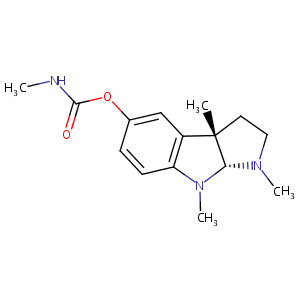
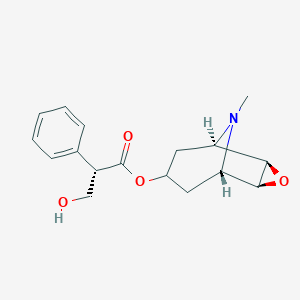
Physostigmine Scopolamine
Indication
Disease Entry Status REF
Nicotine dependence Discontinued [1]
Component Drugs Physostigmine   DM2N0TO Scopolamine   DMOM8AL
Small molecular drug Small molecular drug
2D MOL 2D MOL
3D MOL 3D MOL

Molecular Interaction Atlas of This Drug Combination

Molecular Interaction Atlas (MIA)
Indication(s) of Physostigmine
Disease Entry ICD 11 Status REF
Xerostomia DA02.1 Discontinued in Phase 2 [2]
Physostigmine Interacts with 1 DTT Molecule(s)
DTT Name DTT ID UniProt ID Mode of Action REF
Acetylcholinesterase (AChE) TT1RS9F ACES_HUMAN Inhibitor [5]
------------------------------------------------------------------------------------
Physostigmine Interacts with 1 DOT Molecule(s)
DOT Name DOT ID UniProt ID Mode of Action REF
Cocaine esterase (CES2) OTC647SQ EST2_HUMAN Decreases Activity [6]
------------------------------------------------------------------------------------
Indication(s) of Scopolamine
Disease Entry ICD 11 Status REF
Addictive disorder 6C50-6C5Z Approved [3]
Allergic rhinitis CA08.0 Approved [4]
Common cold CA00 Approved [4]
Cough MD12 Approved [4]
Irritable bowel syndrome DD91.0 Approved [4]
Major depressive disorder 6A70.3 Approved [4]
Mydriasis LA11.62 Approved [4]
Nausea MD90 Approved [3]
Peptic ulcer DA61 Approved [4]
Vasomotor/allergic rhinitis CA08 Approved [4]
Iridocyclitis N.A. Investigative [4]
Uveitis 9A96.Z Investigative [4]
Scopolamine Interacts with 1 DTT Molecule(s)
DTT Name DTT ID UniProt ID Mode of Action REF
Muscarinic acetylcholine receptor (CHRM) TTOXS3C NOUNIPROTAC Antagonist [7]
------------------------------------------------------------------------------------
Scopolamine Interacts with 2 DOT Molecule(s)
DOT Name DOT ID UniProt ID Mode of Action REF
Microtubule-associated protein 2 (MAP2) OT6UYT3X MTAP2_HUMAN Decreases Expression [8]
Neurofilament heavy polypeptide (NEFH) OTMSCW5I NFH_HUMAN Decreases Expression [8]
------------------------------------------------------------------------------------

References

1 Trusted, scientifically sound profiles of drug programs, clinical trials, safety reports, and company deals, written by scientists. Springer. 2015. Adis Insight (drug id 800006543)
2 URL: http://www.guidetopharmacology.org Nucleic Acids Res. 2015 Oct 12. pii: gkv1037. The IUPHAR/BPS Guide to PHARMACOLOGY in 2016: towards curated quantitative interactions between 1300 protein targets and 6000 ligands. (Ligand id: 6598).
3 URL: http://www.guidetopharmacology.org Nucleic Acids Res. 2015 Oct 12. pii: gkv1037. The IUPHAR/BPS Guide to PHARMACOLOGY in 2016: towards curated quantitative interactions between 1300 protein targets and 6000 ligands. (Ligand id: 330).
4 Scopolamine FDA Label
5 The effects of physostigmine on acetylcholinesterase activity of CSF plasma and brain. A comparison of intravenous and intraventricular administration in beagle dogs. Neuropharmacology. 1986 Oct;25(10):1167-77.
6 Purification and cloning of a broad substrate specificity human liver carboxylesterase that catalyzes the hydrolysis of cocaine and heroin. J Biol Chem. 1997 Jun 6;272(23):14769-75. doi: 10.1074/jbc.272.23.14769.
7 The amygdala modulates morphine-induced state-dependent memory retrieval via muscarinic acetylcholine receptors. Neuroscience. 2009 May 5;160(2):255-63.
8 Protective role of Ashwagandha leaf extract and its component withanone on scopolamine-induced changes in the brain and brain-derived cells. PLoS One. 2011;6(11):e27265. doi: 10.1371/journal.pone.0027265. Epub 2011 Nov 11.