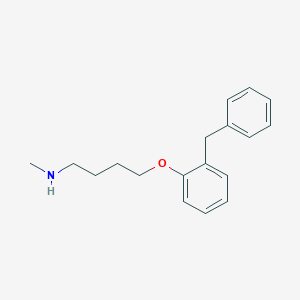
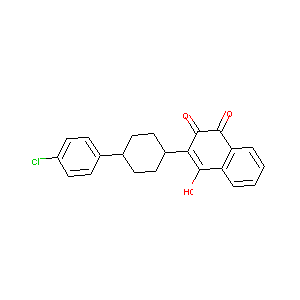
General Information of Drug Combination (ID: DCSW1SA)

Drug Combination Name
Bifemelane Atovaquone
Indication
Disease Entry Status REF
Hepatoblastoma Investigative [1]
Component Drugs Bifemelane   DMU73F0 Atovaquone   DMY4UMW
Small molecular drug Small molecular drug
2D MOL 2D MOL
3D MOL 3D MOL
High-throughput Screening Result Testing Cell Line: HB3
Zero Interaction Potency (ZIP) Score: 6.011
Bliss Independence Score: 7.562
Loewe Additivity Score: 2.638
LHighest Single Agent (HSA) Score: 2.869

Molecular Interaction Atlas of This Drug Combination

Molecular Interaction Atlas (MIA)
Indication(s) of Bifemelane
Disease Entry ICD 11 Status REF
Alzheimer disease 8A20 Terminated [2]
Bifemelane Interacts with 1 DTT Molecule(s)
DTT Name DTT ID UniProt ID Mode of Action REF
Monoamine oxidase type A (MAO-A) TT3WG5C AOFA_HUMAN Modulator [2]
------------------------------------------------------------------------------------
Indication(s) of Atovaquone
Disease Entry ICD 11 Status REF
Fungal infection 1F29-1F2F Approved [3]
Atovaquone Interacts with 1 DTT Molecule(s)
DTT Name DTT ID UniProt ID Mode of Action REF
Plasmodium Dihydroorotate dehydrogenase (Malaria DHOdehase) TT3PQ2Y PYRD_PLAF7 Inhibitor [4]
------------------------------------------------------------------------------------
Atovaquone Interacts with 1 DME Molecule(s)
DME Name DME ID UniProt ID Mode of Action REF
Cytochrome P450 3A4 (CYP3A4) DE4LYSA CP3A4_HUMAN Metabolism [5]
------------------------------------------------------------------------------------

Test Results of This Drug Combination in Other Disease Systems

Indication DrugCom ID Cell Line Status REF
DD2 DCMIEMS DD2 Investigative [6]
------------------------------------------------------------------------------------

References

1 CheMBL Affinity Phenotypic Cellular Interaction Assay ID: CHEMBL1125976
2 4-(O-benzylphenoxy)-N-methylbutylamine (bifemelane) and other 4-(O-benzylphenoxy)-N-methylalkylamines as new inhibitors of type A and B monoamine oxidase. J Neurochem. 1988 Jan;50(1):243-7.
3 The fight against drug-resistant malaria: novel plasmodial targets and antimalarial drugs. Curr Med Chem. 2008;15(2):161-71.
4 Inhibitor binding in a class 2 dihydroorotate dehydrogenase causes variations in the membrane-associated N-terminal domain. Protein Sci. 2004 Apr;13(4):1031-42.
5 Time-dependent pharmacokinetics and drug metabolism of atovaquone plus proguanil (Malarone) when taken as chemoprophylaxis. Eur J Clin Pharmacol. 2002 Apr;58(1):19-27.
6 CheMBL Affinity Phenotypic Cellular Interaction Assay ID: CHEMBL1125966