General Information of Drug Combination (ID: DCT74NS)

Drug Combination Name
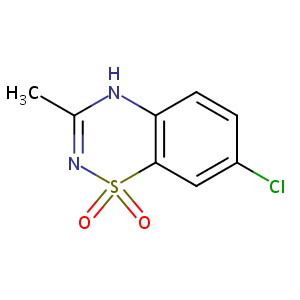
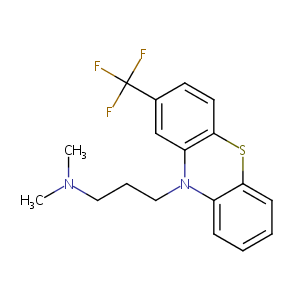
Diazoxide Triflupromazine
Indication
Disease Entry Status REF
Chronic myelogenous leukemia Investigative [1]
Component Drugs Diazoxide   DML1538 Triflupromazine   DMKFQJP
Small molecular drug Small molecular drug
2D MOL 2D MOL
3D MOL 3D MOL
High-throughput Screening Result Testing Cell Line: KBM-7
Zero Interaction Potency (ZIP) Score: 1.92
Bliss Independence Score: 1.92
Loewe Additivity Score: 2.44
LHighest Single Agent (HSA) Score: 2.44

Molecular Interaction Atlas of This Drug Combination

Molecular Interaction Atlas (MIA)
Indication(s) of Diazoxide
Disease Entry ICD 11 Status REF
Congenital hyperinsulinism 5A4Y Approved [2]
Hyperinsulinemia 5A4Y Approved [2]
Hypertension BA00-BA04 Approved [3]
Hypertensive emergency BA03 Approved [2]
Insulinoma 2C10.1 Approved [2]
Malignant essential hypertension BA00 Approved [2]
Diazoxide Interacts with 1 DTT Molecule(s)
DTT Name DTT ID UniProt ID Mode of Action REF
Potassium channel unspecific (KC) TT1VOHK NOUNIPROTAC Modulator [8]
------------------------------------------------------------------------------------
Diazoxide Interacts with 3 DOT Molecule(s)
DOT Name DOT ID UniProt ID Mode of Action REF
Nuclear factor NF-kappa-B p105 subunit (NFKB1) OTNRRD8I NFKB1_HUMAN Increases Activity [9]
Catenin beta-1 (CTNNB1) OTZ932A3 CTNB1_HUMAN Decreases Expression [10]
Bcl-2-like protein 1 (BCL2L1) OTRC5K9O B2CL1_HUMAN Increases Expression [9]
------------------------------------------------------------------------------------
Indication(s) of Triflupromazine
Disease Entry ICD 11 Status REF
Nausea MD90 Approved [4]
Psychotic disorder 6A20-6A25 Approved [5]
Vomiting MD90 Approved [4]
Schizophrenia 6A20 Withdrawn from market [6]
Middle East Respiratory Syndrome (MERS) 1D64 Investigative [7]
Severe acute respiratory syndrome (SARS) 1D65 Investigative [7]
Triflupromazine Interacts with 2 DTT Molecule(s)
DTT Name DTT ID UniProt ID Mode of Action REF
HUMAN clathrin-mediated endocytosis (RME) TTAIY2U N.A. Inhibitor [7]
5-HT 2B receptor (HTR2B) TT0K1SC 5HT2B_HUMAN Antagonist [11]
------------------------------------------------------------------------------------
Triflupromazine Interacts with 1 DTP Molecule(s)
DTP Name DTP ID UniProt ID Mode of Action REF
P-glycoprotein 1 (ABCB1) DTUGYRD MDR1_HUMAN Substrate [12]
------------------------------------------------------------------------------------

References

1 CheMBL Affinity Phenotypic Cellular Interaction Assay ID: CHEMBL1125966
2 Diazoxide FDA Label
3 URL: http://www.guidetopharmacology.org Nucleic Acids Res. 2015 Oct 12. pii: gkv1037. The IUPHAR/BPS Guide to PHARMACOLOGY in 2016: towards curated quantitative interactions between 1300 protein targets and 6000 ligands. (Ligand id: 2409).
4 Triflupromazine FDA Label
5 URL: http://www.guidetopharmacology.org Nucleic Acids Res. 2015 Oct 12. pii: gkv1037. The IUPHAR/BPS Guide to PHARMACOLOGY in 2016: towards curated quantitative interactions between 1300 protein targets and 6000 ligands. (Ligand id: 4330).
6 Drugs@FDA. U.S. Food and Drug Administration. U.S. Department of Health & Human Services. 2015
7 Repurposing of clinically developed drugs for treatment of Middle East respiratory syndrome coronavirus infection. Antimicrob Agents Chemother. 2014 Aug;58(8):4885-93.
8 Drugs@FDA. U.S. Food and Drug Administration. U.S. Department of Health & Human Services.
9 Diazoxide-mediated preconditioning against apoptosis involves activation of cAMP-response element-binding protein (CREB) and NFkappaB. J Biol Chem. 2004 Nov 5;279(45):46748-54. doi: 10.1074/jbc.M406217200. Epub 2004 Aug 23.
10 Diazoxide-mediated growth inhibition in human lung cancer cells via downregulation of beta-catenin-mediated cyclin D1 transcription. Lung. 2009 Jan-Feb;187(1):61-7. doi: 10.1007/s00408-008-9127-1. Epub 2008 Dec 4.
11 Some properties of 5-hydroxytryptamine receptors in the hindquarters of the rat. Br J Pharmacol. 1979 Sep;67(1):79-85.
12 Human intestinal transporter database: QSAR modeling and virtual profiling of drug uptake, efflux and interactions. Pharm Res. 2013 Apr;30(4):996-1007.