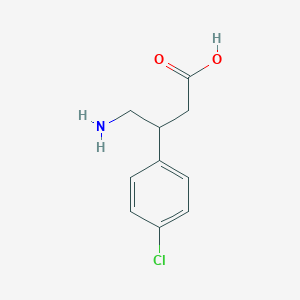
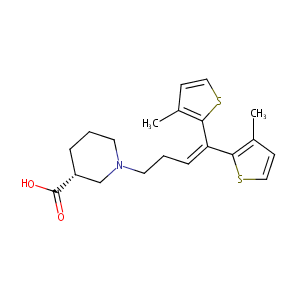
General Information of Drug Combination (ID: DCUXLTV)

Drug Combination Name
Baclofen Tiagabine
Indication
Disease Entry Status REF
Chronic myelogenous leukemia Investigative [1]
Component Drugs Baclofen   DM0QV1J Tiagabine   DMKSQG0
Small molecular drug Small molecular drug
2D MOL 2D MOL
3D MOL 3D MOL
High-throughput Screening Result Testing Cell Line: KBM-7
Zero Interaction Potency (ZIP) Score: 10.27
Bliss Independence Score: 10.27
Loewe Additivity Score: 12.68
LHighest Single Agent (HSA) Score: 12.75

Molecular Interaction Atlas of This Drug Combination

Molecular Interaction Atlas (MIA)
Indication(s) of Baclofen
Disease Entry ICD 11 Status REF
Multiple sclerosis 8A40 Approved [2]
Fragile X syndrome LD55 Phase 3 [3]
Baclofen Interacts with 1 DTT Molecule(s)
DTT Name DTT ID UniProt ID Mode of Action REF
Gamma-aminobutyric acid B receptor (GABBR) TTDCVZW GABR1_HUMAN; GABR2_HUMAN Modulator [5]
------------------------------------------------------------------------------------
Baclofen Interacts with 2 DOT Molecule(s)
DOT Name DOT ID UniProt ID Mode of Action REF
Adenosine receptor A1 (ADORA1) OTI7X39E AA1R_HUMAN Increases ADR [6]
ATP-binding cassette sub-family C member 4 (ABCC4) OTO27PAL MRP4_HUMAN Increases Transport [7]
------------------------------------------------------------------------------------
Indication(s) of Tiagabine
Disease Entry ICD 11 Status REF
Epilepsy 8A60-8A68 Approved [4]
Anxiety disorder 6B00-6B0Z Phase 2 [4]
Tiagabine Interacts with 2 DTT Molecule(s)
DTT Name DTT ID UniProt ID Mode of Action REF
Gamma-aminobutyric acid uptake (GABAU) TTV9MQG NOUNIPROTAC Inhibitor [8]
GABA transporter GAT-1 (SLC6A1) TTPRKM0 SC6A1_HUMAN Inhibitor [9]
------------------------------------------------------------------------------------
Tiagabine Interacts with 2 DME Molecule(s)
DME Name DME ID UniProt ID Mode of Action REF
Cytochrome P450 3A4 (CYP3A4) DE4LYSA CP3A4_HUMAN Metabolism [10]
UDP-glucuronosyltransferase 1A1 (UGT1A1) DEYGVN4 UD11_HUMAN Metabolism [11]
------------------------------------------------------------------------------------

References

1 CheMBL Affinity Phenotypic Cellular Interaction Assay ID: CHEMBL1125966
2 URL: http://www.guidetopharmacology.org Nucleic Acids Res. 2015 Oct 12. pii: gkv1037. The IUPHAR/BPS Guide to PHARMACOLOGY in 2016: towards curated quantitative interactions between 1300 protein targets and 6000 ligands. (Ligand id: 1084).
3 ClinicalTrials.gov (NCT01706523) Open Label Extension Study of STX209 (Arbaclofen) in Autism Spectrum Disorders. U.S. National Institutes of Health.
4 URL: http://www.guidetopharmacology.org Nucleic Acids Res. 2015 Oct 12. pii: gkv1037. The IUPHAR/BPS Guide to PHARMACOLOGY in 2016: towards curated quantitative interactions between 1300 protein targets and 6000 ligands. (Ligand id: 4818).
5 Synthesis and pharmacology of the baclofen homologues 5-amino-4-(4-chlorophenyl)pentanoic acid and the R- and S-enantiomers of 5-amino-3-(4-chlorop... J Med Chem. 1999 Jun 3;42(11):2053-9.
6 ADReCS-Target: target profiles for aiding drug safety research and application. Nucleic Acids Res. 2018 Jan 4;46(D1):D911-D917. doi: 10.1093/nar/gkx899.
7 Multichannel liquid chromatography-tandem mass spectrometry cocktail method for comprehensive substrate characterization of multidrug resistance-associated protein 4 transporter. Pharm Res. 2007 Dec;24(12):2281-96.
8 Glutamate- and GABA-based CNS therapeutics. Curr Opin Pharmacol. 2006 Feb;6(1):7-17.
9 URL: http://www.guidetopharmacology.org Nucleic Acids Res. 2015 Oct 12. pii: gkv1037. The IUPHAR/BPS Guide to PHARMACOLOGY in 2016: towards curated quantitative interactions between 1300 protein targets and 6000 ligands. (Target id: 929).
10 Enzyme induction and inhibition by new antiepileptic drugs: a review of human studies. Fundam Clin Pharmacol. 2000 Jul-Aug;14(4):301-19.
11 Actual and Predicted Pharmacokinetic Interactions Between Anticonvulsants and Antiretrovirals.