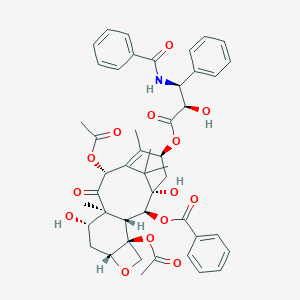
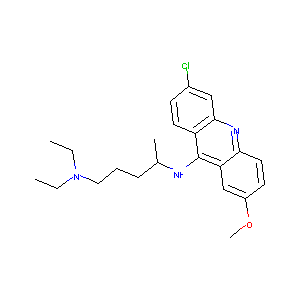
General Information of Drug Combination (ID: DCV75CP)

Drug Combination Name
Taxol Mepacrine
Indication
Disease Entry Status REF
Amelanotic melanoma Investigative [1]
Component Drugs Taxol   DMUOT9V Mepacrine   DMU8L7C
Small molecular drug Small molecular drug
2D MOL 2D MOL
3D MOL is unavailable 3D MOL
High-throughput Screening Result Testing Cell Line: MDA-MB-435
Zero Interaction Potency (ZIP) Score: 11.13
Bliss Independence Score: 7.8
Loewe Additivity Score: 6.23
LHighest Single Agent (HSA) Score: 8.21

Molecular Interaction Atlas of This Drug Combination

Molecular Interaction Atlas (MIA)
Indication(s) of Taxol
Disease Entry ICD 11 Status REF
Breast cancer 2C60-2C65 Approved [2]
Solid tumour/cancer 2A00-2F9Z Approved [3]
Pancreatic cancer 2C10 Phase 3 [4]
Gastric adenocarcinoma 2B72 Phase 2 [5]
Ovarian cancer 2C73 Phase 2 [5]
Taxol Interacts with 2 DTT Molecule(s)
DTT Name DTT ID UniProt ID Mode of Action REF
Apoptosis regulator Bcl-2 (BCL-2) TTJGNVC BCL2_HUMAN Modulator [2]
Tubulin beta (TUBB) TTYFKSZ NOUNIPROTAC Modulator [2]
------------------------------------------------------------------------------------
Indication(s) of Mepacrine
Disease Entry ICD 11 Status REF
Discovery agent N.A. Investigative [6]
Mepacrine Interacts with 1 DTT Molecule(s)
DTT Name DTT ID UniProt ID Mode of Action REF
Phospholipase A2 (PLA2G1B) TT9V5JH PA21B_HUMAN Inhibitor [6]
------------------------------------------------------------------------------------
Mepacrine Interacts with 1 DTP Molecule(s)
DTP Name DTP ID UniProt ID Mode of Action REF
Breast cancer resistance protein (ABCG2) DTI7UX6 ABCG2_HUMAN Substrate [7]
------------------------------------------------------------------------------------
Mepacrine Interacts with 2 DME Molecule(s)
DME Name DME ID UniProt ID Mode of Action REF
Cytochrome P450 3A4 (CYP3A4) DE4LYSA CP3A4_HUMAN Metabolism [8]
Cytochrome P450 3A5 (CYP3A5) DEIBDNY CP3A5_HUMAN Metabolism [8]
------------------------------------------------------------------------------------
Mepacrine Interacts with 11 DOT Molecule(s)
DOT Name DOT ID UniProt ID Mode of Action REF
Myc proto-oncogene protein (MYC) OTPV5LUK MYC_HUMAN Decreases Expression [9]
Poly polymerase 1 (PARP1) OT310QSG PARP1_HUMAN Increases Cleavage [10]
1-phosphatidylinositol 4,5-bisphosphate phosphodiesterase gamma-1 (PLCG1) OTSBQR6D PLCG1_HUMAN Decreases Phosphorylation [11]
Mitogen-activated protein kinase 3 (MAPK3) OTCYKGKO MK03_HUMAN Decreases Phosphorylation [10]
Mitogen-activated protein kinase 1 (MAPK1) OTH85PI5 MK01_HUMAN Decreases Phosphorylation [10]
Catenin beta-1 (CTNNB1) OTZ932A3 CTNB1_HUMAN Decreases Expression [9]
Cyclin-dependent kinase inhibitor 1 (CDKN1A) OTQWHCZE CDN1A_HUMAN Decreases Expression [12]
Casein kinase I isoform alpha (CSNK1A1) OTJ6O1IC KC1A_HUMAN Increases Expression [9]
Forkhead box protein P3 (FOXP3) OTA9Z9OC FOXP3_HUMAN Increases Expression [10]
F-box/WD repeat-containing protein 1A (BTRC) OT2EZDGR FBW1A_HUMAN Decreases Expression [10]
ATP-dependent translocase ABCB1 (ABCB1) OTEJROBO MDR1_HUMAN Increases Transport [8]
------------------------------------------------------------------------------------
⏷ Show the Full List of 11 DOT(s)

Test Results of This Drug Combination in Other Disease Systems

Indication DrugCom ID Cell Line Status REF
Clear cell renal cell carcinoma DCHL2IA CAKI-1 Investigative [13]
Ovarian serous cystadenocarcinoma DCNZRUM SK-OV-3 Investigative [1]
------------------------------------------------------------------------------------

References

1 CheMBL Affinity Phenotypic Cellular Interaction Assay ID: CHEMBL1125976
2 Paclitaxel directly binds to Bcl-2 and functionally mimics activity of Nur77. Cancer Res. 2009 Sep 1;69(17):6906-14.
3 Drugs@FDA. U.S. Food and Drug Administration. U.S. Department of Health & Human Services. 2015
4 Clinical pipeline report, company report or official report of the Pharmaceutical Research and Manufacturers of America (PhRMA)
5 Clinical pipeline report, company report or official report of the Pharmaceutical Research and Manufacturers of America (PhRMA)
6 Involvement of protein kinase C activation in L-leucine-induced stimulation of protein synthesis in l6 myotubes. Cytotechnology. 2003 Nov;43(1-3):97-103.
7 Arginine-482 is not essential for transport of antibiotics, primary bile acids and unconjugated sterols by the human breast cancer resistance protein (ABCG2). Biochem J. 2005 Jan 15;385(Pt 2):419-26.
8 Quinacrine is mainly metabolized to mono-desethyl quinacrine by CYP3A4/5 and its brain accumulation is limited by P-glycoprotein. Drug Metab Dispos. 2006 Jul;34(7):1136-44.
9 Nanoquinacrine caused apoptosis in oral cancer stem cells by disrupting the interaction between GLI1 and catenin through activation of GSK3. Toxicol Appl Pharmacol. 2017 Sep 1;330:53-64. doi: 10.1016/j.taap.2017.07.008. Epub 2017 Jul 15.
10 Quinacrine induces the apoptosis of human leukemia U937 cells through FOXP3/miR-183/-TrCP/SP1 axis-mediated BAX upregulation. Toxicol Appl Pharmacol. 2017 Nov 1;334:35-46. doi: 10.1016/j.taap.2017.08.019. Epub 2017 Sep 1.
11 Quinacrine is active in preclinical models of glioblastoma through suppressing angiogenesis, inducing oxidative stress and activating AMPK. Toxicol In Vitro. 2022 Sep;83:105420. doi: 10.1016/j.tiv.2022.105420. Epub 2022 Jun 17.
12 Multiple-endpoint in vitro carcinogenicity test in human cell line TK6 distinguishes carcinogens from non-carcinogens and highlights mechanisms of action. Arch Toxicol. 2021 Jan;95(1):321-336. doi: 10.1007/s00204-020-02902-3. Epub 2020 Sep 10.
13 CheMBL Affinity Phenotypic Cellular Interaction Assay ID: CHEMBL1125966