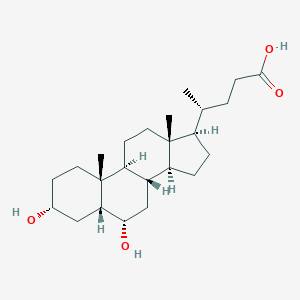
General Information of Drug Combination (ID: DCV9OTH)

Drug Combination Name
Hyodeoxycholic acid Furazolidone
Indication
Disease Entry Status REF
Chronic myelogenous leukemia Investigative [1]
Component Drugs Hyodeoxycholic acid   DMSIWD0 Furazolidone   DM3P6V7
N.A. Small molecular drug
2D MOL 2D MOL
3D MOL 3D MOL
High-throughput Screening Result Testing Cell Line: KBM-7
Zero Interaction Potency (ZIP) Score: 8.98
Bliss Independence Score: 8.98
Loewe Additivity Score: 12.47
LHighest Single Agent (HSA) Score: 12.52

Molecular Interaction Atlas of This Drug Combination

Molecular Interaction Atlas (MIA)
Hyodeoxycholic acid Interacts with 2 DME Molecule(s)
DME Name DME ID UniProt ID Mode of Action REF
UDP-glucuronosyltransferase 1A6 (UGT1A6) DESD26P UD16_HUMAN Metabolism [5]
UDP-glucuronosyltransferase 2A3 (UGT2A3) DEWBT6H UD2A3_HUMAN Metabolism [6]
------------------------------------------------------------------------------------
Indication(s) of Furazolidone
Disease Entry ICD 11 Status REF
Diarrhea ME05.1 Approved [2]
Furazolidone Interacts with 1 DTT Molecule(s)
DTT Name DTT ID UniProt ID Mode of Action REF
Bacterial Deoxyribonucleic acid (Bact DNA) TTS1W4A NOUNIPROTAC Modulator [7]
------------------------------------------------------------------------------------
Furazolidone Interacts with 8 DOT Molecule(s)
DOT Name DOT ID UniProt ID Mode of Action REF
Serine/threonine-protein kinase Chk1 (CHEK1) OTTTI622 CHK1_HUMAN Increases Expression [8]
Poly polymerase 1 (PARP1) OT310QSG PARP1_HUMAN Increases Cleavage [9]
Growth arrest and DNA damage-inducible protein GADD45 alpha (GADD45A) OTDRV63V GA45A_HUMAN Increases Expression [10]
Mitogen-activated protein kinase 1 (MAPK1) OTH85PI5 MK01_HUMAN Increases Phosphorylation [8]
G1/S-specific cyclin-D3 (CCND3) OTNKPQ22 CCND3_HUMAN Increases Expression [11]
DNA damage-inducible transcript 3 protein (DDIT3) OTI8YKKE DDIT3_HUMAN Increases Expression [8]
Breast cancer type 1 susceptibility protein (BRCA1) OT5BN6VH BRCA1_HUMAN Increases Expression [8]
Cyclin-dependent kinase inhibitor 1 (CDKN1A) OTQWHCZE CDN1A_HUMAN Increases Expression [9]
------------------------------------------------------------------------------------
⏷ Show the Full List of 8 DOT(s)

References

1 CheMBL Affinity Phenotypic Cellular Interaction Assay ID: CHEMBL1125966
2 FDA Approved Drug Products from FDA Official Website. 2009. Application Number: (NDA) 011270.
3 Complementary deoxyribonucleic acid cloning and expression of a human liver uridine diphosphate-glucuronosyltransferase glucuronidating carboxylic acid-containing drugs. J Pharmacol Exp Ther. 1993 Jan;264(1):475-9.
4 Isolation and characterization of hyodeoxycholic-acid: UDP-glucuronosyltransferase from human liver. Eur J Biochem. 1991 Sep 1;200(2):393-400. doi: 10.1111/j.1432-1033.1991.tb16197.x.
5 Structural and functional studies of UDP-glucuronosyltransferases. Drug Metab Rev. 1999 Nov;31(4):817-99.
6 Novel polymorphic human UDP-glucuronosyltransferase 2A3: cloning, functional characterization of enzyme variants, comparative tissue expression, and gene induction. Mol Pharmacol. 2008 Sep;74(3):744-54.
7 Interaction of furazolidone with DNA. Biochim Biophys Acta. 1975 Aug 21;402(2):161-5.
8 Involvement of the activation of Nrf2/HO-1, p38 MAPK signaling pathways and endoplasmic reticulum stress in furazolidone induced cytotoxicity and S phase arrest in human hepatocyte L02 cells: modulation of curcumin. Toxicol Mech Methods. 2017 Mar;27(3):165-172. doi: 10.1080/15376516.2016.1273424. Epub 2017 Jan 8.
9 P21(Waf1/Cip1) plays a critical role in furazolidone-induced apoptosis in HepG2 cells through influencing the caspase-3 activation and ROS generation. Food Chem Toxicol. 2016 Feb;88:1-12. doi: 10.1016/j.fct.2015.12.004. Epub 2015 Dec 11.
10 The Effect of GADD45a on Furazolidone-Induced S-Phase Cell-Cycle Arrest in Human Hepatoma G2 Cells. J Biochem Mol Toxicol. 2015 Oct;29(10):489-495. doi: 10.1002/jbt.21719. Epub 2015 Jun 11.
11 Involvement of the p38 MAPK signaling pathway in S-phase cell-cycle arrest induced by Furazolidone in human hepatoma G2 cells. J Appl Toxicol. 2013 Dec;33(12):1500-5. doi: 10.1002/jat.2829. Epub 2012 Oct 30.