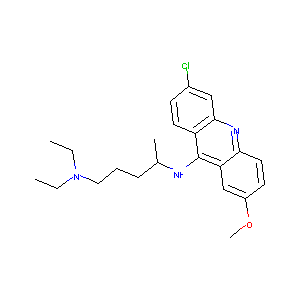
General Information of Drug Combination (ID: DCXZ7JE)

Drug Combination Name
Picoplatin Mepacrine
Indication
Disease Entry Status REF
High grade ovarian serous adenocarcinoma Investigative [1]
Component Drugs Picoplatin   DM0PIY6 Mepacrine   DMU8L7C
Small molecular drug Small molecular drug
2D MOL 2D MOL
3D MOL 3D MOL
High-throughput Screening Result Testing Cell Line: NCI\\/ADR-RES
Zero Interaction Potency (ZIP) Score: 0.73
Bliss Independence Score: 4.9
Loewe Additivity Score: 3.29
LHighest Single Agent (HSA) Score: 2.8

Molecular Interaction Atlas of This Drug Combination

Molecular Interaction Atlas (MIA)
Indication(s) of Picoplatin
Disease Entry ICD 11 Status REF
Colorectal cancer 2B91.Z Phase 3 [2]
Ovarian cancer 2C73 Phase 3 [2]
Prostate cancer 2C82.0 Phase 3 [2]
Small-cell lung cancer 2C25.Y Phase 3 [2]
Indication(s) of Mepacrine
Disease Entry ICD 11 Status REF
Discovery agent N.A. Investigative [3]
Mepacrine Interacts with 1 DTT Molecule(s)
DTT Name DTT ID UniProt ID Mode of Action REF
Phospholipase A2 (PLA2G1B) TT9V5JH PA21B_HUMAN Inhibitor [3]
------------------------------------------------------------------------------------
Mepacrine Interacts with 1 DTP Molecule(s)
DTP Name DTP ID UniProt ID Mode of Action REF
Breast cancer resistance protein (ABCG2) DTI7UX6 ABCG2_HUMAN Substrate [4]
------------------------------------------------------------------------------------
Mepacrine Interacts with 2 DME Molecule(s)
DME Name DME ID UniProt ID Mode of Action REF
Cytochrome P450 3A4 (CYP3A4) DE4LYSA CP3A4_HUMAN Metabolism [5]
Cytochrome P450 3A5 (CYP3A5) DEIBDNY CP3A5_HUMAN Metabolism [5]
------------------------------------------------------------------------------------
Mepacrine Interacts with 11 DOT Molecule(s)
DOT Name DOT ID UniProt ID Mode of Action REF
Myc proto-oncogene protein (MYC) OTPV5LUK MYC_HUMAN Decreases Expression [6]
Poly polymerase 1 (PARP1) OT310QSG PARP1_HUMAN Increases Cleavage [7]
1-phosphatidylinositol 4,5-bisphosphate phosphodiesterase gamma-1 (PLCG1) OTSBQR6D PLCG1_HUMAN Decreases Phosphorylation [8]
Mitogen-activated protein kinase 3 (MAPK3) OTCYKGKO MK03_HUMAN Decreases Phosphorylation [7]
Mitogen-activated protein kinase 1 (MAPK1) OTH85PI5 MK01_HUMAN Decreases Phosphorylation [7]
Catenin beta-1 (CTNNB1) OTZ932A3 CTNB1_HUMAN Decreases Expression [6]
Cyclin-dependent kinase inhibitor 1 (CDKN1A) OTQWHCZE CDN1A_HUMAN Decreases Expression [9]
Casein kinase I isoform alpha (CSNK1A1) OTJ6O1IC KC1A_HUMAN Increases Expression [6]
Forkhead box protein P3 (FOXP3) OTA9Z9OC FOXP3_HUMAN Increases Expression [7]
F-box/WD repeat-containing protein 1A (BTRC) OT2EZDGR FBW1A_HUMAN Decreases Expression [7]
ATP-dependent translocase ABCB1 (ABCB1) OTEJROBO MDR1_HUMAN Increases Transport [5]
------------------------------------------------------------------------------------
⏷ Show the Full List of 11 DOT(s)

Test Results of This Drug Combination in Other Disease Systems

Indication DrugCom ID Cell Line Status REF
Renal cell carcinoma DC3NCVL UO-31 Investigative [10]
Colon carcinoma DCMKCNU KM12 Investigative [11]
Amelanotic melanoma DCRBW3J MDA-MB-435 Investigative [1]
Malignant melanoma DC6V5TV UACC62 Investigative [1]
Mixed endometrioid and clear cell carcinoma DCTR5FC IGROV1 Investigative [1]
------------------------------------------------------------------------------------

References

1 CheMBL Affinity Phenotypic Cellular Interaction Assay ID: CHEMBL1125976
2 ClinicalTrials.gov (NCT00465491) Study of Picoplatin Efficacy After Relapse. U.S. National Institutes of Health.
3 Involvement of protein kinase C activation in L-leucine-induced stimulation of protein synthesis in l6 myotubes. Cytotechnology. 2003 Nov;43(1-3):97-103.
4 Arginine-482 is not essential for transport of antibiotics, primary bile acids and unconjugated sterols by the human breast cancer resistance protein (ABCG2). Biochem J. 2005 Jan 15;385(Pt 2):419-26.
5 Quinacrine is mainly metabolized to mono-desethyl quinacrine by CYP3A4/5 and its brain accumulation is limited by P-glycoprotein. Drug Metab Dispos. 2006 Jul;34(7):1136-44.
6 Nanoquinacrine caused apoptosis in oral cancer stem cells by disrupting the interaction between GLI1 and catenin through activation of GSK3. Toxicol Appl Pharmacol. 2017 Sep 1;330:53-64. doi: 10.1016/j.taap.2017.07.008. Epub 2017 Jul 15.
7 Quinacrine induces the apoptosis of human leukemia U937 cells through FOXP3/miR-183/-TrCP/SP1 axis-mediated BAX upregulation. Toxicol Appl Pharmacol. 2017 Nov 1;334:35-46. doi: 10.1016/j.taap.2017.08.019. Epub 2017 Sep 1.
8 Quinacrine is active in preclinical models of glioblastoma through suppressing angiogenesis, inducing oxidative stress and activating AMPK. Toxicol In Vitro. 2022 Sep;83:105420. doi: 10.1016/j.tiv.2022.105420. Epub 2022 Jun 17.
9 Multiple-endpoint in vitro carcinogenicity test in human cell line TK6 distinguishes carcinogens from non-carcinogens and highlights mechanisms of action. Arch Toxicol. 2021 Jan;95(1):321-336. doi: 10.1007/s00204-020-02902-3. Epub 2020 Sep 10.
10 CheMBL Affinity Phenotypic Cellular Interaction Assay ID: CHEMBL1125966
11 CheMBL Affinity Phenotypic Cellular Interaction Assay ID: CHEMBL1126165