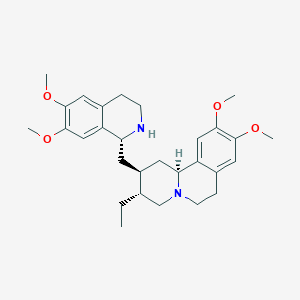
General Information of Drug Combination (ID: DCZAOJ2)

Drug Combination Name
Emetine Busulfan
Indication
Disease Entry Status REF
Chronic myelogenous leukemia Investigative [1]
Component Drugs Emetine   DMCT2YF Busulfan   DMXYJ9C
Small molecular drug Small molecular drug
2D MOL 2D MOL
3D MOL 3D MOL
High-throughput Screening Result Testing Cell Line: KBM-7
Zero Interaction Potency (ZIP) Score: 1.64
Bliss Independence Score: 1.64
Loewe Additivity Score: 3.56
LHighest Single Agent (HSA) Score: 3.56

Molecular Interaction Atlas of This Drug Combination

Molecular Interaction Atlas (MIA)
Indication(s) of Emetine
Disease Entry ICD 11 Status REF
Hepatitis virus infection 1E50-1E51 Approved [2]
Emetine Interacts with 1 DTP Molecule(s)
DTP Name DTP ID UniProt ID Mode of Action REF
P-glycoprotein 1 (ABCB1) DTUGYRD MDR1_HUMAN Substrate [6]
------------------------------------------------------------------------------------
Emetine Interacts with 2 DME Molecule(s)
DME Name DME ID UniProt ID Mode of Action REF
Cytochrome P450 3A4 (CYP3A4) DE4LYSA CP3A4_HUMAN Metabolism [7]
Cytochrome P450 2D6 (CYP2D6) DECB0K3 CP2D6_HUMAN Metabolism [7]
------------------------------------------------------------------------------------
Emetine Interacts with 11 DOT Molecule(s)
DOT Name DOT ID UniProt ID Mode of Action REF
Reversion-inducing cysteine-rich protein with Kazal motifs (RECK) OT9QIHEQ RECK_HUMAN Decreases Expression [8]
Transforming growth factor beta-1 proprotein (TGFB1) OTV5XHVH TGFB1_HUMAN Decreases Activity [9]
Interleukin-6 receptor subunit alpha (IL6R) OTCQL07Z IL6RA_HUMAN Decreases Expression [5]
Poly polymerase 1 (PARP1) OT310QSG PARP1_HUMAN Increases Cleavage [10]
Interleukin-8 (CXCL8) OTS7T5VH IL8_HUMAN Decreases Expression [5]
C-C motif chemokine 3 (CCL3) OTW2H3ND CCL3_HUMAN Decreases Expression [5]
C-C motif chemokine 4 (CCL4) OT6B8P25 CCL4_HUMAN Decreases Expression [5]
C-C motif chemokine 2 (CCL2) OTAD2HEL CCL2_HUMAN Decreases Expression [5]
C-C motif chemokine 5 (CCL5) OTSCA5CK CCL5_HUMAN Decreases Expression [5]
Mitogen-activated protein kinase 3 (MAPK3) OTCYKGKO MK03_HUMAN Decreases Phosphorylation [8]
Mitogen-activated protein kinase 1 (MAPK1) OTH85PI5 MK01_HUMAN Decreases Phosphorylation [8]
------------------------------------------------------------------------------------
⏷ Show the Full List of 11 DOT(s)
Indication(s) of Busulfan
Disease Entry ICD 11 Status REF
Chronic myelogenous leukaemia 2A20.0 Approved [3]
Hematologic disease 3C0Z Approved [3]
Immunodeficiency 4A00-4A85 Approved [3]
Leukemia N.A. Approved [3]
Myeloproliferative syndrome 2A22 Approved [4]
Systemic lupus erythematosus 4A40.0 Approved [3]
Systemic sclerosis 4A42 Approved [3]
Neuroblastoma 2D11.2 Investigative [3]
Retinoblastoma 2D02.2 Investigative [3]
Busulfan Interacts with 1 DTT Molecule(s)
DTT Name DTT ID UniProt ID Mode of Action REF
Human Deoxyribonucleic acid (hDNA) TTUTN1I NOUNIPROTAC Modulator [12]
------------------------------------------------------------------------------------
Busulfan Interacts with 6 DME Molecule(s)
DME Name DME ID UniProt ID Mode of Action REF
Cytochrome P450 3A4 (CYP3A4) DE4LYSA CP3A4_HUMAN Metabolism [13]
Glutathione S-transferase alpha-1 (GSTA1) DE4ZHS1 GSTA1_HUMAN Metabolism [14]
Glutathione S-transferase alpha-2 (GSTA2) DEH49YS GSTA2_HUMAN Metabolism [15]
Glutathione S-transferase pi (GSTP1) DEK6079 GSTP1_HUMAN Metabolism [16]
Microsomal glutathione S-transferase 2 (MGST2) DE31KMQ MGST2_HUMAN Metabolism [17]
Glutathione S-transferase mu-1 (GSTM1) DEYZEJA GSTM1_HUMAN Metabolism [16]
------------------------------------------------------------------------------------
⏷ Show the Full List of 6 DME(s)
Busulfan Interacts with 15 DOT Molecule(s)
DOT Name DOT ID UniProt ID Mode of Action REF
Serotransferrin (TF) OT41PEMS TRFE_HUMAN Increases Expression [18]
Antithrombin-III (SERPINC1) OTDFATG0 ANT3_HUMAN Affects Expression [19]
Transforming growth factor beta-1 proprotein (TGFB1) OTV5XHVH TGFB1_HUMAN Increases Expression [20]
Plasminogen activator inhibitor 1 (SERPINE1) OTT0MPQ3 PAI1_HUMAN Increases Expression [20]
Poly polymerase 1 (PARP1) OT310QSG PARP1_HUMAN Increases Cleavage [21]
Histone H2AX (H2AX) OT18UX57 H2AX_HUMAN Increases Phosphorylation [21]
Cyclic AMP-dependent transcription factor ATF-4 (ATF4) OTRFV19J ATF4_HUMAN Increases Expression [11]
Nuclear factor NF-kappa-B p105 subunit (NFKB1) OTNRRD8I NFKB1_HUMAN Increases Expression [11]
Mitogen-activated protein kinase 3 (MAPK3) OTCYKGKO MK03_HUMAN Increases Activity [22]
Mitogen-activated protein kinase 1 (MAPK1) OTH85PI5 MK01_HUMAN Increases Activity [22]
Cyclin-dependent kinase inhibitor 1 (CDKN1A) OTQWHCZE CDN1A_HUMAN Increases Expression [22]
Signal transducer and activator of transcription 2 (STAT2) OTO9G2RZ STAT2_HUMAN Decreases Expression [11]
Pseudouridylate synthase 7 homolog (PUS7) OTE5AQHJ PUS7_HUMAN Increases Expression [23]
DNA repair nuclease/redox regulator APEX1 (APEX1) OT53OI14 APEX1_HUMAN Increases Response To Substance [24]
Rho GDP-dissociation inhibitor 1 (ARHGDIA) OTEXWJDO GDIR1_HUMAN Affects Response To Substance [25]
------------------------------------------------------------------------------------
⏷ Show the Full List of 15 DOT(s)

References

1 CheMBL Affinity Phenotypic Cellular Interaction Assay ID: CHEMBL1125966
2 Drugs@FDA. U.S. Food and Drug Administration. U.S. Department of Health & Human Services. 2015
3 Busulfan FDA Label
4 URL: http://www.guidetopharmacology.org Nucleic Acids Res. 2015 Oct 12. pii: gkv1037. The IUPHAR/BPS Guide to PHARMACOLOGY in 2016: towards curated quantitative interactions between 1300 protein targets and 6000 ligands. (Ligand id: 7136).
5 Cell-based and cytokine-directed chemical screen to identify potential anti-multiple myeloma agents. Leuk Res. 2010 Jul;34(7):917-24. doi: 10.1016/j.leukres.2009.12.002. Epub 2010 Feb 8.
6 Potential role of drug transporters in the pathogenesis of medically intractable epilepsy. Epilepsia. 2005 Feb;46(2):224-35.
7 Metabolism of ipecac alkaloids cephaeline and emetine by human hepatic microsomal cytochrome P450s, and their inhibitory effects on P450 enzyme activities. Biol Pharm Bull. 2001 Jun;24(6):678-82.
8 Emetine inhibits migration and invasion of human non-small-cell lung cancer cells via regulation of ERK and p38 signaling pathways. Chem Biol Interact. 2015 Dec 5;242:25-33. doi: 10.1016/j.cbi.2015.08.014. Epub 2015 Aug 30.
9 Identification and Profiling of Environmental Chemicals That Inhibit the TGF/SMAD Signaling Pathway. Chem Res Toxicol. 2019 Dec 16;32(12):2433-2444. doi: 10.1021/acs.chemrestox.9b00228. Epub 2019 Nov 11.
10 Apoptosis induces Bcl-XS and cleaved Bcl-XL in chronic lymphocytic leukaemia. Biochem Biophys Res Commun. 2011 Feb 18;405(3):480-5. doi: 10.1016/j.bbrc.2011.01.057. Epub 2011 Jan 20.
11 Direct transcriptomic comparison of xenobiotic metabolism and toxicity pathway induction of airway epithelium models at an air-liquid interface generated from induced pluripotent stem cells and primary bronchial epithelial cells. Cell Biol Toxicol. 2023 Feb;39(1):1-18. doi: 10.1007/s10565-022-09726-0. Epub 2022 May 31.
12 DNA intrastrand cross-link at the 5'-GA-3' sequence formed by busulfan and its role in the cytotoxic effect. Cancer Sci. 2004 May;95(5):454-8.
13 Update: clinically significant cytochrome P-450 drug interactions. Pharmacotherapy. 1998 Jan-Feb;18(1):84-112.
14 Glutathione S-transferase M1 polymorphism: a risk factor for hepatic venoocclusive disease in bone marrow transplantation. Blood. 2004 Sep 1;104(5):1574-7.
15 Endothelial cells do not express GSTA1: potential relevance to busulfan-mediated endothelial damage during haematopoietic stem cell transplantation. Eur J Haematol. 2008 Apr;80(4):299-302.
16 Busulfan conjugation by glutathione S-transferases alpha, mu, and pi. Drug Metab Dispos. 1996 Sep;24(9):1015-9.
17 Overexpression of glutathione-S-transferase, MGSTII, confers resistance to busulfan and melphalan. Cancer Invest. 2005;23(1):19-25.
18 Busulfan induces activin A expression in vitro and in vivo: a possible link to venous occlusive disease. Clin Pharmacol Ther. 2003 Sep;74(3):264-74.
19 Decreased incidence of hepatic veno-occlusive disease and fewer hemostatic derangements associated with intravenous busulfan vs oral busulfan in adults conditioned with busulfan + cyclophosphamide for allogeneic bone marrow transplantation. Ann Hematol. 2005 May;84(5):321-30. doi: 10.1007/s00277-004-0982-4. Epub 2004 Dec 4.
20 Antineoplastic agent busulfan regulates a network of genes related to coagulation and fibrinolysis. Eur J Clin Pharmacol. 2012 Jun;68(6):923-35. doi: 10.1007/s00228-011-1209-y.
21 Altered gene expression in busulfan-resistant human myeloid leukemia. Leuk Res. 2008 Nov;32(11):1684-97. doi: 10.1016/j.leukres.2008.01.016. Epub 2008 Mar 12.
22 Busulfan selectively induces cellular senescence but not apoptosis in WI38 fibroblasts via a p53-independent but extracellular signal-regulated kinase-p38 mitogen-activated protein kinase-dependent mechanism. J Pharmacol Exp Ther. 2006 Nov;319(2):551-60. doi: 10.1124/jpet.106.107771. Epub 2006 Aug 1.
23 CD34+ derived macrophage and dendritic cells display differential responses to paraquat. Toxicol In Vitro. 2021 Sep;75:105198. doi: 10.1016/j.tiv.2021.105198. Epub 2021 Jun 9.
24 Impairment of APE1 function enhances cellular sensitivity to clinically relevant alkylators and antimetabolites. Mol Cancer Res. 2009 Jun;7(6):897-906. doi: 10.1158/1541-7786.MCR-08-0519. Epub 2009 May 26.
25 Reduced expression of Rho guanine nucleotide dissociation inhibitor-alpha modulates the cytotoxic effect of busulfan in HEK293 cells. Anticancer Drugs. 2007 Mar;18(3):333-40. doi: 10.1097/CAD.0b013e328011fd7f.