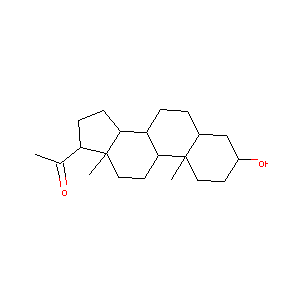
General Information of Drug (ID: DM38CIV)

Drug Name
ELTANOLONE
Synonyms
Pregnanolone; 3alpha-Hydroxy-5beta-pregnan-20-one; 128-20-1; Pregnanolone II; Pregnan-3alpha-ol-20-one; Eltanolona; Eltanolonum; 5beta-Pregnan-3alpha-ol-20-one; Eltanolone [INN]; SKF 6455; NSC 82867; UNII-BXO86P3XXW; Eltanolonum [INN-Latin]; Eltanolona [INN-Spanish]; Allopregnan-3 beta-ol-20-one; (3alpha,5beta)-3-hydroxypregnan-20-one; 3alpha-Hydroxy-5beta-tetrahydroprogesterone; 3alpha,5beta-Epimeric pregnanolone; Pregnanolone, (3alpha,5beta)-isomer; BXO86P3XXW
Indication
Disease Entry ICD 11 Status REF
Premenstrual syndrome GA34.40 Discontinued in Phase 3 [1]
Drug Type
Small molecular drug
Structure
3D MOL 2D MOL
#Ro5 Violations (Lipinski): 0 Molecular Weight (mw) 318.5
Logarithm of the Partition Coefficient (xlogp) 4.9
Rotatable Bond Count (rotbonds) 1
Hydrogen Bond Donor Count (hbonddonor) 1
Hydrogen Bond Acceptor Count (hbondacc) 2
ADMET Property
Clearance
The drug present in the plasma can be removed from the body at the rate of 22 mL/min/kg [2]
Half-life
The concentration or amount of drug in body reduced by one-half in 4.7 hours [2]
Unbound Fraction
The unbound fraction of drug in plasma is 0.01% [2]
Vd
Fluid volume that would be required to contain the amount of drug present in the body at the same concentration as in the plasma 2 L/kg [2]
Chemical Identifiers
Formula
C21H34O2
IUPAC Name
1-[(3R,5R,8R,9S,10S,13S,14S,17S)-3-hydroxy-10,13-dimethyl-2,3,4,5,6,7,8,9,11,12,14,15,16,17-tetradecahydro-1H-cyclopenta[a]phenanthren-17-yl]ethanone
Canonical SMILES
CC(=O)[C@H]1CC[C@@H]2[C@@]1(CC[C@H]3[C@H]2CC[C@H]4[C@@]3(CC[C@H](C4)O)C)C
InChI
InChI=1S/C21H34O2/c1-13(22)17-6-7-18-16-5-4-14-12-15(23)8-10-20(14,2)19(16)9-11-21(17,18)3/h14-19,23H,4-12H2,1-3H3/t14-,15-,16+,17-,18+,19+,20+,21-/m1/s1
InChIKey
AURFZBICLPNKBZ-YZRLXODZSA-N
Cross-matching ID
PubChem CID
31402
ChEBI ID
CHEMBL1712
CAS Number
128-20-1
UNII
BXO86P3XXW
DrugBank ID
DB12308
TTD ID
D0B8YZ
Drug ADMET Endpoint Profile (DAE)NEW Click to Jump to the Detailed DAE Information of This Drug

Molecular Interaction Atlas of This Drug


Drug Therapeutic Target (DTT)
DTT Name DTT ID UniProt ID MOA REF
GABA(A) receptor alpha-1 (GABRA1) TT1MPAY GBRA1_HUMAN Inhibitor [3]
GABA(A) receptor beta-2 (GABRB2) TTZA1NY GBRB2_HUMAN Inhibitor [3]
GABA(A) receptor gamma-2 (GABRG2) TT06RH5 GBRG2_HUMAN Inhibitor [3]
Gamma-aminobutyric acid receptor (GAR) TTNJYV2 NOUNIPROTAC Inhibitor [4]

Drug Off-Target (DOT)
DOT Name DOT ID UniProt ID Interaction REF
Aldo-keto reductase family 1 member C1 (AKR1C1) OTQKR4CM AK1C1_HUMAN Biotransformations [5]
Aldo-keto reductase family 1 member C2 (AKR1C2) OTQ2XMO3 AK1C2_HUMAN Biotransformations [5]
Aldo-keto reductase family 1 member C3 (AKR1C3) OTU2SXBA AK1C3_HUMAN Biotransformations [6]
Aldo-keto reductase family 1 member C4 (AKR1C4) OTW2MMOF AK1C4_HUMAN Regulation of Drug Effects [7]
Molecular Interaction Atlas (MIA) Jump to Detail Molecular Interaction Atlas of This Drug

References

1 Trusted, scientifically sound profiles of drug programs, clinical trials, safety reports, and company deals, written by scientists. Springer. 2015. Adis Insight (drug id 800005875)
2 Trend Analysis of a Database of Intravenous Pharmacokinetic Parameters in Humans for 1352 Drug Compounds
3 Neurosteroid analogues. 10. The effect of methyl group substitution at the C-6 and C-7 positions on the GABA modulatory and anesthetic actions of (... J Med Chem. 2005 Apr 21;48(8):3051-9.
4 Neurosteroid analogues. 11. Alternative ring system scaffolds: gamma-aminobutyric acid receptor modulation and anesthetic actions of benz[f]indenes. J Med Chem. 2006 Jul 27;49(15):4595-605.
5 Substrate specificity of human 3(20)alpha-hydroxysteroid dehydrogenase for neurosteroids and its inhibition by benzodiazepines. Biol Pharm Bull. 2002 Apr;25(4):441-5.
6 Important roles of the AKR1C2 and SRD5A1 enzymes in progesterone metabolism in endometrial cancer model cell lines. Chem Biol Interact. 2015 Jun 5;234:297-308. doi: 10.1016/j.cbi.2014.11.012. Epub 2014 Nov 23.
7 Selective and potent inhibitors of human 20alpha-hydroxysteroid dehydrogenase (AKR1C1) that metabolizes neurosteroids derived from progesterone. Chem Biol Interact. 2003 Feb 1;143-144:503-13.