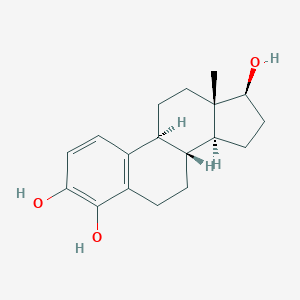
General Information of Drug (ID: DMJXQME)

Drug Name
Hydroxyestradiol
Synonyms
4-Hydroxy-17-beta-estradiol; 4-Hydroxyestradiol-17beta; 4-OH-Estradiol; 4-hydroxy-estradiol; 4-HYDROXYESTRADIOL; 4-hydroxyestradiol-17 beta; 4OHE2; 5976-61-4; C3ZO03450E; CHEBI:62845; MLS000069567; SMR000058747; UNII-C3ZO03450E; estra-1,3,5(10)-triene-2,4,17beta-triol; 4-Hydroxyestradiol; (8R,9S,13S,14S,17S)-13-methyl-6,7,8,9,11,12,14,15,16,17-decahydrocyclopenta[a]phenanthrene-3,4,17-triol; 1,3,5(10)-Estratriene-3,4,17beta-triol; 1,3,5[10]-ESTRATRIENE-3,4,17BETA-TRIOL; 3,4,17beta-estriol; 3,4,17beta-trihydroxy-1,3,5[10]-estratriene
Structure
3D MOL 2D MOL
#Ro5 Violations (Lipinski): 0 Molecular Weight (mw) 288.4
Logarithm of the Partition Coefficient (xlogp) 3.7
Rotatable Bond Count (rotbonds) 0
Hydrogen Bond Donor Count (hbonddonor) 3
Hydrogen Bond Acceptor Count (hbondacc) 3
Chemical Identifiers
Formula
C18H24O3
IUPAC Name
(8R,9S,13S,14S,17S)-13-methyl-6,7,8,9,11,12,14,15,16,17-decahydrocyclopenta[a]phenanthrene-3,4,17-triol
Canonical SMILES
CC12CCC3C(C1CCC2O)CCC4=C3C=CC(=C4O)O
InChI
InChI=1S/C18H24O3/c1-18-9-8-11-10-4-6-15(19)17(21)13(10)3-2-12(11)14(18)5-7-16(18)20/h4,6,11-12,14,16,19-21H,2-3,5,7-9H2,1H3/t11-,12-,14+,16+,18+/m1/s1
InChIKey
QOZFCKXEVSGWGS-ZHIYBZGJSA-N
Cross-matching ID
PubChem CID
5282360
ChEBI ID
CHEMBL1412489
CAS Number
5976-61-4
INTEDE ID
DR1976
Drug-Molecule Activity Atlas (DMA)NEW Click to Jump to the Detailed DMA Information of This Drug
Drug ADMET Endpoint Profile (DAE)NEW Click to Jump to the Detailed DAE Information of This Drug

Molecular Interaction Atlas of This Drug


Drug-Metabolizing Enzyme (DME)
DME Name DME ID UniProt ID MOA REF
UDP-glucuronosyltransferase 1A6 (UGT1A6)
Main DME
DESD26P UD16_HUMAN Substrate [1]

Drug Off-Target (DOT)
DOT Name DOT ID UniProt ID Interaction REF
Alkaline phosphatase, germ cell type (ALPG) OTCIM29R PPBN_HUMAN Gene/Protein Processing [2]
ATP synthase subunit a (ATP6) OTPHOGLX ATP6_HUMAN Gene/Protein Processing [3]
Cadherin-1 (CDH1) OTFJMXPM CADH1_HUMAN Gene/Protein Processing [4]
Cytochrome c oxidase subunit 3 (COX3) OTNNGBYJ COX3_HUMAN Gene/Protein Processing [3]
Myc proto-oncogene protein (MYC) OTPV5LUK MYC_HUMAN Gene/Protein Processing [4]
Sex hormone-binding globulin (SHBG) OTPWU5IW SHBG_HUMAN Gene/Protein Processing [5]
UDP-glucuronosyltransferase 2B15 OTABTFU2 UDB15_HUMAN Regulation of Drug Effects [6]
Vascular endothelial growth factor A, long form OTIM9MZ3 VEGFA_HUMAN Gene/Protein Processing [7]
Vimentin OTGZLW4J VIME_HUMAN Gene/Protein Processing [4]
Molecular Interaction Atlas (MIA) Jump to Detail Molecular Interaction Atlas of This Drug

References

1 Structural and functional studies of UDP-glucuronosyltransferases. Drug Metab Rev. 1999 Nov;31(4):817-99.
2 Estrogenic and genotoxic potential of equol and two hydroxylated metabolites of Daidzein in cultured human Ishikawa cells. Toxicol Lett. 2005 Jul 28;158(1):72-86. doi: 10.1016/j.toxlet.2005.02.011. Epub 2005 Apr 11.
3 Enhanced levels of several mitochondrial mRNA transcripts and mitochondrial superoxide production during ethinyl estradiol-induced hepatocarcinogenesis and after estrogen treatment of HepG2 cells. Carcinogenesis. 1998 Dec;19(12):2187-93. doi: 10.1093/carcin/19.12.2187.
4 Long-term exposure of 4-hydroxyestradiol induces the cancer cell characteristics via upregulating CYP1B1 in MCF-10A cells. Toxicol Mech Methods. 2019 Nov;29(9):686-692. doi: 10.1080/15376516.2019.1650146. Epub 2019 Aug 30.
5 The ability of hydroxylated estrogens (2-OH-E2 and 4-OH-E2) to increase of SHBG gene, protein expression and intracellular levels in MCF-7 cells line. Endocr Regul. 2011 Jul;45(3):125-30. doi: 10.4149/endo_2011_03_125.
6 Stable expression of a human liver UDP-glucuronosyltransferase (UGT2B15) with activity toward steroid and xenobiotic substrates. Drug Metab Dispos. 1994 Sep-Oct;22(5):799-805.
7 4-Hydroxy estradiol but not 2-hydroxy estradiol induces expression of hypoxia-inducible factor 1alpha and vascular endothelial growth factor A through phosphatidylinositol 3-kinase/Akt/FRAP pathway in OVCAR-3 and A2780-CP70 human ovarian carcinoma cells. Toxicol Appl Pharmacol. 2004 Apr 1;196(1):124-35. doi: 10.1016/j.taap.2003.12.002.