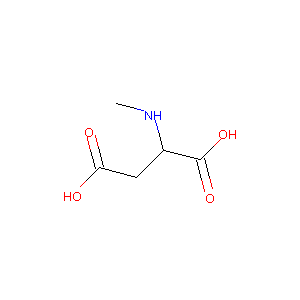
General Information of Drug (ID: DMKP6BM)

Drug Name
2-Methylamino-succinic acid(NMDA)
Synonyms
N-Methyl-D-aspartic acid; N-methyl-D-aspartic acid; NMDA; 6384-92-5; N-Methyl-D-aspartate; N-Methylaspartate; D-Aspartic acid, N-methyl-; N-Me-D-Asp-OH; (R)-2-(Methylamino)succinic acid; NMDA (N-Methyl-D-aspartic acid); Methyl aspartic acid; n-methyl-d-aspartic acid (nmda); UNII-1903B9Q6PI; N-Methyl aspartic acid; (2R)-2-(methylamino)butanedioic acid; 2-Methylamino-succinic acid; BRN 1724431; CHEMBL291278; CHEBI:31882; HOKKHZGPKSLGJE-GSVOUGTGSA-N; 1903B9Q6PI; N-Methyl-D-aspartic Acid, Hydrate; AK-44365; W-203368; N-Methyl-D-aspartic acid, 98%
Indication
Disease Entry ICD 11 Status REF
Discovery agent N.A. Investigative [1]
Drug Type
Small molecular drug
Structure
3D MOL 2D MOL
#Ro5 Violations (Lipinski): 1 Molecular Weight (mw) 147.13
Logarithm of the Partition Coefficient (xlogp) -3.4
Rotatable Bond Count (rotbonds) 4
Hydrogen Bond Donor Count (hbonddonor) 3
Hydrogen Bond Acceptor Count (hbondacc) 5
Chemical Identifiers
Formula
C5H9NO4
IUPAC Name
(2R)-2-(methylamino)butanedioic acid
Canonical SMILES
CN[C@H](CC(=O)O)C(=O)O
InChI
InChI=1S/C5H9NO4/c1-6-3(5(9)10)2-4(7)8/h3,6H,2H2,1H3,(H,7,8)(H,9,10)/t3-/m1/s1
InChIKey
HOKKHZGPKSLGJE-GSVOUGTGSA-N
Cross-matching ID
PubChem CID
22880
ChEBI ID
CHEMBL31882
CAS Number
6384-92-5
TTD ID
D06GKL
Drug-Molecule Activity Atlas (DMA)NEW Click to Jump to the Detailed DMA Information of This Drug
Drug Pharmacogenomic Perturbation (DPP)NEW Click to Jump to the Detailed DPP Information of This Drug
Drug ADMET Endpoint Profile (DAE)NEW Click to Jump to the Detailed DAE Information of This Drug

Molecular Interaction Atlas of This Drug


Drug Therapeutic Target (DTT)
DTT Name DTT ID UniProt ID MOA REF
Glutamate receptor ionotropic NMDA 1 (NMDAR1) TTLD29N NMDZ1_HUMAN Inhibitor [2]
Glutamate receptor ionotropic NMDA 2A (NMDAR2A) TTKJEMQ NMDE1_HUMAN Inhibitor [3]
Glutamate receptor ionotropic NMDA 2B (NMDAR2B) TTN9D8E NMDE2_HUMAN Inhibitor [4]
Glutamate receptor ionotropic NMDA 2C (GluN2C) TT1M8OW NMDE3_HUMAN Agonist [5]
Glutamate receptor ionotropic NMDA 2D (GluN2D) TT5POTG NMDE4_HUMAN Agonist [6]

Drug Off-Target (DOT)
DOT Name DOT ID UniProt ID Interaction REF
Mitogen-activated protein kinase 1 (MAPK1) OTH85PI5 MK01_HUMAN Post-Translational Modifications [7]
Mitogen-activated protein kinase 3 (MAPK3) OTCYKGKO MK03_HUMAN Post-Translational Modifications [7]
SH3 and multiple ankyrin repeat domains protein 2 (SHANK2) OTSQTPFQ SHAN2_HUMAN Gene/Protein Processing [8]
Tight junction protein ZO-1 (TJP1) OTBDCUPK ZO1_HUMAN Gene/Protein Processing [9]
Molecular Interaction Atlas (MIA) Jump to Detail Molecular Interaction Atlas of This Drug

References

1 2,4-Dihydro-3H-1,2,4-triazol-3-ones as anticonvulsant agents. J Med Chem. 1990 Oct;33(10):2772-7.
2 URL: http://www.guidetopharmacology.org Nucleic Acids Res. 2015 Oct 12. pii: gkv1037. The IUPHAR/BPS Guide to PHARMACOLOGY in 2016: towards curated quantitative interactions between 1300 protein targets and 6000 ligands. (Target id: 455).
3 URL: http://www.guidetopharmacology.org Nucleic Acids Res. 2015 Oct 12. pii: gkv1037. The IUPHAR/BPS Guide to PHARMACOLOGY in 2016: towards curated quantitative interactions between 1300 protein targets and 6000 ligands. (Target id: 456).
4 URL: http://www.guidetopharmacology.org Nucleic Acids Res. 2015 Oct 12. pii: gkv1037. The IUPHAR/BPS Guide to PHARMACOLOGY in 2016: towards curated quantitative interactions between 1300 protein targets and 6000 ligands. (Target id: 457).
5 URL: http://www.guidetopharmacology.org Nucleic Acids Res. 2015 Oct 12. pii: gkv1037. The IUPHAR/BPS Guide to PHARMACOLOGY in 2016: towards curated quantitative interactions between 1300 protein targets and 6000 ligands. (Target id: 458).
6 URL: http://www.guidetopharmacology.org Nucleic Acids Res. 2015 Oct 12. pii: gkv1037. The IUPHAR/BPS Guide to PHARMACOLOGY in 2016: towards curated quantitative interactions between 1300 protein targets and 6000 ligands. (Target id: 459).
7 Kukoamine B, an amide alkaloid, protects against NMDA-induced neurotoxicity and potential mechanisms in vitro. Neurochem Int. 2015 Aug;87:66-76. doi: 10.1016/j.neuint.2015.06.001. Epub 2015 Jun 9.
8 Establishment of a 13 genes-based molecular prediction score model to discriminate the neurotoxic potential of food relevant-chemicals. Toxicol Lett. 2022 Feb 1;355:1-18. doi: 10.1016/j.toxlet.2021.10.013. Epub 2021 Nov 5.
9 N-methyl-D-aspartic acid increases tight junction protein destruction in brain endothelial cell via caveolin-1-associated ERK1/2 signaling. Toxicology. 2022 Mar 30;470:153139. doi: 10.1016/j.tox.2022.153139. Epub 2022 Mar 4.