General Information of Drug Combination (ID: DC138IF)

Drug Combination Name
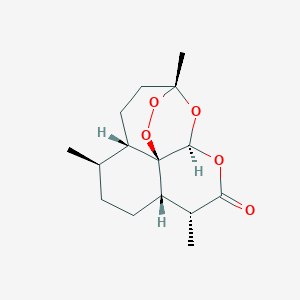
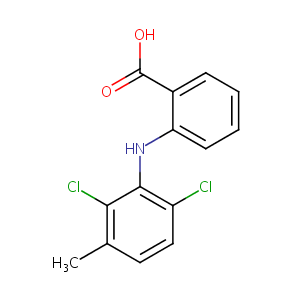
Artemisinin Meclofenamic acid
Indication
Disease Entry Status REF
Chronic myelogenous leukemia Investigative [1]
Component Drugs Artemisinin   DMOY7W3 Meclofenamic acid   DM05FXR
Small molecular drug Small molecular drug
2D MOL 2D MOL
3D MOL 3D MOL
High-throughput Screening Result Testing Cell Line: KBM-7
Zero Interaction Potency (ZIP) Score: 6.8
Bliss Independence Score: 6.8
Loewe Additivity Score: 14.76
LHighest Single Agent (HSA) Score: 14.76

Molecular Interaction Atlas of This Drug Combination

Molecular Interaction Atlas (MIA)
Indication(s) of Artemisinin
Disease Entry ICD 11 Status REF
Malaria 1F40-1F45 Approved [2]
Artemisinin Interacts with 2 DTT Molecule(s)
DTT Name DTT ID UniProt ID Mode of Action REF
Plasmodium Dihydroorotate dehydrogenase (Malaria DHOdehase) TT3PQ2Y PYRD_PLAF7 Inhibitor [2]
Sarcoplasmic/endoplasmic reticulum calcium ATPase (ATP2A) TTZVSJ2 NOUNIPROTAC Inhibitor [2]
------------------------------------------------------------------------------------
Artemisinin Interacts with 4 DME Molecule(s)
DME Name DME ID UniProt ID Mode of Action REF
Cytochrome P450 3A4 (CYP3A4) DE4LYSA CP3A4_HUMAN Metabolism [7]
Cytochrome P450 2A6 (CYP2A6) DEJVYAZ CP2A6_HUMAN Metabolism [8]
Glutathione S-transferase alpha-1 (GSTA1) DE4ZHS1 GSTA1_HUMAN Metabolism [9]
Cytochrome P450 2B6 (CYP2B6) DEPKLMQ CP2B6_HUMAN Metabolism [7]
------------------------------------------------------------------------------------
Artemisinin Interacts with 4 DOT Molecule(s)
DOT Name DOT ID UniProt ID Mode of Action REF
Cytochrome P450 2C19 (CYP2C19) OTFMJYYE CP2CJ_HUMAN Decreases Activity [10]
ATP-dependent translocase ABCB1 (ABCB1) OTEJROBO MDR1_HUMAN Increases Expression [11]
Isocitrate dehydrogenase subunit alpha, mitochondrial (IDH3A) OT5QQB5L IDH3A_HUMAN Decreases Expression [12]
Nuclear receptor subfamily 1 group I member 3 (NR1I3) OTS3SGH7 NR1I3_HUMAN Increases Activity [13]
------------------------------------------------------------------------------------
Indication(s) of Meclofenamic acid
Disease Entry ICD 11 Status REF
Ankylosing spondylitis FA92.0 Approved [3]
Dysmenorrhea GA34.3 Approved [4]
Joint pain ME82 Approved [3]
Menorrhagia GA20.50 Approved [4]
Osteoarthritis FA00-FA05 Approved [5]
Pain MG30-MG3Z Approved [6]
Meclofenamic acid Interacts with 1 DTT Molecule(s)
DTT Name DTT ID UniProt ID Mode of Action REF
Prostaglandin G/H synthase (COX) TTK0943 PGH1_HUMAN; PGH2_HUMAN Inhibitor [14]
------------------------------------------------------------------------------------
Meclofenamic acid Interacts with 1 DME Molecule(s)
DME Name DME ID UniProt ID Mode of Action REF
Cytochrome P450 102A1 (cyp102) DE4OGUF CPXB_BACMB Metabolism [15]
------------------------------------------------------------------------------------
Meclofenamic acid Interacts with 4 DOT Molecule(s)
DOT Name DOT ID UniProt ID Mode of Action REF
Aldo-keto reductase family 1 member C3 (AKR1C3) OTU2SXBA AK1C3_HUMAN Decreases Activity [16]
Aldo-keto reductase family 1 member C2 (AKR1C2) OTQ2XMO3 AK1C2_HUMAN Decreases Activity [16]
Aldo-keto reductase family 1 member C1 (AKR1C1) OTQKR4CM AK1C1_HUMAN Decreases Activity [16]
Aldo-keto reductase family 1 member C4 (AKR1C4) OTW2MMOF AK1C4_HUMAN Decreases Activity [17]
------------------------------------------------------------------------------------

References

1 CheMBL Affinity Phenotypic Cellular Interaction Assay ID: CHEMBL1125966
2 The fight against drug-resistant malaria: novel plasmodial targets and antimalarial drugs. Curr Med Chem. 2008;15(2):161-71.
3 URL: http://www.guidetopharmacology.org Nucleic Acids Res. 2015 Oct 12. pii: gkv1037. The IUPHAR/BPS Guide to PHARMACOLOGY in 2016: towards curated quantitative interactions between 1300 protein targets and 6000 ligands. (Ligand id: 7219).
4 Use of meclofenamic acid in gynecology and obstetrics: effects on postsurgical stress. Clin J Pain. 1991;7 Suppl 1:S60-3.
5 Quantitation of indomethacin in serum and plasma using gas chromatography-mass spectrometry (GC-MS). Methods Mol Biol. 2010;603:297-305.
6 Meclofenamic Acid Restores Gefinitib Sensitivity by Downregulating Breast Cancer Resistance Protein and Multidrug Resistance Protein 7 via FTO/m6A-Demethylation/c-Myc in Non-Small Cell Lung Cancer. Front Oncol. 2022 Apr 21;12:870636.
7 Antimalarial artemisinin drugs induce cytochrome P450 and MDR1 expression by activation of xenosensors pregnane X receptor and constitutive androstane receptor. Mol Pharmacol. 2005 Jun;67(6):1954-65.
8 Identification of the human cytochrome P450 enzymes involved in the in vitro metabolism of artemisinin. Br J Clin Pharmacol. 1999 Oct;48(4):528-35.
9 Inhibition of glutathione S-transferases by antimalarial drugs possible implications for circumventing anticancer drug resistance. Int J Cancer. 2002 Feb 10;97(5):700-5.
10 Application of higher throughput screening (HTS) inhibition assays to evaluate the interaction of antiparasitic drugs with cytochrome P450s. Drug Metab Dispos. 2001 Jan;29(1):30-5.
11 Antimalarial artemisinin drugs induce cytochrome P450 and MDR1 expression by activation of xenosensors pregnane X receptor and constitutive androstane receptor. Mol Pharmacol. 2005 Jun;67(6):1954-65.
12 Identification of Compounds That Inhibit Estrogen-Related Receptor Alpha Signaling Using High-Throughput Screening Assays. Molecules. 2019 Feb 27;24(5):841. doi: 10.3390/molecules24050841.
13 In vivo and mechanistic evidence of nuclear receptor CAR induction by artemisinin. Eur J Clin Invest. 2006 Sep;36(9):647-53. doi: 10.1111/j.1365-2362.2006.01700.x.
14 Interactions of PGH synthase isozymes-1 and -2 with NSAIDs. Ann N Y Acad Sci. 1994 Nov 15;744:50-7.
15 Both reactivity and accessibility are important in cytochrome P450 metabolism: a combined DFT and MD study of fenamic acids in BM3 mutants. J Chem Inf Model. 2019 Feb 25;59(2):743-753.
16 Type 5 17beta-hydroxysteroid dehydrogenase/prostaglandin F synthase (AKR1C3): role in breast cancer and inhibition by non-steroidal anti-inflammatory drug analogs. Chem Biol Interact. 2009 Mar 16;178(1-3):221-7.
17 Initro CAPE inhibitory activity towards human AKR1C3 and the molecular basis. Chem Biol Interact. 2016 Jun 25;253:60-5.