| 1 |
CheMBL Affinity Phenotypic Cellular Interaction Assay ID: CHEMBL1126165
|
| 2 |
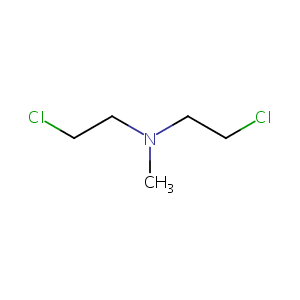
Mechlorethamine FDA Label
|
| 3 |
Drugs@FDA. U.S. Food and Drug Administration. U.S. Department of Health & Human Services. 2015
|
| 4 |
URL: http://www.guidetopharmacology.org Nucleic Acids Res. 2015 Oct 12. pii: gkv1037. The IUPHAR/BPS Guide to PHARMACOLOGY in 2016: towards curated quantitative interactions between 1300 protein targets and 6000 ligands. (Ligand id: 7218).
|
| 5 |
URL: http://www.guidetopharmacology.org Nucleic Acids Res. 2015 Oct 12. pii: gkv1037. The IUPHAR/BPS Guide to PHARMACOLOGY in 2016: towards curated quantitative interactions between 1300 protein targets and 6000 ligands. (Ligand id: 8394).
|
| 6 |
The Pluripotency Factor Musashi-2 Is a Novel Target for Lung Cancer Therapy.Ann Am Thorac Soc. 2018 Apr;15(Supplement_2):S124.
|
| 7 |
Thioredoxin Cross-Linking by Nitrogen Mustard in Lung Epithelial Cells: Formation of Multimeric Thioredoxin/Thioredoxin Reductase Complexes and Inhibition of Disulfide Reduction. Chem Res Toxicol. 2015 Nov 16;28(11):2091-103. doi: 10.1021/acs.chemrestox.5b00194. Epub 2015 Oct 19.
|
| 8 |
Cross-linking of thioredoxin reductase by the sulfur mustard analogue mechlorethamine (methylbis(2-chloroethyl)amine) in human lung epithelial cells and rat lung: selective inhibition of disulfide reduction but not redox cycling. Chem Res Toxicol. 2014 Jan 21;27(1):61-75. doi: 10.1021/tx400329a. Epub 2013 Dec 9.
|
| 9 |
Proteomic analysis of DNA-protein cross-linking by antitumor nitrogen mustards. Chem Res Toxicol. 2009 Jun;22(6):1151-62.
|
| 10 |
Down-regulation of HER-2 expression in human breast cancer cell HBC-4 and ZR75-1 by nitrogen-mustard-N-oxide. Kobe J Med Sci. 2007;53(4):135-42.
|
| 11 |
Nitrogen mustard prevents transport of Fra-1 into the nucleus to promote c-Fos- and FosB-dependent IL-8 induction in injured mouse epidermis. Toxicol Lett. 2020 Feb 1;319:256-263. doi: 10.1016/j.toxlet.2019.10.006. Epub 2019 Oct 19.
|
| 12 |
S100P is selectively upregulated in tumor cell lines challenged with DNA cross-linking agents. Leuk Res. 2005 Oct;29(10):1181-90. doi: 10.1016/j.leukres.2005.03.012.
|
| 13 |
Histopathologic and immunohistochemical features in human skin after exposure to nitrogen and sulfur mustard. Am J Dermatopathol. 1998 Feb;20(1):22-8. doi: 10.1097/00000372-199802000-00005.
|
| 14 |
Increased expression of VDAC1 sensitizes carcinoma cells to apoptosis induced by DNA cross-linking agents. Biochem Pharmacol. 2012 May 1;83(9):1172-82. doi: 10.1016/j.bcp.2012.01.017. Epub 2012 Jan 21.
|
| 15 |
Activation of the human TRPA1 channel by different alkylating sulfur and nitrogen mustards and structurally related chemotherapeutic drugs. Toxicol Lett. 2023 Mar 1;376:51-59. doi: 10.1016/j.toxlet.2023.01.007. Epub 2023 Jan 21.
|
| 16 |
The activity of a novel mithramycin analog is related to its binding to DNA, cellular accumulation, and inhibition of Sp1-driven gene transcription. Chem Biol Interact. 2014 Aug 5;219:123-32. doi: 10.1016/j.cbi.2014.05.019. Epub 2014 Jun 4.
|
| 17 |
Role of magnesium ion in mithramycin-DNA interaction: binding of mithramycin-Mg2+ complexes with DNA. Biochemistry. 1995 Jan 31;34(4):1376-85.
|
| 18 |
SP1 and SP3 mediate progesterone-dependent induction of the 17beta hydroxysteroid dehydrogenase type 2 gene in human endometrium. Biol Reprod. 2006 Oct;75(4):605-14.
|
| 19 |
Molecular mechanisms of transactivation and doxorubicin-mediated repression of survivin gene in cancer cells. J Biol Chem. 2007 Jan 26;282(4):2615-25. doi: 10.1074/jbc.M606203200. Epub 2006 Nov 22.
|
| 20 |
Mithramycin inhibits human epithelial carcinoma cell proliferation and migration involving downregulation of Eps8 expression. Chem Biol Interact. 2010 Jan 5;183(1):181-6. doi: 10.1016/j.cbi.2009.09.018.
|
| 21 |
The human receptor tyrosine kinase Axl gene--promoter characterization and regulation of constitutive expression by Sp1, Sp3 and CpG methylation. Biosci Rep. 2008 Jun;28(3):161-76. doi: 10.1042/BSR20080046.
|
| 22 |
Sp sites contribute to basal and inducible expression of the human TNIP1 (TNF-inducible protein 3-interacting protein 1) promoter. Biochem J. 2013 Jun 15;452(3):519-29. doi: 10.1042/BJ20121666.
|
| 23 |
Transcriptional regulation of neutral sphingomyelinase 2 gene expression of a human breast cancer cell line, MCF-7, induced by the anti-cancer drug, daunorubicin. Biochim Biophys Acta. 2009 Nov-Dec;1789(11-12):681-90. doi: 10.1016/j.bbagrm.2009.08.006. Epub 2009 Aug 19.
|
| 24 |
CheMBL Affinity Phenotypic Cellular Interaction Assay ID: CHEMBL1125966
|
| 25 |
CheMBL Affinity Phenotypic Cellular Interaction Assay ID: CHEMBL1125976
|
|
|
|
|
|
|