General Information of Drug Combination (ID: DC56ANW)

Drug Combination Name
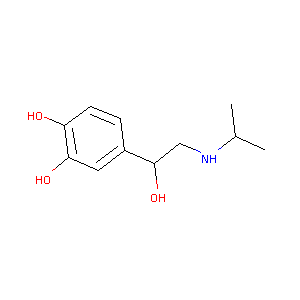
Isoproterenol Trifluoperazine
Indication
Disease Entry Status REF
Chronic myelogenous leukemia Investigative [1]
Component Drugs Isoproterenol   DMK7MEY Trifluoperazine   DMKBYWI
Small molecular drug Small molecular drug
2D MOL 2D MOL
3D MOL 3D MOL
High-throughput Screening Result Testing Cell Line: KBM-7
Zero Interaction Potency (ZIP) Score: 22.21
Bliss Independence Score: 22.21
Loewe Additivity Score: 34.51
LHighest Single Agent (HSA) Score: 34.51

Molecular Interaction Atlas of This Drug Combination

Molecular Interaction Atlas (MIA)
Indication(s) of Isoproterenol
Disease Entry ICD 11 Status REF
Atrioventricular block N.A. Approved [2]
Cardiac arrest MC82 Approved [2]
Common cold CA00 Approved [2]
Heart block BC63 Approved [3]
Melanoma 2C30 Phase 1 [4]
Isoproterenol Interacts with 3 DTT Molecule(s)
DTT Name DTT ID UniProt ID Mode of Action REF
Adrenergic receptor beta-1 (ADRB1) TTR6W5O ADRB1_HUMAN Agonist [8]
Adrenergic receptor beta-2 (ADRB2) TT2CJVK ADRB2_HUMAN Modulator [8]
Interleukin-12 beta (IL12B) TTGW72V IL12B_HUMAN Modulator [9]
------------------------------------------------------------------------------------
Isoproterenol Interacts with 1 DME Molecule(s)
DME Name DME ID UniProt ID Mode of Action REF
Thiopurine methyltransferase (TPMT) DEFQ8VO TPMT_HUMAN Metabolism [10]
------------------------------------------------------------------------------------
Isoproterenol Interacts with 40 DOT Molecule(s)
DOT Name DOT ID UniProt ID Mode of Action REF
Apoptotic protease-activating factor 1 (APAF1) OTJWIVY0 APAF_HUMAN Increases Expression [7]
ATP-binding cassette sub-family C member 3 (ABCC3) OTC3IJV4 MRP3_HUMAN Decreases Expression [7]
Bcl-2-like protein 11 (BCL2L11) OTNQQWFJ B2L11_HUMAN Increases Expression [7]
Metalloproteinase inhibitor 1 (TIMP1) OTOXC51H TIMP1_HUMAN Decreases Expression [7]
C-C motif chemokine 3 (CCL3) OTW2H3ND CCL3_HUMAN Increases Expression [7]
Heat shock cognate 71 kDa protein (HSPA8) OTJI2RCI HSP7C_HUMAN Decreases Expression [7]
Tumor necrosis factor receptor superfamily member 1A (TNFRSF1A) OT2D9DOV TNR1A_HUMAN Decreases Expression [7]
Phosphatidylcholine translocator ABCB4 (ABCB4) OTE6PY83 MDR3_HUMAN Decreases Expression [7]
14-3-3 protein sigma (SFN) OTLJCZ1U 1433S_HUMAN Decreases Expression [7]
Heat shock 70 kDa protein 1-like (HSPA1L) OTC2V1K6 HS71L_HUMAN Decreases Expression [7]
Metalloproteinase inhibitor 3 (TIMP3) OTDGQAD1 TIMP3_HUMAN Increases Expression [7]
Heat shock-related 70 kDa protein 2 (HSPA2) OTSDET7B HSP72_HUMAN Increases Expression [7]
C-C motif chemokine 7 (CCL7) OTDIS99H CCL7_HUMAN Decreases Expression [7]
Bcl-2-like protein 1 (BCL2L1) OTRC5K9O B2CL1_HUMAN Decreases Expression [7]
Four and a half LIM domains protein 1 (FHL1) OTN535SU FHL1_HUMAN Decreases Expression [7]
Phorbol-12-myristate-13-acetate-induced protein 1 (PMAIP1) OTXEE550 APR_HUMAN Increases Expression [7]
Bcl-2 homologous antagonist/killer (BAK1) OTDP6ILW BAK_HUMAN Decreases Expression [7]
Regenerating islet-derived protein 3-gamma (REG3G) OTLIUY8Z REG3G_HUMAN Decreases Expression [7]
Metalloproteinase inhibitor 4 (TIMP4) OT8A68SW TIMP4_HUMAN Decreases Expression [7]
Aryl hydrocarbon receptor nuclear translocator 2 (ARNT2) OTAQD3YV ARNT2_HUMAN Decreases Expression [7]
Hypoxia-inducible factor 1-alpha inhibitor (HIF1AN) OT5LIL3W HIF1N_HUMAN Decreases Expression [7]
Hypoxia-inducible factor 3-alpha (HIF3A) OTPWAAMC HIF3A_HUMAN Increases Expression [7]
Proepiregulin (EREG) OTRM4NQY EREG_HUMAN Increases Expression [11]
Renin (REN) OT52GZR2 RENI_HUMAN Increases Activity [12]
Transforming growth factor beta-1 proprotein (TGFB1) OTV5XHVH TGFB1_HUMAN Decreases Expression [13]
Natriuretic peptides A (NPPA) OTMQNTNX ANF_HUMAN Increases Expression [14]
Antileukoproteinase (SLPI) OTUNFUU8 SLPI_HUMAN Increases Expression [11]
Alkaline phosphatase, placental type (ALPP) OTZU4G9W PPB1_HUMAN Increases Expression [15]
Beta-2 adrenergic receptor (ADRB2) OTSDOX4Q ADRB2_HUMAN Increases Expression [16]
Poly polymerase 1 (PARP1) OT310QSG PARP1_HUMAN Decreases Expression [17]
Interleukin-8 (CXCL8) OTS7T5VH IL8_HUMAN Increases Expression [11]
Beta-3 adrenergic receptor (ADRB3) OTPMG4V7 ADRB3_HUMAN Increases Activity [18]
Natriuretic peptides B (NPPB) OTSN2IPY ANFB_HUMAN Increases Expression [14]
Mitogen-activated protein kinase 3 (MAPK3) OTCYKGKO MK03_HUMAN Increases Phosphorylation [19]
Mitogen-activated protein kinase 1 (MAPK1) OTH85PI5 MK01_HUMAN Increases Phosphorylation [19]
Tumor necrosis factor-inducible gene 6 protein (TNFAIP6) OT1SLUZH TSG6_HUMAN Decreases Expression [11]
Ryanodine receptor 2 (RYR2) OT0PF19E RYR2_HUMAN Increases Phosphorylation [20]
Guanine nucleotide-binding protein G(olf) subunit alpha (GNAL) OTESDTEU GNAL_HUMAN Increases Response To Substance [21]
Neuroendocrine secretory protein 55 (GNAS) OTMH8BKJ GNAS3_HUMAN Increases Response To Substance [21]
Interleukin-5 receptor subunit alpha (IL5RA) OTMSLUG9 IL5RA_HUMAN Affects Response To Substance [22]
------------------------------------------------------------------------------------
⏷ Show the Full List of 40 DOT(s)
Indication(s) of Trifluoperazine
Disease Entry ICD 11 Status REF
Anxiety N.A. Approved [5]
Schizophrenia 6A20 Approved [6]
Trifluoperazine Interacts with 1 DTT Molecule(s)
DTT Name DTT ID UniProt ID Mode of Action REF
Calmodulin (CALM) TTV3NH6 CALM1_HUMAN; CALM2_HUMAN; CALM3_HUMAN Inhibitor [24]
------------------------------------------------------------------------------------
Trifluoperazine Interacts with 1 DTP Molecule(s)
DTP Name DTP ID UniProt ID Mode of Action REF
P-glycoprotein 1 (ABCB1) DTUGYRD MDR1_HUMAN Substrate [25]
------------------------------------------------------------------------------------
Trifluoperazine Interacts with 2 DME Molecule(s)
DME Name DME ID UniProt ID Mode of Action REF
Cytochrome P450 1A2 (CYP1A2) DEJGDUW CP1A2_HUMAN Metabolism [26]
Dimethylaniline oxidase 2 (FMO2) DEIASEZ FMO2_HUMAN Metabolism [27]
------------------------------------------------------------------------------------
Trifluoperazine Interacts with 7 DOT Molecule(s)
DOT Name DOT ID UniProt ID Mode of Action REF
Flavin-containing monooxygenase 2 (FMO2) OTUJUL9S FMO2_HUMAN Increases Oxidation [27]
ATP-dependent translocase ABCB1 (ABCB1) OTEJROBO MDR1_HUMAN Increases Activity [28]
E3 ubiquitin-protein ligase parkin (PRKN) OTJBN41W PRKN_HUMAN Affects Localization [29]
Stonin-2 (STON2) OT01JHHE STON2_HUMAN Decreases Expression [30]
D(3) dopamine receptor (DRD3) OT0OFFKB DRD3_HUMAN Increases ADR [31]
D(4) dopamine receptor (DRD4) OTAJTO7N DRD4_HUMAN Increases ADR [31]
D(2) dopamine receptor (DRD2) OTBLXKEG DRD2_HUMAN Increases ADR [31]
------------------------------------------------------------------------------------
⏷ Show the Full List of 7 DOT(s)

References

1 CheMBL Affinity Phenotypic Cellular Interaction Assay ID: CHEMBL1125966
2 Isoproterenol FDA Label
3 FDA Approved Drug Products from FDA Official Website. 2009. Application Number: (ANDA) 083346.
4 A phase 1 study of AS1409, a novel antibody-cytokine fusion protein, in patients with malignant melanoma or renal cell carcinoma. Clin Cancer Res. 2011 Apr 1;17(7):1998-2005.
5 Trifluoperazine FDA Label
6 Drugs@FDA. U.S. Food and Drug Administration. U.S. Department of Health & Human Services. 2015
7 Isoproterenol effects evaluated in heart slices of human and rat in comparison to rat heart in vivo. Toxicol Appl Pharmacol. 2014 Jan 15;274(2):302-12.
8 Current therapeutic uses and potential of beta-adrenoceptor agonists and antagonists. Eur J Clin Pharmacol. 1998 Feb;53(6):389-404.
9 A phase 1 study of AS1409, a novel antibody-cytokine fusion protein, in patients with malignant melanoma or renal cell carcinoma. Clin Cancer Res. 2011 Apr 1;17(7):1998-2005.
10 Identification, characterization, and ontogenic study of a catechol O-methyltransferase from zebrafish. Aquat Toxicol. 2011 Mar;102(1-2):18-23.
11 An in vitro coculture system of human peripheral blood mononuclear cells with hepatocellular carcinoma-derived cells for predicting drug-induced liver injury. Arch Toxicol. 2021 Jan;95(1):149-168. doi: 10.1007/s00204-020-02882-4. Epub 2020 Aug 20.
12 Hypokalemia from beta2-receptor stimulation by circulating epinephrine. N Engl J Med. 1983 Dec 8;309(23):1414-9. doi: 10.1056/NEJM198312083092303.
13 The regulation of human vascular smooth muscle extracellular matrix protein production by alpha- and beta-adrenoceptor stimulation. J Hypertens. 2002 Feb;20(2):287-94. doi: 10.1097/00004872-200202000-00019.
14 Low doses of BPF-induced hypertrophy in cardiomyocytes derived from human embryonic stem cells via disrupting the mitochondrial fission upon the interaction between ER and calcineurin A-DRP1 signaling pathway. Cell Biol Toxicol. 2022 Jun;38(3):409-426. doi: 10.1007/s10565-021-09615-y. Epub 2021 May 22.
15 The effects of desmethylimipramine on cyclic AMP-stimulated gene transcription in a model cell system. Biochem Pharmacol. 2005 Sep 1;70(5):762-9. doi: 10.1016/j.bcp.2005.06.012.
16 Isoproterenol inhibits angiotensin II-stimulated proliferation and reactive oxygen species production in vascular smooth muscle cells through heme oxygenase-1. Biol Pharm Bull. 2009 Jun;32(6):1047-52. doi: 10.1248/bpb.32.1047.
17 Impaired PARP activity in response to the -adrenergic receptor agonist isoproterenol. Toxicol In Vitro. 2018 Aug;50:29-39. doi: 10.1016/j.tiv.2018.02.001. Epub 2018 Feb 10.
18 Discovery of a novel series of biphenyl benzoic acid derivatives as highly potent and selective human beta3 adrenergic receptor agonists with good oral bioavailability. Part II. J Med Chem. 2008 Jul 10;51(13):4002-20. doi: 10.1021/jm8000345. Epub 2008 Jun 14.
19 A unique mechanism of beta-blocker action: carvedilol stimulates beta-arrestin signaling. Proc Natl Acad Sci U S A. 2007 Oct 16;104(42):16657-62. doi: 10.1073/pnas.0707936104. Epub 2007 Oct 9.
20 Carvedilol and its new analogs suppress arrhythmogenic store overload-induced Ca2+ release. Nat Med. 2011 Jul 10;17(8):1003-9. doi: 10.1038/nm.2406.
21 Identification of specific ligands for orphan olfactory receptors. G protein-dependent agonism and antagonism of odorants. J Biol Chem. 2005 Mar 25;280(12):11807-15. doi: 10.1074/jbc.M411508200. Epub 2004 Dec 14.
22 Autocrine interaction between IL-5 and IL-1beta mediates altered responsiveness of atopic asthmatic sensitized airway smooth muscle. J Clin Invest. 1999 Sep;104(5):657-67. doi: 10.1172/JCI7137.
23 Assessment of the inhibition potential of Licochalcone A against human UDP-glucuronosyltransferases. Food Chem Toxicol. 2016 Apr;90:112-22.
24 Inhibitory effect of jujuboside A on glutamate-mediated excitatory signal pathway in hippocampus. Planta Med. 2003 Aug;69(8):692-5.
25 Mammalian drug efflux transporters of the ATP binding cassette (ABC) family in multidrug resistance: A review of the past decade. Cancer Lett. 2016 Jan 1;370(1):153-64.
26 Psychotropic Medications Metabolized by Cytochromes P450 (CYP) 1A2 Enzyme and Relevant Drug Interactions: Review of Articles
27 Human FMO2-based microbial whole-cell catalysts for drug metabolite synthesis. Microb Cell Fact. 2015 Jun 12;14:82.
28 Characterization of the ATPase activity of the Mr 170,000 to 180,000 membrane glycoprotein (P-glycoprotein) associated with multidrug resistance in K562/ADM cells. Cancer Res. 1988 Sep 1;48(17):4926-32.
29 Rescue of Pink1 Deficiency by Stress-Dependent Activation of Autophagy. Cell Chem Biol. 2017 Apr 20;24(4):471-480.e4. doi: 10.1016/j.chembiol.2017.03.005. Epub 2017 Mar 30.
30 Stonin 2 activates lysosomal-mTOR axis for cell survival in oral cancer. Toxicol In Vitro. 2023 Apr;88:105561. doi: 10.1016/j.tiv.2023.105561. Epub 2023 Jan 23.
31 ADReCS-Target: target profiles for aiding drug safety research and application. Nucleic Acids Res. 2018 Jan 4;46(D1):D911-D917. doi: 10.1093/nar/gkx899.