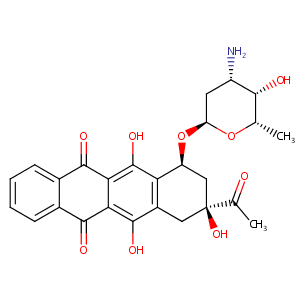
General Information of Drug Combination (ID: DC64XYH)

Drug Combination Name
Myricetin Idarubicin
Indication
Disease Entry Status REF
Glioblastoma? Investigative [1]
Component Drugs Myricetin   DMTV4L0 Idarubicin   DMM0XGL
Small molecular drug Small molecular drug
2D MOL 2D MOL
3D MOL 3D MOL
High-throughput Screening Result Testing Cell Line: T98G
Zero Interaction Potency (ZIP) Score: 7.86
Bliss Independence Score: 7.86
Loewe Additivity Score: 8.8
LHighest Single Agent (HSA) Score: 8.8

Molecular Interaction Atlas of This Drug Combination

Molecular Interaction Atlas (MIA)
Indication(s) of Myricetin
Disease Entry ICD 11 Status REF
Discovery agent N.A. Investigative [2]
Myricetin Interacts with 1 DTT Molecule(s)
DTT Name DTT ID UniProt ID Mode of Action REF
PI3-kinase gamma (PIK3CG) TTHBTOP PK3CG_HUMAN Inhibitor [2]
------------------------------------------------------------------------------------
Myricetin Interacts with 21 DOT Molecule(s)
DOT Name DOT ID UniProt ID Mode of Action REF
Poly(ADP-ribose) glycohydrolase (PARG) OT10JTIO PARG_HUMAN Decreases Activity [6]
Myc proto-oncogene protein (MYC) OTPV5LUK MYC_HUMAN Decreases Expression [7]
Catenin beta-1 (CTNNB1) OTZ932A3 CTNB1_HUMAN Decreases Expression [7]
Egl nine homolog 1 (EGLN1) OT5QODDK EGLN1_HUMAN Decreases Expression [7]
Cytochrome P450 2C19 (CYP2C19) OTFMJYYE CP2CJ_HUMAN Decreases Activity [8]
Phosphatidylinositol 4-phosphate 3-kinase C2 domain-containing subunit beta (PIK3C2B) OTY2PROB P3C2B_HUMAN Decreases Expression [9]
Tumor protein p73 (TP73) OT0LUO47 P73_HUMAN Increases Expression [10]
E3 ubiquitin-protein ligase listerin (LTN1) OTIW2HTX LTN1_HUMAN Decreases Expression [9]
ATP-dependent translocase ABCB1 (ABCB1) OTEJROBO MDR1_HUMAN Increases Activity [11]
Poly polymerase 1 (PARP1) OT310QSG PARP1_HUMAN Decreases Activity [12]
Cytochrome c oxidase subunit 5B, mitochondrial (COX5B) OTDP94F3 COX5B_HUMAN Increases Expression [9]
Solute carrier family 2, facilitated glucose transporter member 1 (SLC2A1) OTA675TJ GTR1_HUMAN Decreases Activity [13]
Tyrosine-protein kinase JAK1 (JAK1) OT0X3D17 JAK1_HUMAN Affects Binding [14]
Cofilin-1 (CFL1) OTT6D5MH COF1_HUMAN Increases Expression [9]
Cyclin-dependent kinase inhibitor 1 (CDKN1A) OTQWHCZE CDN1A_HUMAN Increases Expression [10]
Cyclin-dependent kinase 4 inhibitor C (CDKN2C) OTCLOV90 CDN2C_HUMAN Increases Expression [15]
Rho GDP-dissociation inhibitor 2 (ARHGDIB) OT9PD6CS GDIR2_HUMAN Increases Cleavage [16]
Cytochrome c (CYCS) OTBFALJD CYC_HUMAN Affects Localization [16]
Quinone oxidoreductase PIG3 (TP53I3) OTSCM68G QORX_HUMAN Increases Expression [10]
Tumor protein 63 (TP63) OT0WOOKQ P63_HUMAN Increases Expression [10]
Serine/threonine-protein kinase 38-like (STK38L) OTI00JVW ST38L_HUMAN Decreases Expression [9]
------------------------------------------------------------------------------------
⏷ Show the Full List of 21 DOT(s)
Indication(s) of Idarubicin
Disease Entry ICD 11 Status REF
Acute myelogenous leukaemia 2A41 Approved [3]
Acute myeloid leukaemia 2A60 Approved [4]
Adult acute monocytic leukemia N.A. Approved [3]
Childhood acute megakaryoblastic leukemia N.A. Approved [3]
Leukemia N.A. Approved [3]
Idarubicin Interacts with 1 DTT Molecule(s)
DTT Name DTT ID UniProt ID Mode of Action REF
DNA topoisomerase II (TOP2) TT0IHXV TOP2A_HUMAN; TOP2B_HUMAN Modulator [18]
------------------------------------------------------------------------------------
Idarubicin Interacts with 3 DTP Molecule(s)
DTP Name DTP ID UniProt ID Mode of Action REF
Multidrug resistance-associated protein 1 (ABCC1) DTSYQGK MRP1_HUMAN Substrate [19]
P-glycoprotein 1 (ABCB1) DTUGYRD MDR1_HUMAN Substrate [20]
Breast cancer resistance protein (ABCG2) DTI7UX6 ABCG2_HUMAN Substrate [20]
------------------------------------------------------------------------------------
Idarubicin Interacts with 2 DME Molecule(s)
DME Name DME ID UniProt ID Mode of Action REF
Cytochrome P450 2D6 (CYP2D6) DECB0K3 CP2D6_HUMAN Metabolism [21]
Cytochrome P450 2C9 (CYP2C9) DE5IED8 CP2C9_HUMAN Metabolism [21]
------------------------------------------------------------------------------------
Idarubicin Interacts with 2 DOT Molecule(s)
DOT Name DOT ID UniProt ID Mode of Action REF
Natriuretic peptides B (NPPB) OTSN2IPY ANFB_HUMAN Increases Expression [22]
Bile acid receptor (NR1H4) OTWZLPTB NR1H4_HUMAN Decreases Activity [17]
------------------------------------------------------------------------------------

References

1 CheMBL Affinity Phenotypic Cellular Interaction Assay ID: CHEMBL1125966
2 How many drug targets are there Nat Rev Drug Discov. 2006 Dec;5(12):993-6.
3 Idarubicin FDA Label
4 URL: http://www.guidetopharmacology.org Nucleic Acids Res. 2015 Oct 12. pii: gkv1037. The IUPHAR/BPS Guide to PHARMACOLOGY in 2016: towards curated quantitative interactions between 1300 protein targets and 6000 ligands. (Ligand id: 7083).
5 Potential interactions among myricetin and dietary flavonols through the inhibition of human UDP-glucuronosyltransferase in vitro. Toxicol Lett. 2022 Apr 1;358:40-47. doi: 10.1016/j.toxlet.2022.01.007. Epub 2022 Jan 19.
6 The effect of dietary polyphenols on the epigenetic regulation of gene expression in MCF7 breast cancer cells. Toxicol Lett. 2010 Feb 1;192(2):119-25.
7 Involvement of SIRT1 in hypoxic down-regulation of c-Myc and beta-catenin and hypoxic preconditioning effect of polyphenols. Toxicol Appl Pharmacol. 2012 Mar 1;259(2):210-8.
8 Drug interaction study of flavonoids toward CYP3A4 and their quantitative structure activity relationship (QSAR) analysis for predicting potential effects. Toxicol Lett. 2018 Sep 15;294:27-36.
9 Potential role of nucleoside diphosphate kinase in myricetin-induced selective apoptosis in colon cancer HCT-15?cells. Food Chem Toxicol. 2018 Jun;116(Pt B):315-322. doi: 10.1016/j.fct.2018.04.053. Epub 2018 Apr 24.
10 Cytotoxicity of flavones and flavonols to a human esophageal squamous cell carcinoma cell line (KYSE-510) by induction of G2/M arrest and apoptosis. Toxicol In Vitro. 2009 Aug;23(5):797-807. doi: 10.1016/j.tiv.2009.04.007. Epub 2009 May 3.
11 Structure-activity relationship and mechanism of flavonoids on the inhibitory activity of P-glycoprotein (P-gp)-mediated transport of rhodamine123 and daunorubicin in P-gp overexpressed human mouth epidermal carcinoma (KB/MDR) cells. Food Chem Toxicol. 2021 Sep;155:112381. doi: 10.1016/j.fct.2021.112381. Epub 2021 Jul 1.
12 Dietary flavones and flavonoles are inhibitors of poly(ADP-ribose)polymerase-1 in pulmonary epithelial cells. J Nutr. 2007 Oct;137(10):2190-5. doi: 10.1093/jn/137.10.2190.
13 The inhibitory effects of flavonoids and antiestrogens on the Glut1 glucose transporter in human erythrocytes. Chem Biol Interact. 2003 Dec 15;146(3):225-35. doi: 10.1016/j.cbi.2003.06.001.
14 Myricetin directly targets JAK1 to inhibit cell transformation. Cancer Lett. 2009 Mar 8;275(1):17-26. doi: 10.1016/j.canlet.2008.09.027. Epub 2008 Nov 7.
15 Flavones and flavonols exert cytotoxic effects on a human oesophageal adenocarcinoma cell line (OE33) by causing G2/M arrest and inducing apoptosis. Food Chem Toxicol. 2008 Jun;46(6):2042-53. doi: 10.1016/j.fct.2008.01.049. Epub 2008 Feb 7.
16 Mitochondrial-dependent, reactive oxygen species-independent apoptosis by myricetin: roles of protein kinase C, cytochrome c, and caspase cascade. Biochem Pharmacol. 2005 Mar 15;69(6):913-27. doi: 10.1016/j.bcp.2004.12.005.
17 Quantitative high-throughput profiling of environmental chemicals and drugs that modulate farnesoid X receptor. Sci Rep. 2014 Sep 26;4:6437. doi: 10.1038/srep06437.
18 Drugs@FDA. U.S. Food and Drug Administration. U.S. Department of Health & Human Services.
19 Human intestinal transporter database: QSAR modeling and virtual profiling of drug uptake, efflux and interactions. Pharm Res. 2013 Apr;30(4):996-1007.
20 Amonafide L-malate is not a substrate for multidrug resistance proteins in secondary acute myeloid leukemia. Leukemia. 2008 Nov;22(11):2110-5.
21 In vitro evaluation of cytochrome P450-mediated drug interactions between cytarabine, idarubicin, itraconazole and caspofungin. Hematology. 2004 Jun;9(3):217-21.
22 The use of biochemical markers in cardiotoxicity monitoring in patients treated for leukemia. Neoplasma. 2005;52(5):430-4.