General Information of Drug Combination (ID: DCD6D1O)

Drug Combination Name
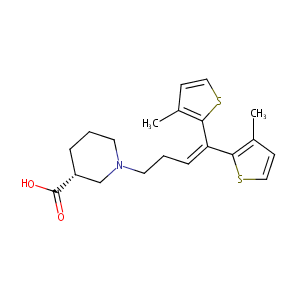
Tiagabine GINKGOLIDE A
Indication
Disease Entry Status REF
Chronic myelogenous leukemia Investigative [1]
Component Drugs Tiagabine   DMKSQG0 GINKGOLIDE A   DMKZJ7T
Small molecular drug Small molecular drug
2D MOL 2D MOL
3D MOL 3D MOL
High-throughput Screening Result Testing Cell Line: KBM-7
Zero Interaction Potency (ZIP) Score: 1.79
Bliss Independence Score: 1.79
Loewe Additivity Score: 4.53
LHighest Single Agent (HSA) Score: 4.6

Molecular Interaction Atlas of This Drug Combination

Molecular Interaction Atlas (MIA)
Indication(s) of Tiagabine
Disease Entry ICD 11 Status REF
Epilepsy 8A60-8A68 Approved [2]
Anxiety disorder 6B00-6B0Z Phase 2 [2]
Tiagabine Interacts with 2 DTT Molecule(s)
DTT Name DTT ID UniProt ID Mode of Action REF
Gamma-aminobutyric acid uptake (GABAU) TTV9MQG NOUNIPROTAC Inhibitor [4]
GABA transporter GAT-1 (SLC6A1) TTPRKM0 SC6A1_HUMAN Inhibitor [5]
------------------------------------------------------------------------------------
Tiagabine Interacts with 2 DME Molecule(s)
DME Name DME ID UniProt ID Mode of Action REF
Cytochrome P450 3A4 (CYP3A4) DE4LYSA CP3A4_HUMAN Metabolism [6]
UDP-glucuronosyltransferase 1A1 (UGT1A1) DEYGVN4 UD11_HUMAN Metabolism [7]
------------------------------------------------------------------------------------
Indication(s) of GINKGOLIDE A
Disease Entry ICD 11 Status REF
Discovery agent N.A. Investigative [3]
GINKGOLIDE A Interacts with 2 DTT Molecule(s)
DTT Name DTT ID UniProt ID Mode of Action REF
Strychnine-binding glycine receptor (GLRA1) TTF45NW GLRA1_HUMAN Inhibitor [9]
Glycine receptor (GlyR) TTZ8EM9 GLRA1_HUMAN; GLRA2_HUMAN; GLRA3_HUMAN; GLRA4_HUMAN; GLRB_HUMAN Inhibitor [9]
------------------------------------------------------------------------------------
GINKGOLIDE A Interacts with 2 DOT Molecule(s)
DOT Name DOT ID UniProt ID Mode of Action REF
Nuclear receptor subfamily 1 group I member 2 (NR1I2) OTC5U0N5 NR1I2_HUMAN Increases Activity [8]
ATP-dependent translocase ABCB1 (ABCB1) OTEJROBO MDR1_HUMAN Increases Expression [8]
------------------------------------------------------------------------------------

References

1 CheMBL Affinity Phenotypic Cellular Interaction Assay ID: CHEMBL1125966
2 URL: http://www.guidetopharmacology.org Nucleic Acids Res. 2015 Oct 12. pii: gkv1037. The IUPHAR/BPS Guide to PHARMACOLOGY in 2016: towards curated quantitative interactions between 1300 protein targets and 6000 ligands. (Ligand id: 4818).
3 URL: http://www.guidetopharmacology.org Nucleic Acids Res. 2015 Oct 12. pii: gkv1037. The IUPHAR/BPS Guide to PHARMACOLOGY in 2016: towards curated quantitative interactions between 1300 protein targets and 6000 ligands. (Ligand id: 1861).
4 Glutamate- and GABA-based CNS therapeutics. Curr Opin Pharmacol. 2006 Feb;6(1):7-17.
5 URL: http://www.guidetopharmacology.org Nucleic Acids Res. 2015 Oct 12. pii: gkv1037. The IUPHAR/BPS Guide to PHARMACOLOGY in 2016: towards curated quantitative interactions between 1300 protein targets and 6000 ligands. (Target id: 929).
6 Enzyme induction and inhibition by new antiepileptic drugs: a review of human studies. Fundam Clin Pharmacol. 2000 Jul-Aug;14(4):301-19.
7 Actual and Predicted Pharmacokinetic Interactions Between Anticonvulsants and Antiretrovirals.
8 Bioactive terpenoids and flavonoids from Ginkgo biloba extract induce the expression of hepatic drug-metabolizing enzymes through pregnane X receptor, constitutive androstane receptor, and aryl hydrocarbon receptor-mediated pathways. Pharm Res. 2009 Apr;26(4):872-82.
9 Probing the pharmacophore of ginkgolides as glycine receptor antagonists. J Med Chem. 2007 Apr 5;50(7):1610-7.