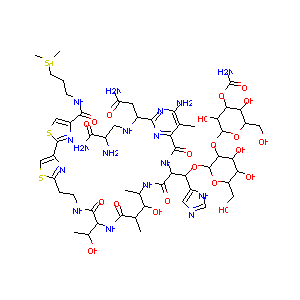
General Information of Drug Combination (ID: DCFWV0U)

Drug Combination Name
Lenalidomide Bleomycin
Indication
Disease Entry Status REF
Mixed endometrioid and clear cell carcinoma Investigative [1]
Component Drugs Lenalidomide   DM6Q7U4 Bleomycin   DMNER5S
Small molecular drug Small molecular drug
2D MOL 2D MOL
3D MOL 3D MOL
High-throughput Screening Result Testing Cell Line: IGROV1
Zero Interaction Potency (ZIP) Score: 3.6
Bliss Independence Score: 6
Loewe Additivity Score: 2.55
LHighest Single Agent (HSA) Score: 9.38

Molecular Interaction Atlas of This Drug Combination

Molecular Interaction Atlas (MIA)
Indication(s) of Lenalidomide
Disease Entry ICD 11 Status REF
Adult T-cell leukemia/lymphoma N.A. Approved [2]
Advanced cancer 2A00-2F9Z Approved [2]
Complex regional pain syndrome type 1 N.A. Approved [2]
Hepatosplenic T-cell lymphoma N.A. Approved [2]
Large granular lymphocytic leukemia 2A90.1 Approved [2]
Leukemia N.A. Approved [2]
MALT lymphoma N.A. Approved [2]
Multiple myeloma 2A83 Approved [3]
Nodal marginal zone lymphoma 2A85.0 Approved [2]
Pain MG30-MG3Z Approved [2]
Plasma cell myeloma 2A83.1 Approved [2]
Primary cutaneous peripheral T-cell lymphoma not otherwise specified N.A. Approved [2]
Prolymphocytic leukaemia 2A82.1 Approved [2]
Recurrent adult burkitt lymphoma 2A85.6 Approved [2]
Small intestine lymphoma N.A. Approved [2]
Splenic marginal zone lymphoma N.A. Approved [2]
Testicular lymphoma N.A. Approved [2]
Urinary bladder neoplasm N.A. Approved [2]
Waldenstrom macroglobulinemia 2A85.4 Approved [2]
Coronavirus Disease 2019 (COVID-19) 1D6Y Phase 3 [4]
Colon cancer 2B90.Z Investigative [2]
Lenalidomide Interacts with 1 DTT Molecule(s)
DTT Name DTT ID UniProt ID Mode of Action REF
Tumor necrosis factor (TNF) TTF8CQI TNFA_HUMAN Inhibitor [7]
------------------------------------------------------------------------------------
Lenalidomide Interacts with 1 DTP Molecule(s)
DTP Name DTP ID UniProt ID Mode of Action REF
P-glycoprotein 1 (ABCB1) DTUGYRD MDR1_HUMAN Substrate [8]
------------------------------------------------------------------------------------
Lenalidomide Interacts with 5 DOT Molecule(s)
DOT Name DOT ID UniProt ID Mode of Action REF
Tumor necrosis factor receptor superfamily member 1A (TNFRSF1A) OT2D9DOV TNR1A_HUMAN Decreases Expression [9]
Tumor necrosis factor receptor superfamily member 1B (TNFRSF1B) OTDS2EAR TNR1B_HUMAN Decreases Expression [9]
Interleukin-6 receptor subunit beta (IL6ST) OT1N9C70 IL6RB_HUMAN Decreases Expression [9]
DNA damage-binding protein 1 (DDB1) OTTR2L3Z DDB1_HUMAN Affects Binding [10]
Sal-like protein 4 (SALL4) OTC08PR5 SALL4_HUMAN Affects Binding [11]
------------------------------------------------------------------------------------
Indication(s) of Bleomycin
Disease Entry ICD 11 Status REF
Cervical cancer 2C77.0 Approved [5]
Head and neck cancer 2D42 Approved [5]
Hodgkin lymphoma 2B30 Approved [6]
Penile cancer N.A. Approved [5]
Testicular germ cell tumor N.A. Approved [5]
Classic Hodgkin lymphoma N.A. Investigative [5]
Follicular lymphoma 2A80 Investigative [5]
Bleomycin Interacts with 1 DTT Molecule(s)
DTT Name DTT ID UniProt ID Mode of Action REF
Human Deoxyribonucleic acid (hDNA) TTUTN1I NOUNIPROTAC Breaker [16]
------------------------------------------------------------------------------------
Bleomycin Interacts with 1 DME Molecule(s)
DME Name DME ID UniProt ID Mode of Action REF
Bleomycin hydrolase (BLMH) DECH1VP BLMH_HUMAN Metabolism [17]
------------------------------------------------------------------------------------
Bleomycin Interacts with 23 DOT Molecule(s)
DOT Name DOT ID UniProt ID Mode of Action REF
Superoxide dismutase , mitochondrial (SOD2) OTIWXGZ9 SODM_HUMAN Increases Expression [18]
Interstitial collagenase (MMP1) OTI4I2V1 MMP1_HUMAN Increases Expression [19]
Interleukin-8 (CXCL8) OTS7T5VH IL8_HUMAN Increases Expression [19]
Mucin-5AC (MUC5AC) OTJV8O04 MUC5A_HUMAN Increases Expression [19]
Transmembrane protein 250 (TMEM250) OTLJ4G5G TM250_HUMAN Increases Expression [12]
Serine/threonine-protein kinase Chk2 (CHEK2) OT8ZPCNS CHK2_HUMAN Increases Phosphorylation [20]
Transforming growth factor beta-1 proprotein (TGFB1) OTV5XHVH TGFB1_HUMAN Increases Expression [13]
Histone H2AX (H2AX) OT18UX57 H2AX_HUMAN Increases Expression [21]
Max-interacting protein 1 (MXI1) OTUQ9E0D MXI1_HUMAN Decreases Expression [12]
Actin, aortic smooth muscle (ACTA2) OTEDLG8E ACTA_HUMAN Increases Expression [13]
Unconventional myosin-Ie (MYO1E) OTM9YSIZ MYO1E_HUMAN Decreases Expression [12]
Serine-protein kinase ATM (ATM) OTQVOHLT ATM_HUMAN Increases Phosphorylation [20]
Structural maintenance of chromosomes protein 1A (SMC1A) OT9ZMRK9 SMC1A_HUMAN Increases Phosphorylation [20]
7SK snRNA methylphosphate capping enzyme (MEPCE) OTRBQEYP MEPCE_HUMAN Increases Expression [12]
Transmembrane protein 87A (TMEM87A) OT8ATDVX TM87A_HUMAN Increases Expression [12]
Lipase member H (LIPH) OTRGYLKL LIPH_HUMAN Decreases Expression [12]
Abasic site processing protein HMCES (HMCES) OTVRDL6U HMCES_HUMAN Decreases Expression [12]
Small integral membrane protein 14 (SMIM14) OT47IF19 SIM14_HUMAN Decreases Expression [12]
Kelch-like protein 42 (KLHL42) OTK6WARI KLH42_HUMAN Increases Expression [12]
Inactive cell surface hyaluronidase CEMIP2 (CEMIP2) OT9I1XUO CEIP2_HUMAN Decreases Expression [12]
ERBB receptor feedback inhibitor 1 (ERRFI1) OT7VZ2IZ ERRFI_HUMAN Decreases Expression [12]
Transmembrane and coiled-coil domain protein 3 (TMCC3) OTAIQ6V6 TMCC3_HUMAN Decreases Expression [12]
Baculoviral IAP repeat-containing protein 2 (BIRC2) OTFXFREP BIRC2_HUMAN Decreases Response To Substance [22]
------------------------------------------------------------------------------------
⏷ Show the Full List of 23 DOT(s)

Test Results of This Drug Combination in Other Disease Systems

Indication DrugCom ID Cell Line Status REF
Anaplastic large cell lymphoma DC3RI4F SR Investigative [23]
Clear cell renal cell carcinoma DCGPT8C TK-10 Investigative [23]
Glioma DCOQUAM SF-539 Investigative [23]
Breast adenocarcinoma DCVPC0X MDA-MB-468 Investigative [24]
Invasive ductal carcinoma DCD7EFC BT-549 Investigative [24]
Adenocarcinoma DCJFJT0 A549 Investigative [1]
Adenocarcinoma DCFJ3CQ SW-620 Investigative [1]
Adenocarcinoma DC994HE HCC-2998 Investigative [1]
Cutaneous melanoma DCOU0NF SK-MEL-28 Investigative [1]
Large cell lung carcinoma DCDA98Z NCI-H460 Investigative [1]
Lung adenocarcinoma DCCFM9N EKVX Investigative [1]
Malignant melanoma DCMD504 LOX IMVI Investigative [1]
Melanoma DCNVKN8 UACC-257 Investigative [1]
Melanoma DC7RMS7 SK-MEL-2 Investigative [1]
------------------------------------------------------------------------------------
⏷ Show the Full List of 14 DrugCom(s)

References

1 CheMBL Affinity Phenotypic Cellular Interaction Assay ID: CHEMBL1125976
2 Lenalidomide FDA Label
3 URL: http://www.guidetopharmacology.org Nucleic Acids Res. 2015 Oct 12. pii: gkv1037. The IUPHAR/BPS Guide to PHARMACOLOGY in 2016: towards curated quantitative interactions between 1300 protein targets and 6000 ligands. (Ligand id: 7331).
4 Low-dose Lenalidomide for Non-severe COVID-19 Treatment Trial (GETAFE)
5 Bleomycin FDA Label
6 Natural products as sources of new drugs over the last 25 years. J Nat Prod. 2007 Mar;70(3):461-77.
7 Thalidomide and thalidomide analogues for maintenance of remission in Crohn's disease. Cochrane Database Syst Rev. 2009 Apr 15;(2):CD007351.
8 DrugBank 5.0: a major update to the DrugBank database for 2018. Nucleic Acids Res. 2018 Jan 4;46(D1):D1074-D1082. (ID: DB00480)
9 Circulating endothelial progenitor cells in multiple myeloma: implications and significance. Blood. 2005 Apr 15;105(8):3286-94. doi: 10.1182/blood-2004-06-2101. Epub 2004 Dec 23.
10 Structure of the human Cereblon-DDB1-lenalidomide complex reveals basis for responsiveness to thalidomide analogs. Nat Struct Mol Biol. 2014 Sep;21(9):803-9. doi: 10.1038/nsmb.2874. Epub 2014 Aug 10.
11 Thalidomide promotes degradation of SALL4, a transcription factor implicated in Duane Radial Ray syndrome. Elife. 2018 Aug 1;7:e38430. doi: 10.7554/eLife.38430.
12 Development and validation of the TGx-HDACi transcriptomic biomarker to detect histone deacetylase inhibitors in human TK6 cells. Arch Toxicol. 2021 May;95(5):1631-1645. doi: 10.1007/s00204-021-03014-2. Epub 2021 Mar 26.
13 Pulmonary fibrosis model using micro-CT analyzable human PSC-derived alveolar organoids containing alveolar macrophage-like cells. Cell Biol Toxicol. 2022 Aug;38(4):557-575. doi: 10.1007/s10565-022-09698-1. Epub 2022 Mar 10.
14 An antisense oligonucleotide targeted to human Ku86 messenger RNA sensitizes M059K malignant glioma cells to ionizing radiation, bleomycin, and etoposide but not DNA cross-linking agents. Cancer Res. 2002 Oct 15;62(20):5888-96.
15 XRCC1 deficiency sensitizes human lung epithelial cells to genotoxicity by crocidolite asbestos and Libby amphibole. Environ Health Perspect. 2010 Dec;118(12):1707-13. doi: 10.1289/ehp.1002312. Epub 2010 Aug 11.
16 Bleomycin and talisomycin sequence-specific strand scission of DNA: a mechanism of double-strand cleavage. Cancer Res. 1982 Jul;42(7):2779-85.
17 The C-terminus of human bleomycin hydrolase is required for protection against bleomycin-induced chromosomal damage. Mutat Res. 1998 Oct 12;421(1):1-7.
18 Age-dependent basal level and induction capacity of copper-zinc and manganese superoxide dismutase and other scavenging enzyme activities in leukocytes from young and elderly adults. Am J Pathol. 1993 Jul;143(1):312-20.
19 Agents associated with lung inflammation induce similar responses in NCI-H292 lung epithelial cells. Toxicol In Vitro. 2008 Oct;22(7):1782-8.
20 Direct activation of ATM by resveratrol under oxidizing conditions. PLoS One. 2014 Jun 16;9(6):e97969. doi: 10.1371/journal.pone.0097969. eCollection 2014.
21 Distinct mechanisms of cell-kill by triapine and its terminally dimethylated derivative Dp44mT due to a loss or gain of activity of their copper(II) complexes. Biochem Pharmacol. 2014 Oct 1;91(3):312-22. doi: 10.1016/j.bcp.2014.08.006. Epub 2014 Aug 15.
22 Expression and prognostic significance of IAP-family genes in human cancers and myeloid leukemias. Clin Cancer Res. 2000 May;6(5):1796-803.
23 CheMBL Affinity Phenotypic Cellular Interaction Assay ID: CHEMBL1125966
24 CheMBL Affinity Phenotypic Cellular Interaction Assay ID: CHEMBL1126165