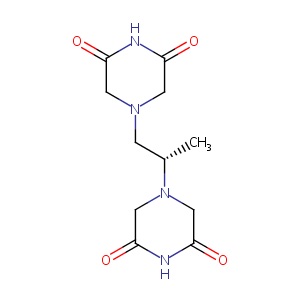
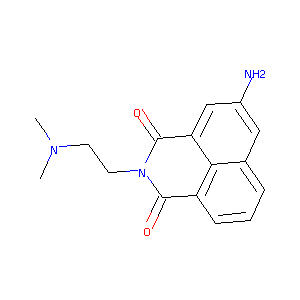
General Information of Drug Combination (ID: DCG92IZ)

Drug Combination Name
Dexrazoxane Amonafide
Indication
Disease Entry Status REF
High grade ovarian serous adenocarcinoma Investigative [1]
Component Drugs Dexrazoxane   DMD7X1O Amonafide   DMAH59S
Small molecular drug Small molecular drug
2D MOL 2D MOL
3D MOL 3D MOL
High-throughput Screening Result Testing Cell Line: NCI\\/ADR-RES
Zero Interaction Potency (ZIP) Score: 0.64
Bliss Independence Score: 6.81
Loewe Additivity Score: 4.56
LHighest Single Agent (HSA) Score: 6.21

Molecular Interaction Atlas of This Drug Combination

Molecular Interaction Atlas (MIA)
Indication(s) of Dexrazoxane
Disease Entry ICD 11 Status REF
Breast cancer 2C60-2C65 Approved [2]
Chemoprotection N.A. Approved [3]
Inflammatory breast cancer 2C62 Approved [4]
Respiratory tract disease CB7Z Investigative [5]
Dexrazoxane Interacts with 2 DTT Molecule(s)
DTT Name DTT ID UniProt ID Mode of Action REF
DNA topoisomerase II beta (TOP2B) TT4NVEM TOP2B_HUMAN Inhibitor [7]
DNA topoisomerase II (TOP2) TT0IHXV TOP2A_HUMAN; TOP2B_HUMAN Modulator [8]
------------------------------------------------------------------------------------
Dexrazoxane Interacts with 1 DME Molecule(s)
DME Name DME ID UniProt ID Mode of Action REF
Dihydropyrimidinase-related protein 1 (DRP1) DE0EUXB DPYL1_HUMAN Metabolism [9]
------------------------------------------------------------------------------------
Indication(s) of Amonafide
Disease Entry ICD 11 Status REF
Breast cancer 2C60-2C65 Phase 3 [6]
Ovarian cancer 2C73 Phase 3 [6]
Prostate cancer 2C82.0 Phase 3 [6]

Test Results of This Drug Combination in Other Disease Systems

Indication DrugCom ID Cell Line Status REF
Adult acute myeloid leukemia DCXWYM2 HL-60(TB) Investigative [10]
Adult T acute lymphoblastic leukemia DCLU4RL MOLT-4 Investigative [10]
Anaplastic large cell lymphoma DC5WJ3G SR Investigative [10]
Astrocytoma DCSOJ0S U251 Investigative [10]
Childhood T acute lymphoblastic leukemia DCEIHBB CCRF-CEM Investigative [10]
Chronic myelogenous leukemia DCGOH7K K-562 Investigative [10]
Clear cell renal cell carcinoma DCCYSX6 TK-10 Investigative [10]
Glioma DC20PZG SF-539 Investigative [10]
Glioma DCWBM6B SF-268 Investigative [10]
Renal cell carcinoma DCLU9JC SN12C Investigative [10]
Breast adenocarcinoma DCST2BW MDA-MB-468 Investigative [11]
Colon adenocarcinoma DCF2O13 COLO 205 Investigative [11]
Invasive ductal carcinoma DCH8JHY HS 578T Investigative [11]
Cutaneous melanoma DCWQCOT SK-MEL-5 Investigative [1]
High grade ovarian serous adenocarcinoma DC8GXLC OVCAR-8 Investigative [1]
High grade ovarian serous adenocarcinoma DC0ZC1P OVCAR-4 Investigative [1]
Large cell lung carcinoma DC7N1ZO NCI-H460 Investigative [1]
Malignant melanoma DCS11A4 LOX IMVI Investigative [1]
Mixed endometrioid and clear cell carcinoma DCW3T3D IGROV1 Investigative [1]
Pleural epithelioid mesothelioma DCSEE3U NCI-H226 Investigative [1]
------------------------------------------------------------------------------------
⏷ Show the Full List of 20 DrugCom(s)

References

1 CheMBL Affinity Phenotypic Cellular Interaction Assay ID: CHEMBL1125976
2 URL: http://www.guidetopharmacology.org Nucleic Acids Res. 2015 Oct 12. pii: gkv1037. The IUPHAR/BPS Guide to PHARMACOLOGY in 2016: towards curated quantitative interactions between 1300 protein targets and 6000 ligands. (Ligand id: 7330).
3 Drugs@FDA. U.S. Food and Drug Administration. U.S. Department of Health & Human Services. 2015
4 Dexrazoxane FDA Label
5 Design and development of antisense drugs. Expert Opin. Drug Discov. 2008 3(10):1189-1207.
6 ClinicalTrials.gov (NCT00715637) Phase III Randomized Study of Amonafide (AS1413) and Cytarabine Versus Daunorubicin and Cytarabine in Patients With Secondary Acute Myeloid Leukemia (AML)- the ACCEDEStudy. U.S. National Institutes of Health.
7 How many drug targets are there Nat Rev Drug Discov. 2006 Dec;5(12):993-6.
8 Drugs@FDA. U.S. Food and Drug Administration. U.S. Department of Health & Human Services.
9 Metabolism of the cardioprotective drug dexrazoxane and one of its metabolites by isolated rat myocytes, hepatocytes, and blood. Drug Metab Dispos. 2005 Jun;33(6):719-25.
10 CheMBL Affinity Phenotypic Cellular Interaction Assay ID: CHEMBL1125966
11 CheMBL Affinity Phenotypic Cellular Interaction Assay ID: CHEMBL1126165