General Information of Drug Combination (ID: DCH7VUS)

Drug Combination Name
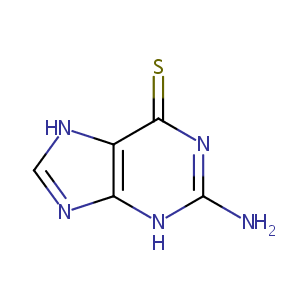
Thioguanine Plicamycin
Indication
Disease Entry Status REF
Invasive ductal carcinoma Investigative [1]
Component Drugs Thioguanine   DM7NKEV Plicamycin   DM7C8YV
Small molecular drug Small molecular drug
2D MOL 2D MOL
3D MOL 3D MOL is unavailable
High-throughput Screening Result Testing Cell Line: HS 578T
Zero Interaction Potency (ZIP) Score: 2.75
Bliss Independence Score: 6.52
Loewe Additivity Score: 5.51
LHighest Single Agent (HSA) Score: 5.59

Molecular Interaction Atlas of This Drug Combination

Molecular Interaction Atlas (MIA)
Indication(s) of Thioguanine
Disease Entry ICD 11 Status REF
Acute lymphocytic leukaemia 2B33.3 Approved [2]
Acute myelogenous leukaemia 2A41 Approved [3]
Acute myeloid leukaemia 2A60 Approved [4]
Middle East Respiratory Syndrome (MERS) 1D64 Preclinical [5]
Severe acute respiratory syndrome (SARS) 1D65 Preclinical [5]
Thioguanine Interacts with 3 DTT Molecule(s)
DTT Name DTT ID UniProt ID Mode of Action REF
MERS-CoV papain-like proteinase (PL-PRO) TTYJOLE R1AB_CVEMC (854-2740) Inhibitor [5]
Inosine-5'-monophosphate dehydrogenase (IMPDH) TTCAQMW NOUNIPROTAC Intercalator [8]
SARS-CoV papain-like proteinase (PL-PRO) TTRGHB2 R1AB_CVHSA (819-2740) Inhibitor [5]
------------------------------------------------------------------------------------
Thioguanine Interacts with 3 DTP Molecule(s)
DTP Name DTP ID UniProt ID Mode of Action REF
Breast cancer resistance protein (ABCG2) DTI7UX6 ABCG2_HUMAN Substrate [9]
Multidrug resistance-associated protein 4 (ABCC4) DTCSGPB MRP4_HUMAN Substrate [10]
Concentrative Na(+)-nucleoside cotransporter 3 (SLC28A3) DT4YL5R S28A3_HUMAN Substrate [11]
------------------------------------------------------------------------------------
Thioguanine Interacts with 2 DME Molecule(s)
DME Name DME ID UniProt ID Mode of Action REF
Thiopurine methyltransferase (TPMT) DEFQ8VO TPMT_HUMAN Metabolism [12]
Hypoxanthine phosphoribosyltransferase (HPRT1) DEVXTP5 HPRT_HUMAN Metabolism [13]
------------------------------------------------------------------------------------
Thioguanine Interacts with 3 DOT Molecule(s)
DOT Name DOT ID UniProt ID Mode of Action REF
Occludin (OCLN) OTSUTVWL OCLN_HUMAN Decreases Activity [14]
ATP-binding cassette sub-family C member 5 (ABCC5) OT34G4US MRP5_HUMAN Decreases Response To Substance [15]
Baculoviral IAP repeat-containing protein 2 (BIRC2) OTFXFREP BIRC2_HUMAN Decreases Response To Substance [16]
------------------------------------------------------------------------------------
Indication(s) of Plicamycin
Disease Entry ICD 11 Status REF
Hypercalcaemia 5B91.0 Approved [2]
Testicular cancer 2C80 Approved [2]
Solid tumour/cancer 2A00-2F9Z Withdrawn from market [6]
Lung cancer 2C25.0 Investigative [7]
Ovarian cancer 2C73 Investigative [7]
Plicamycin Interacts with 1 DTT Molecule(s)
DTT Name DTT ID UniProt ID Mode of Action REF
RNA synthesis (hRNA synth) TTX2AYW NOUNIPROTAC Modulator [18]
------------------------------------------------------------------------------------
Plicamycin Interacts with 8 DOT Molecule(s)
DOT Name DOT ID UniProt ID Mode of Action REF
17-beta-hydroxysteroid dehydrogenase type 2 (HSD17B2) OT3K7HY5 DHB2_HUMAN Decreases Expression [19]
Baculoviral IAP repeat-containing protein 5 (BIRC5) OTILXZYL BIRC5_HUMAN Decreases Expression [20]
Proto-oncogene tyrosine-protein kinase Src (SRC) OTETYX40 SRC_HUMAN Decreases Expression [21]
Tyrosine-protein kinase receptor UFO (AXL) OTKA2SUX UFO_HUMAN Decreases Expression [22]
Transcription factor Sp3 (SP3) OTYDQZ1T SP3_HUMAN Decreases Expression [17]
Epidermal growth factor receptor kinase substrate 8 (EPS8) OTZ6ES6V EPS8_HUMAN Decreases Expression [21]
TNFAIP3-interacting protein 1 (TNIP1) OTRAOTEW TNIP1_HUMAN Decreases Expression [23]
Sphingomyelin phosphodiesterase 3 (SMPD3) OTHQBETH NSMA2_HUMAN Decreases Expression [24]
------------------------------------------------------------------------------------
⏷ Show the Full List of 8 DOT(s)

Test Results of This Drug Combination in Other Disease Systems

Indication DrugCom ID Cell Line Status REF
Adult acute myeloid leukemia DCYS8YP HL-60(TB) Investigative [25]
Adult T acute lymphoblastic leukemia DC26IKP MOLT-4 Investigative [25]
Anaplastic large cell lymphoma DCHB204 SR Investigative [25]
Childhood T acute lymphoblastic leukemia DCFV82K CCRF-CEM Investigative [25]
Clear cell renal cell carcinoma DCQN5TX 786-0 Investigative [25]
Clear cell renal cell carcinoma DC9G5VL CAKI-1 Investigative [25]
Glioma DCONS86 SF-268 Investigative [25]
Glioma DCVGRT7 SF-539 Investigative [25]
Plasma cell myeloma DCHE0MO RPMI-8226 Investigative [25]
Renal cell carcinoma DCU0MML SN12C Investigative [25]
Renal cell carcinoma DCLYTBH UO-31 Investigative [25]
Invasive ductal carcinoma DCRLIJ9 BT-549 Investigative [1]
Adenocarcinoma DCSXTZE HCC-2998 Investigative [26]
Adenocarcinoma DCCVVD5 HCT116 Investigative [26]
Adenocarcinoma DCBBS3R SW-620 Investigative [26]
High grade ovarian serous adenocarcinoma DC18PVF OVCAR-4 Investigative [26]
High grade ovarian serous adenocarcinoma DCLGJ22 OVCAR-5 Investigative [26]
Large cell lung carcinoma DCM1C07 NCI-H460 Investigative [26]
Lung adenocarcinoma DCX2ICZ HOP-62 Investigative [26]
Lung adenocarcinoma DC4US7Z NCI-H522 Investigative [26]
Malignant melanoma DCWAI88 UACC62 Investigative [26]
Melanoma DCWMPLW MALME-3M Investigative [26]
Melanoma DCN6AZO SK-MEL-2 Investigative [26]
Mixed endometrioid and clear cell carcinoma DCFR43N IGROV1 Investigative [26]
Non-small cell lung carcinoma DCL2RVI HOP-92 Investigative [26]
------------------------------------------------------------------------------------
⏷ Show the Full List of 25 DrugCom(s)

References

1 CheMBL Affinity Phenotypic Cellular Interaction Assay ID: CHEMBL1126165
2 Drugs@FDA. U.S. Food and Drug Administration. U.S. Department of Health & Human Services. 2015
3 Thioguanine FDA Label
4 URL: http://www.guidetopharmacology.org Nucleic Acids Res. 2015 Oct 12. pii: gkv1037. The IUPHAR/BPS Guide to PHARMACOLOGY in 2016: towards curated quantitative interactions between 1300 protein targets and 6000 ligands. (Ligand id: 6845).
5 Thiopurine analogs and mycophenolic acid synergistically inhibit the papain-like protease of Middle East respiratory syndrome coronavirus. Antiviral Res. 2015 Mar;115:9-16.
6 URL: http://www.guidetopharmacology.org Nucleic Acids Res. 2015 Oct 12. pii: gkv1037. The IUPHAR/BPS Guide to PHARMACOLOGY in 2016: towards curated quantitative interactions between 1300 protein targets and 6000 ligands. (Ligand id: 8394).
7 The Pluripotency Factor Musashi-2 Is a Novel Target for Lung Cancer Therapy.Ann Am Thorac Soc. 2018 Apr;15(Supplement_2):S124.
8 Immune effector cells produce lethal DNA damage in cells treated with a thiopurine. Cancer Res. 2009 Mar 15;69(6):2393-9.
9 ABC transporters and their role in nucleoside and nucleotide drug resistance. Biochem Pharmacol. 2012 Apr 15;83(8):1073-83.
10 Multidrug resistance protein 4 (MRP4/ABCC4) mediates efflux of bimane-glutathione. Int J Biochem Cell Biol. 2004 Feb;36(2):247-57.
11 Involvement of the concentrative nucleoside transporter 3 and equilibrative nucleoside transporter 2 in the resistance of T-lymphoblastic cell lines to thiopurines. Biochem Biophys Res Commun. 2006 Apr 28;343(1):208-15.
12 Usefulness of thiopurine methyltransferase and thiopurine metabolite analysis in clinical practice in patients with inflammatory bowel diseases. Acta Gastroenterol Belg. 2010 Jul-Sep;73(3):331-5.
13 Qualitative and quantitative difference in mutation induction between carbon- and neon-ion beams in normal human cells. Biol Sci Space. 2003 Dec;17(4):302-6.
14 The thiopurine methyltransferase genetic polymorphism is associated with thioguanine-related veno-occlusive disease of the liver in children with acute lymphoblastic leukemia. Clin Pharmacol Ther. 2006 Oct;80(4):375-83. doi: 10.1016/j.clpt.2006.07.002.
15 The multidrug resistance protein 5 (ABCC5) confers resistance to 5-fluorouracil and transports its monophosphorylated metabolites. Mol Cancer Ther. 2005 May;4(5):855-63.
16 Expression and prognostic significance of IAP-family genes in human cancers and myeloid leukemias. Clin Cancer Res. 2000 May;6(5):1796-803.
17 The activity of a novel mithramycin analog is related to its binding to DNA, cellular accumulation, and inhibition of Sp1-driven gene transcription. Chem Biol Interact. 2014 Aug 5;219:123-32. doi: 10.1016/j.cbi.2014.05.019. Epub 2014 Jun 4.
18 Role of magnesium ion in mithramycin-DNA interaction: binding of mithramycin-Mg2+ complexes with DNA. Biochemistry. 1995 Jan 31;34(4):1376-85.
19 SP1 and SP3 mediate progesterone-dependent induction of the 17beta hydroxysteroid dehydrogenase type 2 gene in human endometrium. Biol Reprod. 2006 Oct;75(4):605-14.
20 Molecular mechanisms of transactivation and doxorubicin-mediated repression of survivin gene in cancer cells. J Biol Chem. 2007 Jan 26;282(4):2615-25. doi: 10.1074/jbc.M606203200. Epub 2006 Nov 22.
21 Mithramycin inhibits human epithelial carcinoma cell proliferation and migration involving downregulation of Eps8 expression. Chem Biol Interact. 2010 Jan 5;183(1):181-6. doi: 10.1016/j.cbi.2009.09.018.
22 The human receptor tyrosine kinase Axl gene--promoter characterization and regulation of constitutive expression by Sp1, Sp3 and CpG methylation. Biosci Rep. 2008 Jun;28(3):161-76. doi: 10.1042/BSR20080046.
23 Sp sites contribute to basal and inducible expression of the human TNIP1 (TNF-inducible protein 3-interacting protein 1) promoter. Biochem J. 2013 Jun 15;452(3):519-29. doi: 10.1042/BJ20121666.
24 Transcriptional regulation of neutral sphingomyelinase 2 gene expression of a human breast cancer cell line, MCF-7, induced by the anti-cancer drug, daunorubicin. Biochim Biophys Acta. 2009 Nov-Dec;1789(11-12):681-90. doi: 10.1016/j.bbagrm.2009.08.006. Epub 2009 Aug 19.
25 CheMBL Affinity Phenotypic Cellular Interaction Assay ID: CHEMBL1125966
26 CheMBL Affinity Phenotypic Cellular Interaction Assay ID: CHEMBL1125976