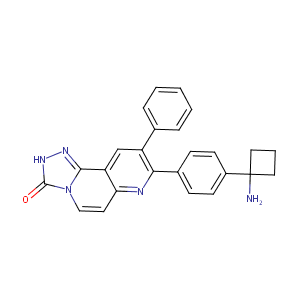
General Information of Drug Combination (ID: DCJ05B9)

Drug Combination Name
Metformin MK-2206
Indication
Disease Entry Status REF
Malignant melanoma Investigative [1]
Component Drugs Metformin   DM89QE1 MK-2206   DMT1OZ6
Small molecular drug Small molecular drug
2D MOL 2D MOL
3D MOL 3D MOL
High-throughput Screening Result Testing Cell Line: SKMEL30
Zero Interaction Potency (ZIP) Score: 9.45
Bliss Independence Score: 15.67
Loewe Additivity Score: 6.88
LHighest Single Agent (HSA) Score: 10.56

Molecular Interaction Atlas of This Drug Combination

Molecular Interaction Atlas (MIA)
Indication(s) of Metformin
Disease Entry ICD 11 Status REF
Colorectal carcinoma N.A. Approved [2]
Non-insulin dependent diabetes 5A11 Approved [2]
Ovarian serous cystadenocarcinoma N.A. Approved [2]
Prostate carcinoma N.A. Approved [2]
Type-2 diabetes 5A11 Approved [3]
Coronavirus Disease 2019 (COVID-19) 1D6Y Investigative [4]
Metformin Interacts with 3 DTT Molecule(s)
DTT Name DTT ID UniProt ID Mode of Action REF
Acetyl-CoA carboxylase 2 (ACACB) TTY84UG ACACB_HUMAN Activator [7]
Solute carrier family 47 member 1 (SLC47A1) TTMHCGA S47A1_HUMAN Modulator [8]
HUMAN mannose receptor (MRC1) TTKV8W5 MRC1_HUMAN Inhibitor [4]
------------------------------------------------------------------------------------
Metformin Interacts with 9 DTP Molecule(s)
DTP Name DTP ID UniProt ID Mode of Action REF
Breast cancer resistance protein (ABCG2) DTI7UX6 ABCG2_HUMAN Substrate [9]
Organic cation transporter 2 (SLC22A2) DT9IDPW S22A2_HUMAN Substrate [10]
Multidrug and toxin extrusion protein 1 (SLC47A1) DTZGT0P S47A1_HUMAN Substrate [11]
Organic cation transporter 3 (SLC22A3) DT6201N S22A3_HUMAN Substrate [12]
Organic cation transporter 1 (SLC22A1) DTT79CX S22A1_HUMAN Substrate [10]
Multidrug and toxin extrusion protein 2 (SLC47A2) DT3TX4H S47A2_HUMAN Substrate [13]
Thiamine transporter 1 (SLC19A2) DTLA4Q2 S19A2_HUMAN Substrate [14]
Thiamine transporter 2 (SLC19A3) DT39CEA S19A3_HUMAN Substrate [14]
Equilibrative nucleoside transporter 4 (SLC29A4) DT3EAQP S29A4_HUMAN Substrate [15]
------------------------------------------------------------------------------------
⏷ Show the Full List of 9 DTP(s)
Indication(s) of MK-2206
Disease Entry ICD 11 Status REF
Rectal adenocarcinoma 2B92 Phase 2 [5]
Nasopharyngeal carcinoma 2B6B Investigative [6]
MK-2206 Interacts with 2 DTT Molecule(s)
DTT Name DTT ID UniProt ID Mode of Action REF
RAC-gamma serine/threonine-protein kinase (AKT3) TTAZ05C AKT3_HUMAN Modulator [17]
E2 ubiquitin-conjugating enzyme T (UBE2T) TT0A1R8 UBE2T_HUMAN Inhibitor [6]
------------------------------------------------------------------------------------
MK-2206 Interacts with 9 DOT Molecule(s)
DOT Name DOT ID UniProt ID Mode of Action REF
Receptor tyrosine-protein kinase erbB-2 (ERBB2) OTOAUNCK ERBB2_HUMAN Increases Expression [18]
Endothelin receptor type B (EDNRB) OTLLZV3P EDNRB_HUMAN Increases Expression [16]
Tumor necrosis factor receptor superfamily member 6 (FAS) OTP9XG86 TNR6_HUMAN Affects Response To Substance [19]
T-lymphocyte activation antigen CD80 (CD80) OTJBLUQE CD80_HUMAN Decreases Expression [16]
CCAAT/enhancer-binding protein alpha (CEBPA) OTOM9OE4 CEBPA_HUMAN Decreases Expression [16]
Actin, aortic smooth muscle (ACTA2) OTEDLG8E ACTA_HUMAN Decreases Expression [20]
Small ribosomal subunit protein eS6 (RPS6) OTT4D1LN RS6_HUMAN Decreases Phosphorylation [21]
Interferon regulatory factor 8 (IRF8) OT8YSNI4 IRF8_HUMAN Decreases Expression [16]
Proline-rich AKT1 substrate 1 (AKT1S1) OT4JHN4Y AKTS1_HUMAN Decreases Phosphorylation [22]
------------------------------------------------------------------------------------
⏷ Show the Full List of 9 DOT(s)

Test Results of This Drug Combination in Other Disease Systems

Indication DrugCom ID Cell Line Status REF
Adenocarcinoma DCE0TF5 HT29 Investigative [1]
Ewing sarcoma-peripheral primitive neuroectodermal tumour DCPMMW1 ES2 Investigative [1]
Malignant melanoma DCAZPCM A375 Investigative [1]
Breast carcinoma DCVV3DN OCUBM Investigative [23]
------------------------------------------------------------------------------------

References

1 CheMBL Affinity Phenotypic Cellular Interaction Assay ID: CHEMBL1125966
2 Metformin FDA Label
3 Drugs@FDA. U.S. Food and Drug Administration. U.S. Department of Health & Human Services. 2015
4 A SARS-CoV-2-Human Protein-Protein Interaction Map Reveals Drug Targets and Potential Drug-Repurposing. March 2020
5 URL: http://www.guidetopharmacology.org Nucleic Acids Res. 2015 Oct 12. pii: gkv1037. The IUPHAR/BPS Guide to PHARMACOLOGY in 2016: towards curated quantitative interactions between 1300 protein targets and 6000 ligands. (Ligand id: 7945).
6 UBE2T promotes nasopharyngeal carcinoma cell proliferation, invasion, and metastasis by activating the AKT/GSK3/-catenin pathway.Oncotarget. 2016 Mar 22;7(12):15161-72.
7 AMP-activated protein kinase-dependent and -independent mechanisms underlying in vitro antiglioma action of compound C. Biochem Pharmacol. 2009 Jun 1;77(11):1684-93.
8 Molecular cloning, functional characterization and tissue distribution of rat H+/organic cation antiporter MATE1. Pharm Res. 2006 Aug;23(8):1696-701.
9 Role of human placental apical membrane transporters in the efflux of glyburide, rosiglitazone, and metformin. Am J Obstet Gynecol. 2010 Apr;202(4):383.e1-7.
10 Metformin is a superior substrate for renal organic cation transporter OCT2 rather than hepatic OCT1. Drug Metab Pharmacokinet. 2005 Oct;20(5):379-86.
11 Human multidrug and toxin extrusion 1 (MATE1/SLC47A1) transporter: functional characterization, interaction with OCT2 (SLC22A2), and single nucleotide polymorphisms. Am J Physiol Renal Physiol. 2010 Apr;298(4):F997-F1005.
12 Expression of organic cation transporters OCT1 (SLC22A1) and OCT3 (SLC22A3) is affected by genetic factors and cholestasis in human liver. Hepatology. 2009 Oct;50(4):1227-40.
13 Substrate specificity of MATE1 and MATE2-K, human multidrug and toxin extrusions/H(+)-organic cation antiporters. Biochem Pharmacol. 2007 Jul 15;74(2):359-71.
14 Metformin Is a Substrate and Inhibitor of the Human Thiamine Transporter, THTR-2 (SLC19A3). Mol Pharm. 2015 Dec 7;12(12):4301-10.
15 Metformin: from mechanisms of action to therapies. Cell Metab. 2014 Dec 2;20(6):953-66.
16 Chemerin promotes the pathogenesis of preeclampsia by activating CMKLR1/p-Akt/CEBP axis and inducing M1 macrophage polarization. Cell Biol Toxicol. 2022 Aug;38(4):611-628. doi: 10.1007/s10565-021-09636-7. Epub 2021 Aug 16.
17 First-in-man clinical trial of the oral pan-AKT inhibitor MK-2206 in patients with advanced solid tumors.J Clin Oncol.2011 Dec 10;29(35):4688-95.
18 Platycodin D potentiates proliferation inhibition and apoptosis induction upon AKT inhibition via feedback blockade in non-small cell lung cancer cells. Sci Rep. 2016 Nov 29;6:37997. doi: 10.1038/srep37997.
19 PI3K/AKT inhibitors aggravate death receptor-mediated hepatocyte apoptosis and liver injury. Toxicol Appl Pharmacol. 2019 Oct 15;381:114729. doi: 10.1016/j.taap.2019.114729. Epub 2019 Aug 22.
20 -Mangostin alleviates liver fibrosis through Sirtuin 3-superoxide-high mobility group box 1 signaling axis. Toxicol Appl Pharmacol. 2019 Jan 15;363:142-153. doi: 10.1016/j.taap.2018.11.011. Epub 2018 Nov 29.
21 Harnessing the PI3K/Akt/mTOR pathway in T-cell acute lymphoblastic leukemia: eliminating activity by targeting at different levels. Oncotarget. 2012 Aug;3(8):811-23. doi: 10.18632/oncotarget.579.
22 Akt activation by Ca(2+)/calmodulin-dependent protein kinase kinase 2 (CaMKK2) in ovarian cancer cells. J Biol Chem. 2017 Aug 25;292(34):14188-14204. doi: 10.1074/jbc.M117.778464. Epub 2017 Jun 20.
23 CheMBL Affinity Phenotypic Cellular Interaction Assay ID: CHEMBL1126165