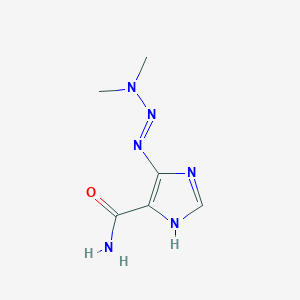
General Information of Drug Combination (ID: DCJI44M)

Drug Combination Name
Dacarbazine Romidepsin
Indication
Disease Entry Status REF
Clear cell renal cell carcinoma Investigative [1]
Component Drugs Dacarbazine   DMNPZL4 Romidepsin   DMT5GNL
Small molecular drug Small molecular drug
2D MOL 2D MOL
3D MOL 3D MOL
High-throughput Screening Result Testing Cell Line: TK-10
Zero Interaction Potency (ZIP) Score: 1.07
Bliss Independence Score: 2.38
Loewe Additivity Score: 0.87
LHighest Single Agent (HSA) Score: 3.02

Molecular Interaction Atlas of This Drug Combination

Molecular Interaction Atlas (MIA)
Indication(s) of Dacarbazine
Disease Entry ICD 11 Status REF
Adenocarcinoma 2D40 Approved [2]
Astrocytoma 2A00.0Y Approved [2]
Brain disease 8C70-8E61 Approved [2]
Central nervous system disease 8A04-8D87 Approved [2]
Glioblastoma 2A00 Approved [2]
Gliosarcoma N.A. Approved [2]
Melanoma 2C30 Approved [3]
Classic Hodgkin lymphoma N.A. Investigative [2]
Neuroblastoma 2D11.2 Investigative [2]
Dacarbazine Interacts with 1 DTT Molecule(s)
DTT Name DTT ID UniProt ID Mode of Action REF
Human Deoxyribonucleic acid (hDNA) TTUTN1I NOUNIPROTAC Breaker [8]
------------------------------------------------------------------------------------
Dacarbazine Interacts with 3 DME Molecule(s)
DME Name DME ID UniProt ID Mode of Action REF
Cytochrome P450 1A2 (CYP1A2) DEJGDUW CP1A2_HUMAN Metabolism [9]
Cytochrome P450 1A1 (CYP1A1) DE6OQ3W CP1A1_HUMAN Metabolism [10]
Cytochrome P450 2E1 (CYP2E1) DEVDYN7 CP2E1_HUMAN Metabolism [11]
------------------------------------------------------------------------------------
Dacarbazine Interacts with 8 DOT Molecule(s)
DOT Name DOT ID UniProt ID Mode of Action REF
Baculoviral IAP repeat-containing protein 5 (BIRC5) OTILXZYL BIRC5_HUMAN Increases Expression [12]
Interleukin-8 (CXCL8) OTS7T5VH IL8_HUMAN Increases Expression [7]
Methylated-DNA--protein-cysteine methyltransferase (MGMT) OT40A9WH MGMT_HUMAN Decreases Activity [13]
DNA repair nuclease/redox regulator APEX1 (APEX1) OT53OI14 APEX1_HUMAN Increases Response To Substance [14]
Solute carrier family 2, facilitated glucose transporter member 1 (SLC2A1) OTA675TJ GTR1_HUMAN Decreases Response To Substance [15]
Mitogen-activated protein kinase 3 (MAPK3) OTCYKGKO MK03_HUMAN Decreases Response To Substance [16]
Mitogen-activated protein kinase 1 (MAPK1) OTH85PI5 MK01_HUMAN Decreases Response To Substance [16]
Mitogen-activated protein kinase kinase kinase 1 (MAP3K1) OTS3FVTY M3K1_HUMAN Decreases Response To Substance [16]
------------------------------------------------------------------------------------
⏷ Show the Full List of 8 DOT(s)
Indication(s) of Romidepsin
Disease Entry ICD 11 Status REF
Cutaneous T-cell lymphoma 2B01 Approved [4]
Gastrin-producing neuroendocrine tumor N.A. Approved [5]
Glucagonoma N.A. Approved [5]
Insulinoma 2C10.1 Approved [5]
Lung carcinoid tumor N.A. Approved [5]
Melanoma 2C30 Approved [5]
Primary cutaneous peripheral T-cell lymphoma not otherwise specified N.A. Approved [5]
Primary cutaneous T-cell lymphoma N.A. Approved [5]
Urethral cancer 2C93 Approved [5]
Peripheral T-cell lymphoma 2A90.C Phase 3 [6]
Renal cell carcinoma 2C90 Phase 3 [4]
Romidepsin Interacts with 1 DTT Molecule(s)
DTT Name DTT ID UniProt ID Mode of Action REF
Histone deacetylase 1 (HDAC1) TT6R7JZ HDAC1_HUMAN Inhibitor [19]
------------------------------------------------------------------------------------
Romidepsin Interacts with 2 DTP Molecule(s)
DTP Name DTP ID UniProt ID Mode of Action REF
P-glycoprotein 1 (ABCB1) DTUGYRD MDR1_HUMAN Substrate [20]
Organic anion transporting polypeptide 1B3 (SLCO1B3) DT9C1TS SO1B3_HUMAN Substrate [20]
------------------------------------------------------------------------------------
Romidepsin Interacts with 3 DME Molecule(s)
DME Name DME ID UniProt ID Mode of Action REF
Cytochrome P450 3A4 (CYP3A4) DE4LYSA CP3A4_HUMAN Metabolism [21]
Cytochrome P450 3A5 (CYP3A5) DEIBDNY CP3A5_HUMAN Metabolism [22]
Cytochrome P450 2B6 (CYP2B6) DEPKLMQ CP2B6_HUMAN Metabolism [23]
------------------------------------------------------------------------------------
Romidepsin Interacts with 27 DOT Molecule(s)
DOT Name DOT ID UniProt ID Mode of Action REF
ATP-dependent translocase ABCB1 (ABCB1) OTEJROBO MDR1_HUMAN Increases Expression [24]
Broad substrate specificity ATP-binding cassette transporter ABCG2 (ABCG2) OTW8V2V1 ABCG2_HUMAN Affects Expression [25]
E3 SUMO-protein ligase CBX4 (CBX4) OT4XVRRF CBX4_HUMAN Increases Expression [26]
Tumor necrosis factor receptor superfamily member 10B (TNFRSF10B) OTA1CPBV TR10B_HUMAN Increases Expression [27]
Bcl-2-like protein 11 (BCL2L11) OTNQQWFJ B2L11_HUMAN Increases Expression [28]
Growth arrest and DNA damage-inducible protein GADD45 beta (GADD45B) OTL9I7LO GA45B_HUMAN Increases Expression [29]
Serine/threonine-protein kinase 17B (STK17B) OT4NYNO8 ST17B_HUMAN Increases Expression [26]
RAF proto-oncogene serine/threonine-protein kinase (RAF1) OT51LSFO RAF1_HUMAN Decreases Expression [30]
Receptor tyrosine-protein kinase erbB-2 (ERBB2) OTOAUNCK ERBB2_HUMAN Decreases Expression [30]
Retinoblastoma-associated protein (RB1) OTQJUJMZ RB_HUMAN Decreases Phosphorylation [30]
Poly polymerase 1 (PARP1) OT310QSG PARP1_HUMAN Increases Cleavage [31]
Histone H2AX (H2AX) OT18UX57 H2AX_HUMAN Increases Phosphorylation [18]
Transcription factor JunD (JUND) OTNKACJD JUND_HUMAN Increases Expression [26]
Nuclear factor NF-kappa-B p105 subunit (NFKB1) OTNRRD8I NFKB1_HUMAN Increases Expression [31]
Mitogen-activated protein kinase 3 (MAPK3) OTCYKGKO MK03_HUMAN Decreases Phosphorylation [18]
Mitogen-activated protein kinase 1 (MAPK1) OTH85PI5 MK01_HUMAN Decreases Phosphorylation [18]
Receptor-type tyrosine-protein kinase FLT3 (FLT3) OTMSRYMK FLT3_HUMAN Decreases Phosphorylation [18]
Cyclin-dependent kinase inhibitor 1 (CDKN1A) OTQWHCZE CDN1A_HUMAN Increases Expression [32]
Friend leukemia integration 1 transcription factor (FLI1) OT0EV3LX FLI1_HUMAN Decreases Expression [33]
RNA-binding protein EWS (EWSR1) OT7SRHV3 EWS_HUMAN Decreases Expression [33]
Bcl-2-interacting killer (BIK) OTTH1T3D BIK_HUMAN Increases Expression [26]
Spectrin alpha chain, non-erythrocytic 1 (SPTAN1) OT6VY3A3 SPTN1_HUMAN Increases Expression [26]
Nuclear receptor subfamily 1 group I member 3 (NR1I3) OTS3SGH7 NR1I3_HUMAN Increases Expression [34]
Bcl-2 homologous antagonist/killer (BAK1) OTDP6ILW BAK_HUMAN Increases Expression [35]
Histone H3.1t (H3-4) OTY6ITYF H31T_HUMAN Increases Acetylation [34]
Mitogen-activated protein kinase kinase kinase 3 (MAP3K3) OT53LJGW M3K3_HUMAN Increases Expression [26]
Transcription factor p65 (RELA) OTUJP9CN TF65_HUMAN Decreases Response To Substance [31]
------------------------------------------------------------------------------------
⏷ Show the Full List of 27 DOT(s)

Test Results of This Drug Combination in Other Disease Systems

Indication DrugCom ID Cell Line Status REF
Adenocarcinoma DCBHO58 A549 Investigative [1]
Amelanotic melanoma DCJ8DJO MDA-MB-435 Investigative [1]
Anaplastic large cell lymphoma DC1INYN SR Investigative [1]
Cutaneous melanoma DCHYN2U SK-MEL-5 Investigative [1]
Glioblastoma DC9C9NT SNB-75 Investigative [1]
Glioma DC7WSEP SF-268 Investigative [1]
High grade ovarian serous adenocarcinoma DCC800G OVCAR-5 Investigative [1]
Lung adenocarcinoma DC8FXOF EKVX Investigative [1]
Melanoma DC2SAYU MALME-3M Investigative [1]
Invasive ductal carcinoma DCX4ZA6 BT-549 Investigative [36]
------------------------------------------------------------------------------------
⏷ Show the Full List of 10 DrugCom(s)

References

1 CheMBL Affinity Phenotypic Cellular Interaction Assay ID: CHEMBL1125966
2 Dacarbazine FDA Label
3 FDA Approved Drug Products from FDA Official Website. 2009. Application Number: (ANDA) 075259.
4 URL: http://www.guidetopharmacology.org Nucleic Acids Res. 2015 Oct 12. pii: gkv1037. The IUPHAR/BPS Guide to PHARMACOLOGY in 2016: towards curated quantitative interactions between 1300 protein targets and 6000 ligands. (Ligand id: 7006).
5 Romidepsin FDA Label
6 Clinical pipeline report, company report or official report of the Pharmaceutical Research and Manufacturers of America (PhRMA)
7 Dacarbazine causes transcriptional up-regulation of interleukin 8 and vascular endothelial growth factor in melanoma cells: a possible escape mechanism from chemotherapy. Mol Cancer Ther. 2003 Aug;2(8):753-63.
8 Predicting the myelotoxicity of chemotherapy: the use of pretreatment O6-methylguanine-DNA methyltransferase determination in peripheral blood mono... Melanoma Res. 2011 Dec;21(6):502-8.
9 Study on mesenchymal stem cells mediated enzyme-prodrug gene CYP1A2 targeting anti-tumor effect. Zhonghua Xue Ye Xue Za Zhi. 2009 Oct;30(10):667-71.
10 Metabolic activation of dacarbazine by human cytochromes P450: the role of CYP1A1, CYP1A2, and CYP2E1. Clin Cancer Res. 1999 Aug;5(8):2192-7.
11 Role of cytochrome P450 isoenzymes in metabolism of O(6)-benzylguanine: implications for dacarbazine activation. Clin Cancer Res. 2001 Dec;7(12):4239-44.
12 Serum bcl-2 and survivin levels in melanoma. Melanoma Res. 2004 Dec;14(6):543-6. doi: 10.1097/00008390-200412000-00017.
13 Pharmacokinetic, biochemical and clinical effects of dimethyltriazenoimidazole-4-carboxamide-bischloroethylnitrosourea combination therapy in patients with advanced breast cancer. Int J Cancer. 2003 Feb 20;103(5):686-92. doi: 10.1002/ijc.10849.
14 Impairment of APE1 function enhances cellular sensitivity to clinically relevant alkylators and antimetabolites. Mol Cancer Res. 2009 Jun;7(6):897-906. doi: 10.1158/1541-7786.MCR-08-0519. Epub 2009 May 26.
15 Glut-1 as a therapeutic target: increased chemoresistance and HIF-1-independent link with cell turnover is revealed through COMPARE analysis and metabolomic studies. Cancer Chemother Pharmacol. 2008 Mar;61(3):377-93. doi: 10.1007/s00280-007-0480-1. Epub 2007 May 23.
16 Exposure of melanoma cells to dacarbazine results in enhanced tumor growth and metastasis in vivo. J Clin Oncol. 2004 Jun 1;22(11):2092-100. doi: 10.1200/JCO.2004.11.070. Epub 2004 May 3.
17 Inhibition of transcription, expression, and secretion of the vascular epithelial growth factor in human epithelial endometriotic cells by romidepsin. Fertil Steril. 2011 Apr;95(5):1579-83. doi: 10.1016/j.fertnstert.2010.12.058. Epub 2011 Feb 4.
18 Inhibitors of class I HDACs and of FLT3 combine synergistically against leukemia cells with mutant FLT3. Arch Toxicol. 2022 Jan;96(1):177-193. doi: 10.1007/s00204-021-03174-1. Epub 2021 Oct 19.
19 Hughes B: 2009 FDA drug approvals. Nat Rev Drug Discov. 2010 Feb;9(2):89-92.
20 Population pharmacokinetics of romidepsin in patients with cutaneous T-cell lymphoma and relapsed peripheral T-cell lymphoma. Clin Cancer Res. 2009 Feb 15;15(4):1496-503.
21 A phase I/II trial of the histone deacetylase inhibitor romidepsin for adults with recurrent malignant glioma: North American Brain Tumor Consortium Study 03-03. Neuro Oncol. 2011 May;13(5):509-16.
22 Population pharmacokinetics of romidepsin in patients with cutaneous T-cell lymphoma and relapsed peripheral T-cell lymphoma. Clin Cancer Res. 2009 Feb 15;15(4):1496-503.
23 FDA Label of Romidepsin. The 2020 official website of the U.S. Food and Drug Administration.
24 Chemoresistance to depsipeptide FK228 [(E)-(1S,4S,10S,21R)-7-[(Z)-ethylidene]-4,21-diisopropyl-2-oxa-12,13-dithia-5,8,20,23-tetraazabicyclo[8,7,6]-tricos-16-ene-3,6,9,22-pentanone] is mediated by reversible MDR1 induction in human cancer cell lines. J Pharmacol Exp Ther. 2005 Jul;314(1):467-75. doi: 10.1124/jpet.105.083956. Epub 2005 Apr 15.
25 Aberrant promoter methylation of the ABCG2 gene in renal carcinoma. Mol Cell Biol. 2006 Nov;26(22):8572-85.
26 5-Aza-2'-deoxycytidine and depsipeptide synergistically induce expression of BIK (BCL2-interacting killer). Biochem Biophys Res Commun. 2006 Dec 15;351(2):455-61. doi: 10.1016/j.bbrc.2006.10.055. Epub 2006 Oct 18.
27 Bortezomib and depsipeptide sensitize tumors to tumor necrosis factor-related apoptosis-inducing ligand: a novel method to potentiate natural killer cell tumor cytotoxicity. Cancer Res. 2006 Jul 15;66(14):7317-25. doi: 10.1158/0008-5472.CAN-06-0680.
28 Histone deacetylase inhibitors FK228, N-(2-aminophenyl)-4-[N-(pyridin-3-yl-methoxycarbonyl)amino- methyl]benzamide and m-carboxycinnamic acid bis-hydroxamide augment radiation-induced cell death in gastrointestinal adenocarcinoma cells. Int J Cancer. 2004 Jun 10;110(2):301-8. doi: 10.1002/ijc.20117.
29 A sequential treatment of depsipeptide followed by 5-azacytidine enhances Gadd45beta expression in hepatocellular carcinoma cells. Anticancer Res. 2007 Nov-Dec;27(6B):3783-9.
30 Abrogation of p21 expression by flavopiridol enhances depsipeptide-mediated apoptosis in malignant pleural mesothelioma cells. Clin Cancer Res. 2004 Mar 1;10(5):1813-25. doi: 10.1158/1078-0432.ccr-0901-3.
31 Interactions between bortezomib and romidepsin and belinostat in chronic lymphocytic leukemia cells. Clin Cancer Res. 2008 Jan 15;14(2):549-58. doi: 10.1158/1078-0432.CCR-07-1934.
32 Up-regulation of MDR1 and induction of doxorubicin resistance by histone deacetylase inhibitor depsipeptide (FK228) and ATRA in acute promyelocytic leukemia cells. Blood. 2006 Feb 15;107(4):1546-54. doi: 10.1182/blood-2004-10-4126. Epub 2005 Oct 13.
33 Antitumor effects of histone deacetylase inhibitor on Ewing's family tumors. Int J Cancer. 2005 Sep 20;116(5):784-92. doi: 10.1002/ijc.21069.
34 Enhanced transgene expression in urothelial cancer gene therapy with histone deacetylase inhibitor. J Urol. 2005 Aug;174(2):747-52. doi: 10.1097/01.ju.0000164723.20555.e6.
35 Blocking downstream signaling pathways in the context of HDAC inhibition promotes apoptosis preferentially in cells harboring mutant Ras. Oncotarget. 2016 Oct 25;7(43):69804-69815. doi: 10.18632/oncotarget.12001.
36 CheMBL Affinity Phenotypic Cellular Interaction Assay ID: CHEMBL1126165