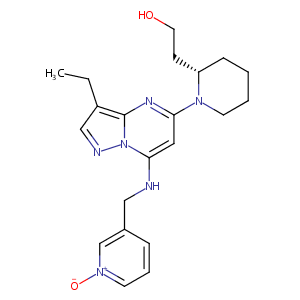
General Information of Drug Combination (ID: DCLXN1R)

Drug Combination Name
SCH 727965 Plicamycin
Indication
Disease Entry Status REF
Adenocarcinoma Investigative [1]
Component Drugs SCH 727965   DMCJLD1 Plicamycin   DM7C8YV
Small molecular drug Small molecular drug
2D MOL 2D MOL
3D MOL 3D MOL is unavailable
High-throughput Screening Result Testing Cell Line: HCC-2998
Zero Interaction Potency (ZIP) Score: 1.58
Bliss Independence Score: 2.42
Loewe Additivity Score: 3.9
LHighest Single Agent (HSA) Score: 2.5

Molecular Interaction Atlas of This Drug Combination

Molecular Interaction Atlas (MIA)
Indication(s) of SCH 727965
Disease Entry ICD 11 Status REF
Acute lymphoblastic leukaemia 2A85 Discontinued in Phase 3 [2]
SCH 727965 Interacts with 3 DTT Molecule(s)
DTT Name DTT ID UniProt ID Mode of Action REF
Cyclin-dependent kinase 9 (CDK9) TT1LVF2 CDK9_HUMAN Inhibitor [6]
Cyclin-dependent kinase 1 (CDK1) TTH6V3D CDK1_HUMAN Inhibitor [6]
Cyclin-dependent kinase 2 (CDK2) TT7HF4W CDK2_HUMAN Inhibitor [6]
------------------------------------------------------------------------------------
SCH 727965 Interacts with 4 DOT Molecule(s)
DOT Name DOT ID UniProt ID Mode of Action REF
Retinoblastoma-associated protein (RB1) OTQJUJMZ RB_HUMAN Decreases Phosphorylation [7]
Poly polymerase 1 (PARP1) OT310QSG PARP1_HUMAN Increases Cleavage [7]
Breast cancer type 1 susceptibility protein (BRCA1) OT5BN6VH BRCA1_HUMAN Decreases Expression [8]
Fanconi anemia group D2 protein (FANCD2) OTVEB5LF FACD2_HUMAN Decreases Expression [8]
------------------------------------------------------------------------------------
Indication(s) of Plicamycin
Disease Entry ICD 11 Status REF
Hypercalcaemia 5B91.0 Approved [3]
Testicular cancer 2C80 Approved [3]
Solid tumour/cancer 2A00-2F9Z Withdrawn from market [4]
Lung cancer 2C25.0 Investigative [5]
Ovarian cancer 2C73 Investigative [5]
Plicamycin Interacts with 1 DTT Molecule(s)
DTT Name DTT ID UniProt ID Mode of Action REF
RNA synthesis (hRNA synth) TTX2AYW NOUNIPROTAC Modulator [10]
------------------------------------------------------------------------------------
Plicamycin Interacts with 8 DOT Molecule(s)
DOT Name DOT ID UniProt ID Mode of Action REF
17-beta-hydroxysteroid dehydrogenase type 2 (HSD17B2) OT3K7HY5 DHB2_HUMAN Decreases Expression [11]
Baculoviral IAP repeat-containing protein 5 (BIRC5) OTILXZYL BIRC5_HUMAN Decreases Expression [12]
Proto-oncogene tyrosine-protein kinase Src (SRC) OTETYX40 SRC_HUMAN Decreases Expression [13]
Tyrosine-protein kinase receptor UFO (AXL) OTKA2SUX UFO_HUMAN Decreases Expression [14]
Transcription factor Sp3 (SP3) OTYDQZ1T SP3_HUMAN Decreases Expression [9]
Epidermal growth factor receptor kinase substrate 8 (EPS8) OTZ6ES6V EPS8_HUMAN Decreases Expression [13]
TNFAIP3-interacting protein 1 (TNIP1) OTRAOTEW TNIP1_HUMAN Decreases Expression [15]
Sphingomyelin phosphodiesterase 3 (SMPD3) OTHQBETH NSMA2_HUMAN Decreases Expression [16]
------------------------------------------------------------------------------------
⏷ Show the Full List of 8 DOT(s)

Test Results of This Drug Combination in Other Disease Systems

Indication DrugCom ID Cell Line Status REF
Glioma DCODDKT SF-295 Investigative [17]
Glioma DCWFVW1 SF-268 Investigative [17]
Plasma cell myeloma DC0YANM RPMI-8226 Investigative [17]
Breast adenocarcinoma DCMAAYH MDA-MB-468 Investigative [18]
Cutaneous melanoma DC1JZD7 SK-MEL-28 Investigative [1]
Hodgkin lymphoma DCYONGQ L-1236 Investigative [1]
Lung adenocarcinoma DC7HGEQ HOP-62 Investigative [1]
Melanoma DCRA9IY UACC-257 Investigative [1]
Mixed endometrioid and clear cell carcinoma DCEGF2U IGROV1 Investigative [1]
------------------------------------------------------------------------------------
⏷ Show the Full List of 9 DrugCom(s)

References

1 CheMBL Affinity Phenotypic Cellular Interaction Assay ID: CHEMBL1125976
2 URL: http://www.guidetopharmacology.org Nucleic Acids Res. 2015 Oct 12. pii: gkv1037. The IUPHAR/BPS Guide to PHARMACOLOGY in 2016: towards curated quantitative interactions between 1300 protein targets and 6000 ligands. (Ligand id: 7379).
3 Drugs@FDA. U.S. Food and Drug Administration. U.S. Department of Health & Human Services. 2015
4 URL: http://www.guidetopharmacology.org Nucleic Acids Res. 2015 Oct 12. pii: gkv1037. The IUPHAR/BPS Guide to PHARMACOLOGY in 2016: towards curated quantitative interactions between 1300 protein targets and 6000 ligands. (Ligand id: 8394).
5 The Pluripotency Factor Musashi-2 Is a Novel Target for Lung Cancer Therapy.Ann Am Thorac Soc. 2018 Apr;15(Supplement_2):S124.
6 Cell cycle kinases as therapeutic targets for cancer. Nat Rev Drug Discov. 2009 Jul;8(7):547-66.
7 Dinaciclib (SCH 727965), a novel and potent cyclin-dependent kinase inhibitor. Mol Cancer Ther. 2010 Aug;9(8):2344-53. doi: 10.1158/1535-7163.MCT-10-0324. Epub 2010 Jul 27.
8 CDK12 Inhibition Reverses De Novo and Acquired PARP Inhibitor Resistance in BRCA Wild-Type and Mutated Models of Triple-Negative Breast Cancer. Cell Rep. 2016 Nov 22;17(9):2367-2381. doi: 10.1016/j.celrep.2016.10.077.
9 The activity of a novel mithramycin analog is related to its binding to DNA, cellular accumulation, and inhibition of Sp1-driven gene transcription. Chem Biol Interact. 2014 Aug 5;219:123-32. doi: 10.1016/j.cbi.2014.05.019. Epub 2014 Jun 4.
10 Role of magnesium ion in mithramycin-DNA interaction: binding of mithramycin-Mg2+ complexes with DNA. Biochemistry. 1995 Jan 31;34(4):1376-85.
11 SP1 and SP3 mediate progesterone-dependent induction of the 17beta hydroxysteroid dehydrogenase type 2 gene in human endometrium. Biol Reprod. 2006 Oct;75(4):605-14.
12 Molecular mechanisms of transactivation and doxorubicin-mediated repression of survivin gene in cancer cells. J Biol Chem. 2007 Jan 26;282(4):2615-25. doi: 10.1074/jbc.M606203200. Epub 2006 Nov 22.
13 Mithramycin inhibits human epithelial carcinoma cell proliferation and migration involving downregulation of Eps8 expression. Chem Biol Interact. 2010 Jan 5;183(1):181-6. doi: 10.1016/j.cbi.2009.09.018.
14 The human receptor tyrosine kinase Axl gene--promoter characterization and regulation of constitutive expression by Sp1, Sp3 and CpG methylation. Biosci Rep. 2008 Jun;28(3):161-76. doi: 10.1042/BSR20080046.
15 Sp sites contribute to basal and inducible expression of the human TNIP1 (TNF-inducible protein 3-interacting protein 1) promoter. Biochem J. 2013 Jun 15;452(3):519-29. doi: 10.1042/BJ20121666.
16 Transcriptional regulation of neutral sphingomyelinase 2 gene expression of a human breast cancer cell line, MCF-7, induced by the anti-cancer drug, daunorubicin. Biochim Biophys Acta. 2009 Nov-Dec;1789(11-12):681-90. doi: 10.1016/j.bbagrm.2009.08.006. Epub 2009 Aug 19.
17 CheMBL Affinity Phenotypic Cellular Interaction Assay ID: CHEMBL1125966
18 CheMBL Affinity Phenotypic Cellular Interaction Assay ID: CHEMBL1126165